Estimated reading time: 20 minutes
Early months
After the violent expulsion of thousands of Catholics, as well as Protestant socialists and trade unionists, from the Belfast shipyards on the afternoon of 21 July 1920, sectarian rioting quickly spread, with loyalist shipyard workers attacked on their way home and nationalist residential areas invaded by loyalists. The Market, Clonard and Ballymacarrett were particularly affected by rioting.
The Illustrated London News (ILN) was the world’s first illustrated weekly news magazine. Its 31 July edition carried photographs depicting the news from Belfast. Although most of the images that would appear over the next two years would portray the aftermath of violence, one from that edition of the ILN shows the very moment of violence, as a loyalist mob smashes its way into a shop in Kashmir Road in Clonard. The blurring of the image suggests that the photographer was physically trembling at what was unfolding in front of him.
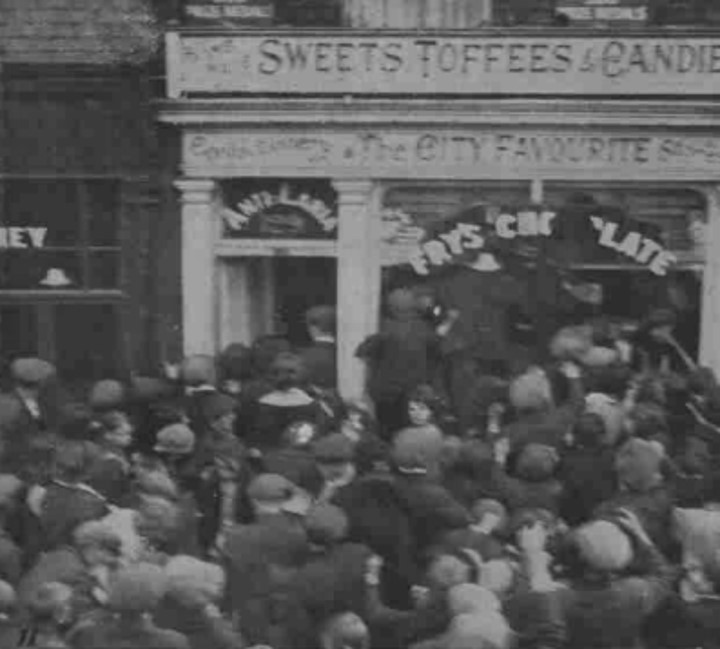
Loyalists loot a shop in Kashmir Road, Clonard (Illustrated London News, 31 July 1920)
Looting was not confined to shops. The licensed trade was one of the few in Belfast that was dominated by Catholics, so pubs and spirit groceries presented an obvious target for sectarian violence, with dozens being attacked, especially in east Belfast.
The Graphic was a London-based competitor of the ILN – it captured the scene after a pub had been looted. This photo also appeared in the ILN, indicating that both titles used the same local photo agency.
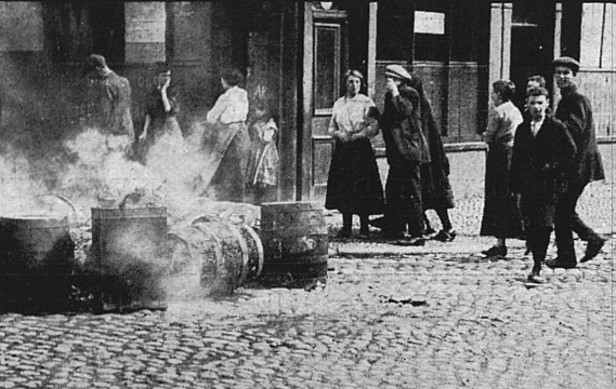
A looted pub (The Graphic, 31 July 1920)
Another feature of the violence was the expulsion from their homes of people living in the “wrong” religious area or on the interfaces where contending areas met – this was done by threats and intimidation or by simply being burned out. The ILN showed one such scene on the Grosvenor Road, a natural boundary between the nationalist Lower Falls and loyalist Sandy Row; it must be assumed that the people smiling are local bystanders posing for the camera rather than the victims of this particular “removal.”
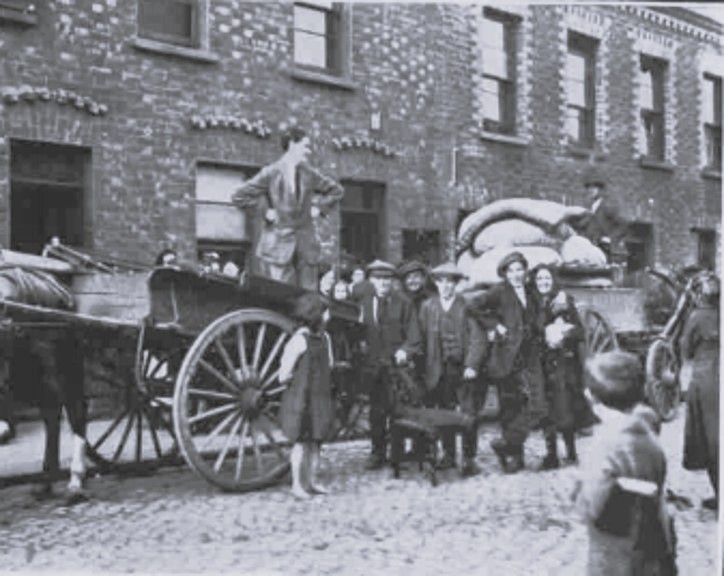
A “removal” from the Grosvenor Road (Illustrated London News, 4 September 1920)
One notable way in which threats were made was through the use of effigies left dangling from lampposts; one nationalist woman claimed that prior to her brother Francis McCann being killed during rioting in Ballymacarrett, “the Orangemen had his coffin already made and hoisted on a lamp with a placard attached for Fenian McCann.”1
The ILN showed an example of this from the Newtownards Road, and the phenomenon was also captured in a Pathé newsreel, illustrating that, even in its infancy, this new branch of the media was also reporting on what was happening in Belfast.
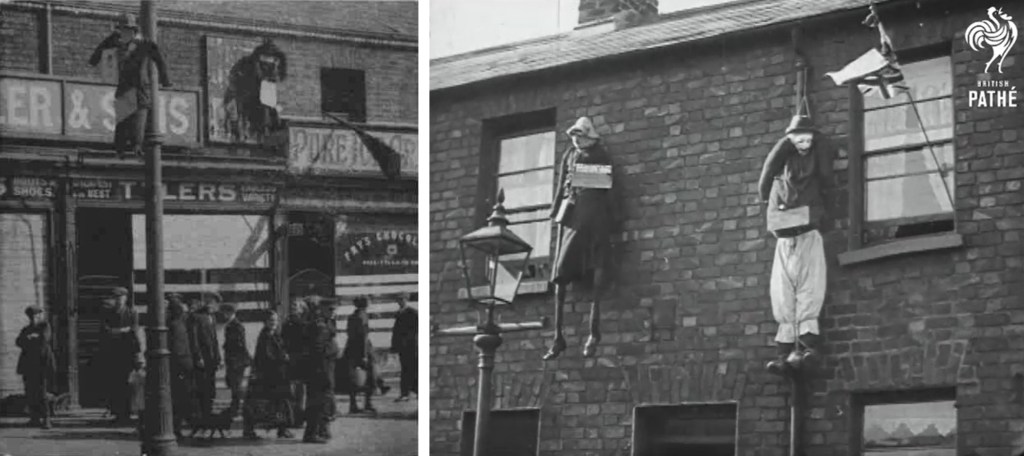
Depictions of effigies: (L) On the Newtownards Road (Illustrated London News, 4 September 1920); (R) Location unknown, still from Pathé News
British troops were sent onto the streets to contain the violence, and The Graphic depicted a section of soldiers manning a makeshift barricade with steely determination.
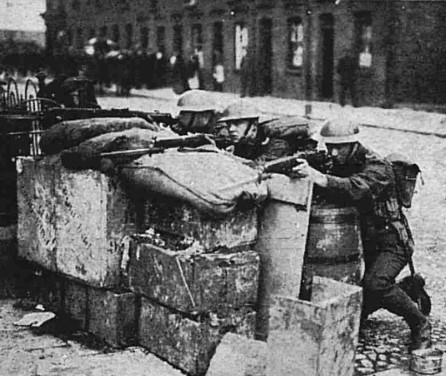
British soldiers at a barricade (The Graphic, 31 July 1920)
However, civilian onlookers were not the only ones capable of posing for the camera, as two other unpublished photos from the same sequence show that this photo was staged.
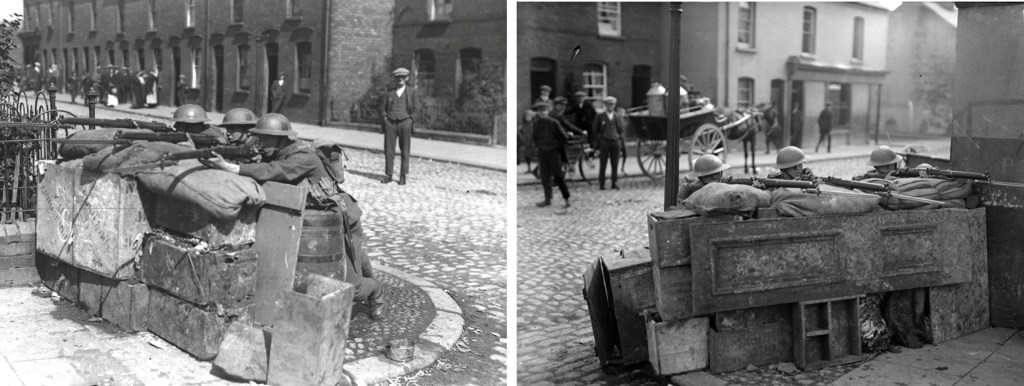
In the one on the left, a man can be seen smoking behind the soldiers, wearing a white shirt and a waistcoat but no tie, and with an emblem of some kind in his lapel; he is nonchalant, unconcerned about the prospect of being hit by crossfire, as there isn’t any. The photographer clearly urged him to get out of the way to allow him to take the photo that was published in The Graphic, so in the photo on the right, the observer has finished his cigarette and is now watching the troops who are manning a barricade on the opposite footpath with equally steely determination.
The international press from further afield than Britain was also reporting on what was happening in Belfast. This example is chosen purely because it was published about as far from Belfast as it is possible to imagine – it appeared in the Alaska Daily Empire.
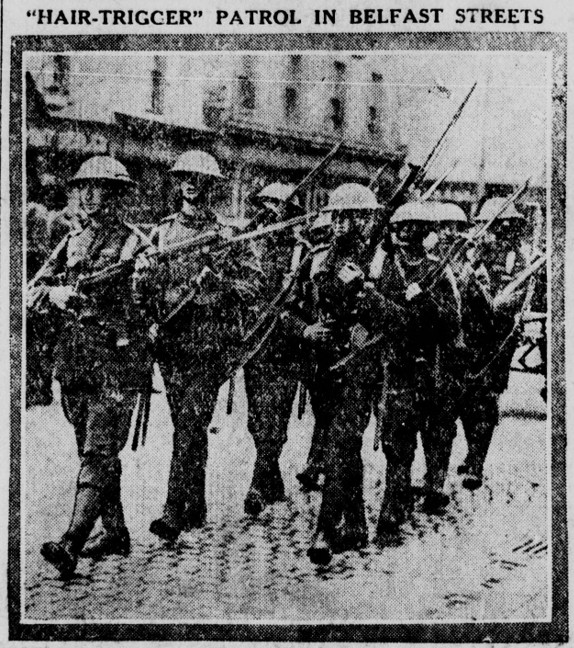
British Army patrol, (Alaska Daily Empire, 20 August 1920)
The images shown so far are all taken from the international press and demonstrate how photos were used to accompany news reports as an integral part of journalism.
Papers in Ireland were slower to adopt photography – the nationalist Irish News would not begin to do so until the 1930s. The unionist Belfast Telegraph and its sister publication the Belfast Weekly Telegraph were probably the ones which embraced the relatively new technology the most.
The next image demonstrates that images of the violence were used in a way that went beyond objective news reporting, moving into the realm of providing either implicit or overt political commentary.
This photo, taken during rioting in York Street on 1 September 1920, and published in the Belfast Telegraph the following day, is probably one of the most familiar and frequently reproduced images from the conflict. However, there is something crucial missing from the image: there is no identification of who is rioting in the foreground. Without that, the image is sanitised.
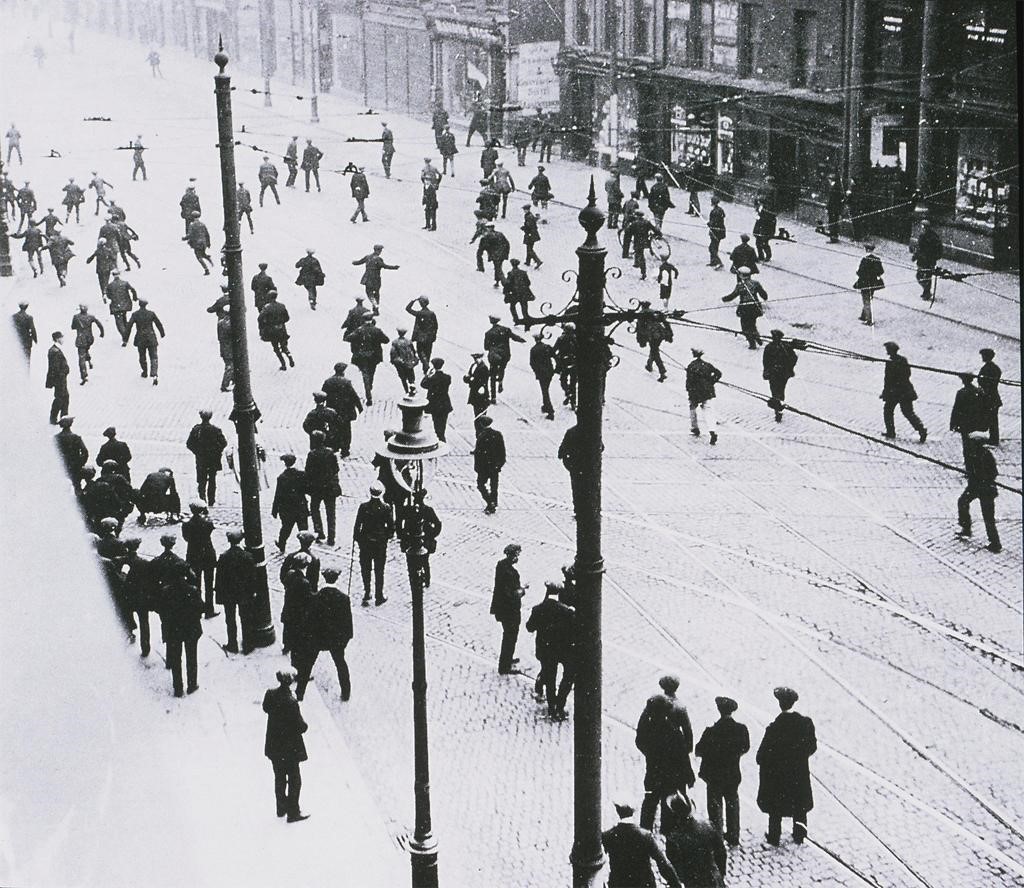
Rioting in York Street (Belfast Telegraph 2 September 1920)
That crucial context was provided a week later by the French Meurisse news agency when they published a photo of the same riot, but one taken shortly before the one chosen by the picture editor of the Telegraph.
The opposing mob are now out of the frame, but we can see that the rioters in the foreground are carrying Union Jacks, clearly identifying them as loyalists.
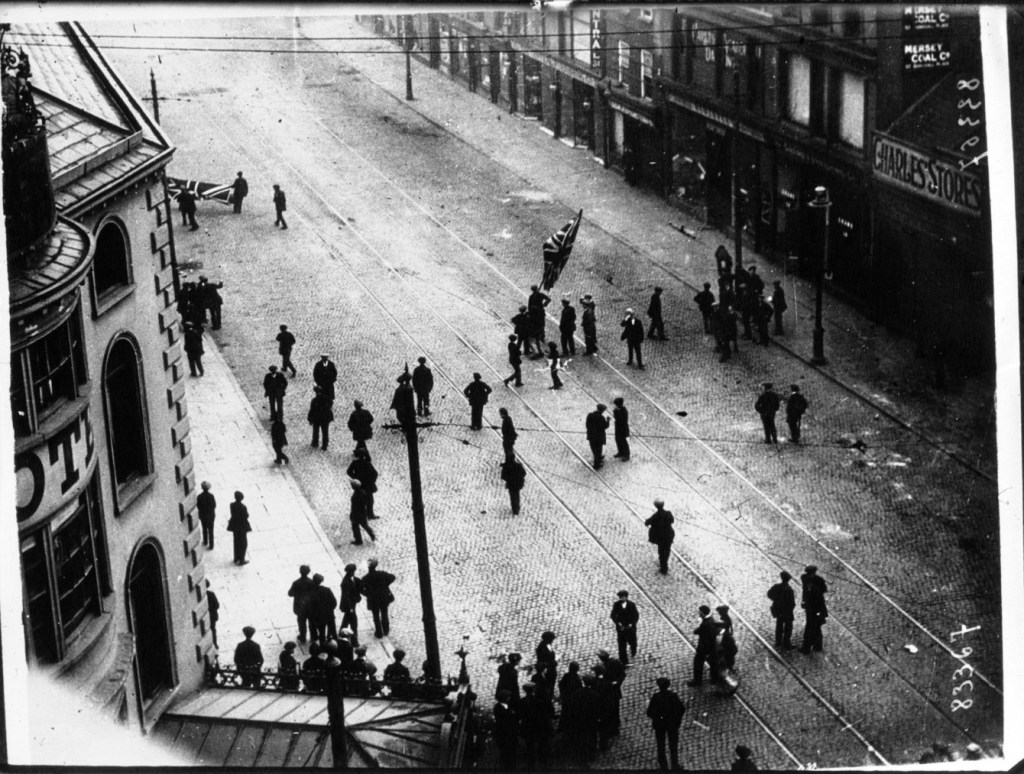
Rioting in York Street (Meurisse agency 8 September 1920; collection held by University of Lille)
The Telegraph image suggests, in an apparently neutral, if somewhat pearl-clutching, way: “Mob violence is awful.” But by eliding the fact that “Loyalists engage in mob violence,” the picture editor made a political decision.
Incidents during 1921
Nobody was killed in Belfast in November or December 1920. But killings resumed in January 1921, when the IRA embarked on a series of opportunistic attacks on policemen. On 23 April, they shot and killed two policemen in Belfast city centre, members of the Auxiliary Division of the Royal Irish Constabulary (RIC), a dedicated counter-insurgency formation within the police. That night, there was a reprisal.

Neighbours queueing to pay their respects to the family of the dead Duffin brothers (Photo courtesy of John Duffin)
This photo shows neighbours queueing to pay their respects to the relatives of two dead men from Clonard Cardens. The photo is from the family collection of a man named John Duffin; his grandfather, also named John Duffin, was a brother of the two men killed the night before. It is possible that the family was given copies of the photos, which were never published, by a press agency assigned to cover the men’s joint wake and funeral.
John Duffin told a military court of inquiry: “I myself went to the kitchen and found Pat and Dan lying on the floor, bleeding and unconscious. After I had recovered slightly from my initial shock, I observed a dog in the kitchen. This dog remained with us until taken away by the police.” The Duffins did not own a dog. The dog in question belonged to Springfield Road RIC Barracks.2
Roughly two and a half months after the killings of the Duffin brothers, on 6 July 1921, the IRA shot and fatally wounded RIC Constable Timothy Galvin, a policeman from Limerick, in Little Donegall Street; Constable Henry Conway was also wounded. The ILN published a photo showing the immediate aftermath.
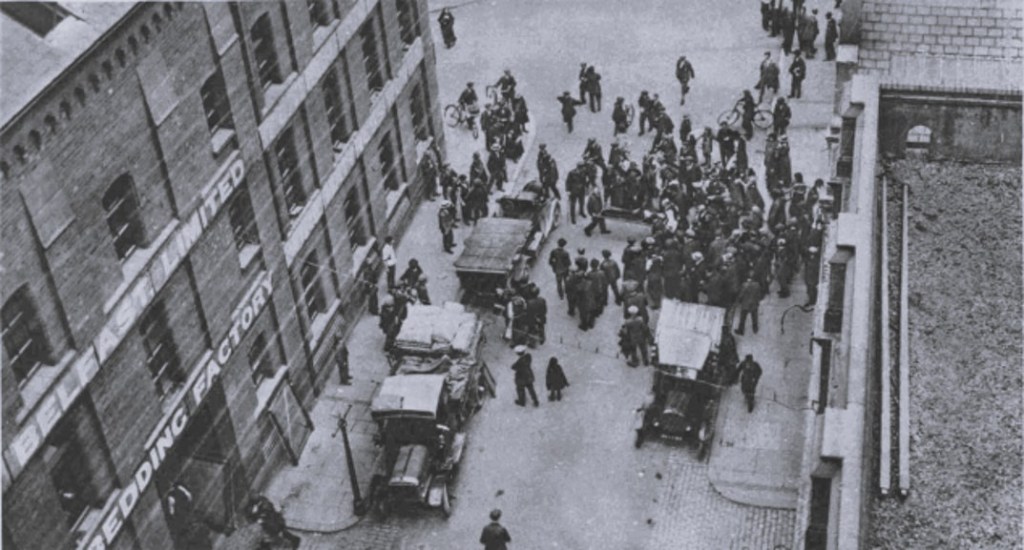
Fatal shooting of Constable Timothy Galvin by IRA, 6 July 1921 (Illustrated London News, 16 July 1921)
The image conveys the urgency of the situation. Desperate to get the wounded policemen to hospital quickly and unwilling to wait for an ambulance to arrive, a military officer has commandeered a lorry; the shutter from one of the windows from the factory on the left has been removed to create a makeshift stretcher over the bed of the lorry and one of the policemen is being carried to it. Constable Galvin died two days later.
Less than a week after his death, a Truce was signed between British and Irish representatives, which in theory brought a ceasefire to the whole of Ireland, but which was ignored in Belfast. One of its clauses provided for the demobilisation of the B Class of the Special Constabulary, a part-time reserve police force operating exclusively in Ulster and consisting almost entirely of Protestant recruits.
This horrified unionists, who feared that Ulster would be left unprotected. In response, there was an upsurge in recruitment to loyalist paramilitary groups. That development caught the attention of the international press, as shown in this example from the Colombia Evening Missourian in the United States.
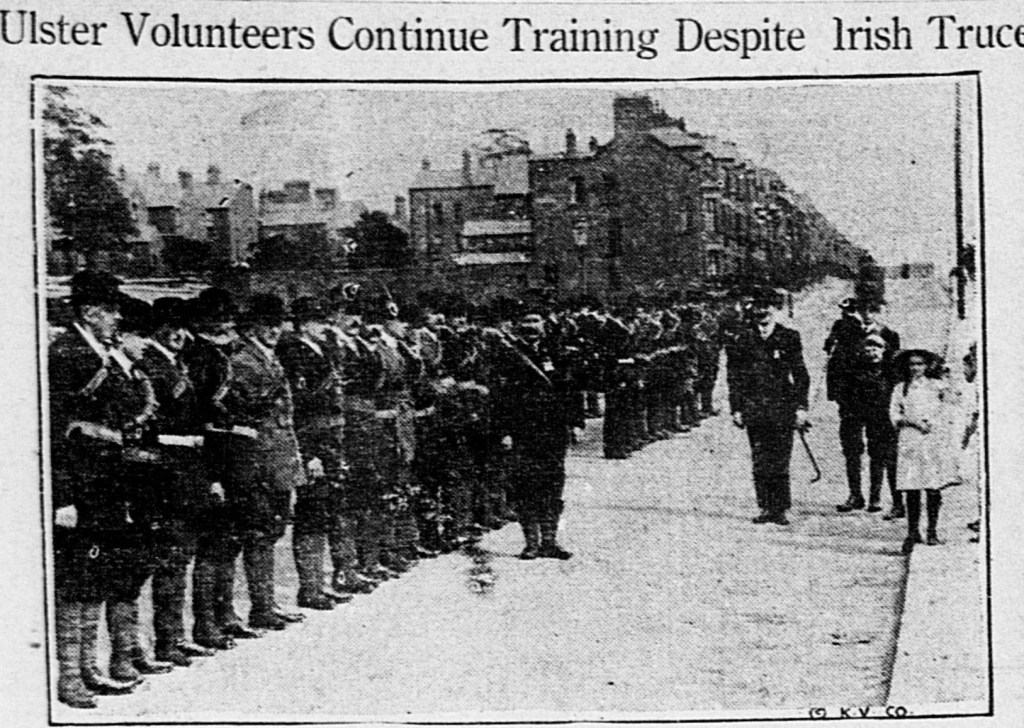
UVF drilling during the Truce (Colombia Evening Missourian, 15 September 1921)
The UVF were not the only loyalist paramilitary group making preparations. A new organisation, the Ulster Imperial Guards, emerged in the early autumn and began recruiting. They were photographed on parade, although unarmed, in a photo published in the Belfast Telegraph on 1 November 1921.
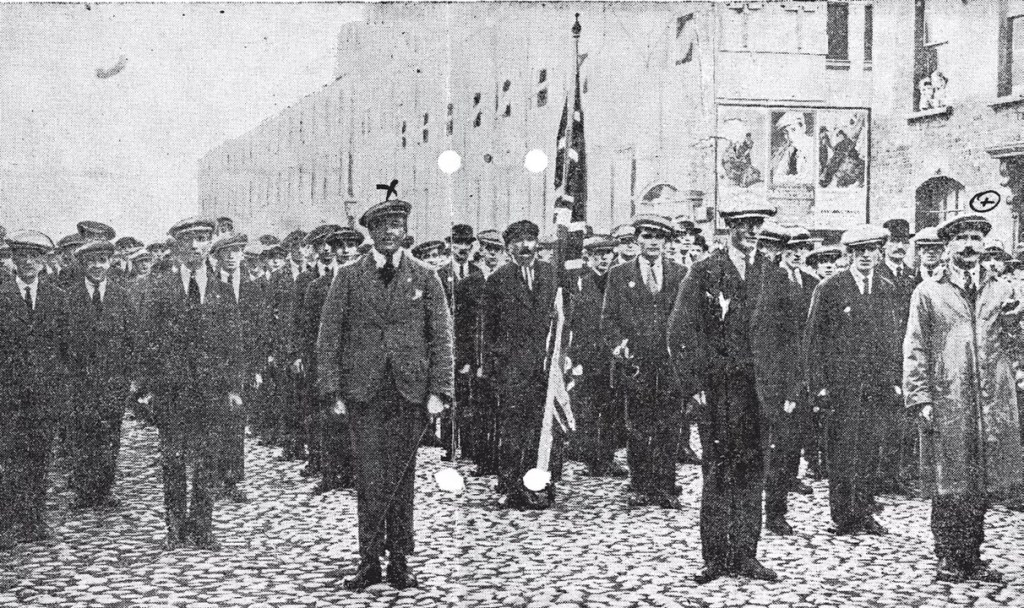
Parade of Ulster Imperial Guards (Belfast Telegraph, 1 November 1921)
With this image the Telegraph appeared to be once more venturing into the realm of political commentary, if not outright propaganda – “There are strong men, prepared to defend Ulster against her foes.”
The man marked with an X near the centre of the photo is an Imperial Guards officer named David Duncan. Just over three weeks after this photo was taken, he was charged with the attempted murder of a Catholic publican, Patrick McMahon, who told police,
“Three shots came through the door. I stooped down and the shots went over my head. When I went to push the door to, the prisoner fired the shots through the glass. I had a good view of the man. The gas was lit in the kitchen and the light flashed in his face when I opened the door.”3
The attempted shooting of McMahon may have been a reprisal for an attack only an hour and a half earlier, during which the IRA threw a bomb onto a tram carrying Protestant shipyard workers home from work. Four men were killed and five wounded, among them James Bell from the Shankill, who was interviewed by another unionist newspaper, the Northern Whig:
“When asked were there many passengers in the tram Bell went on, ‘Packed, you know what a workmen’s car is like coming from the Island. We were sitting where we could and standing all round. Nobody expected anything in Royal Avenue above all places … The glass shattered and the pieces of the bomb flew round us. Then there was the awful steamy, smoky smell of the explosive. Darkness. And I remember nothing more until now.’”4
The ILN published an eerily stark photo of the bombed tram.
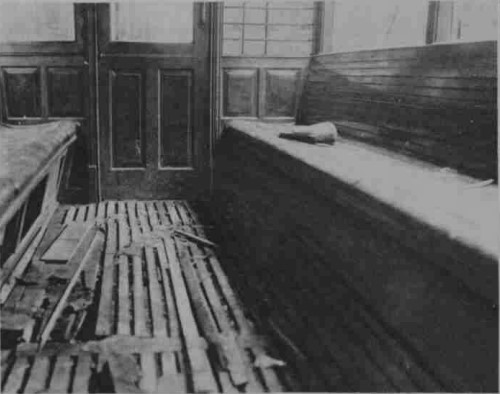
Interior of bombed tram (Illustrated London News, 3 December 1921)
1922: descent into hell
Less than three months later, the ILN published an equally stark photo of the aftermath of another bombing. On 18 March 1922, two Catholic women, Rose McGreevy and her niece, Annie Mullan, were killed while they slept when loyalists threw a bomb into the bedroom of their home in Thompson Street, Ballymacarrett. The ILN showed the shattered remains of one of the women’s beds.
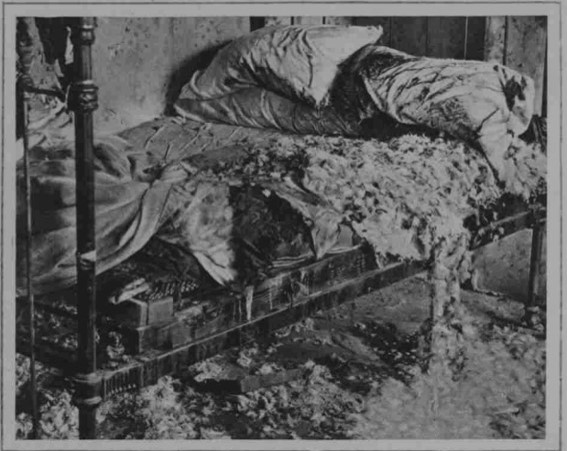
The bombed bedroom of Rose McGreevy and Annie Mullan (Illustrated London News, 25 March 1922)
Only five days after that attack, the IRA killed two Special Constables, Thomas Cunningham and William Chermside in May Street in the Market. The Belfast Weekly Telegraph accompanied its news report of the ensuing search of the area with a photo showing military and police at the scene of the killing.
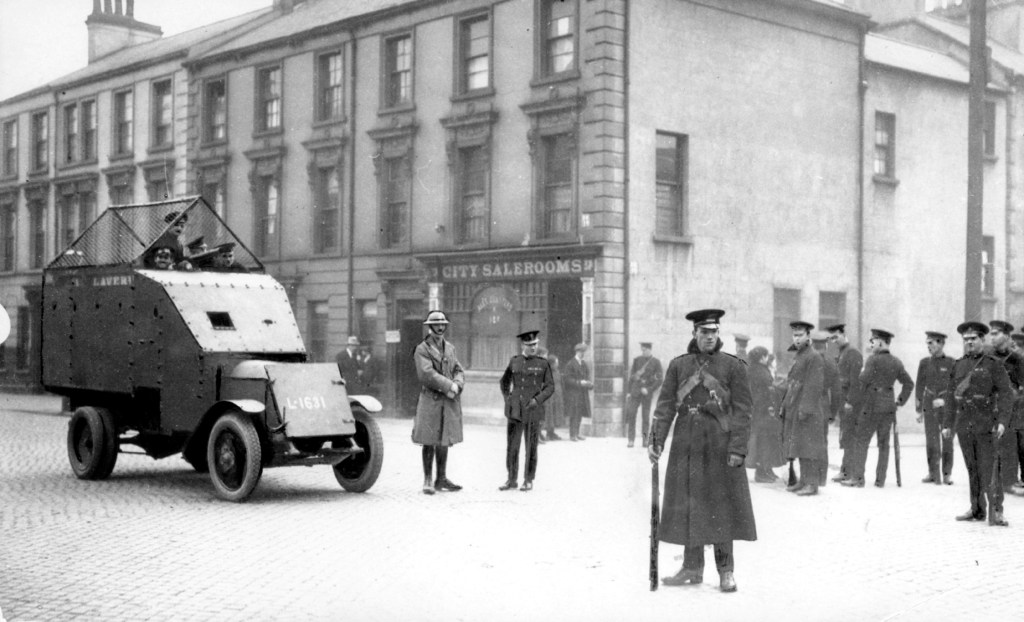
Military and police in May Street after the killings of two Special Constables (Belfast Weekly Telegraph, 1 April 1922)
That night, there was another reprisal.
The killings of the McMahon family have been extensively written about. The statement given to police by one of the survivors, John McMahon, contains one of the most chilling phrases associated with the Pogrom:
“There was a man there with a dust coat a trench coat with a belt on it. He said ‘Do you boys say prayers?’ He shot straight before him at my father. Another man who was in uniform shot in my direction. I ducked my head and was shot in the neck. I fell on the floor under the floor under the table and lay there. There were two or three shots more fired and then they went out. I thought one filled his revolver but I am not sure. Inside the door on the left lay Frank. In the centre of the hearth rug were my father, Eddie McKinney and Gerard, Bernard lay near me.”5
The southern newspapers did not generally carry photos relating to the violence in Belfast. But four days after the onslaught on the McMahons, the Freeman’s Journal in Dublin published images of the victims, one of which was the most shocking photo of Belfast violence yet seen and which has since become almost iconic.
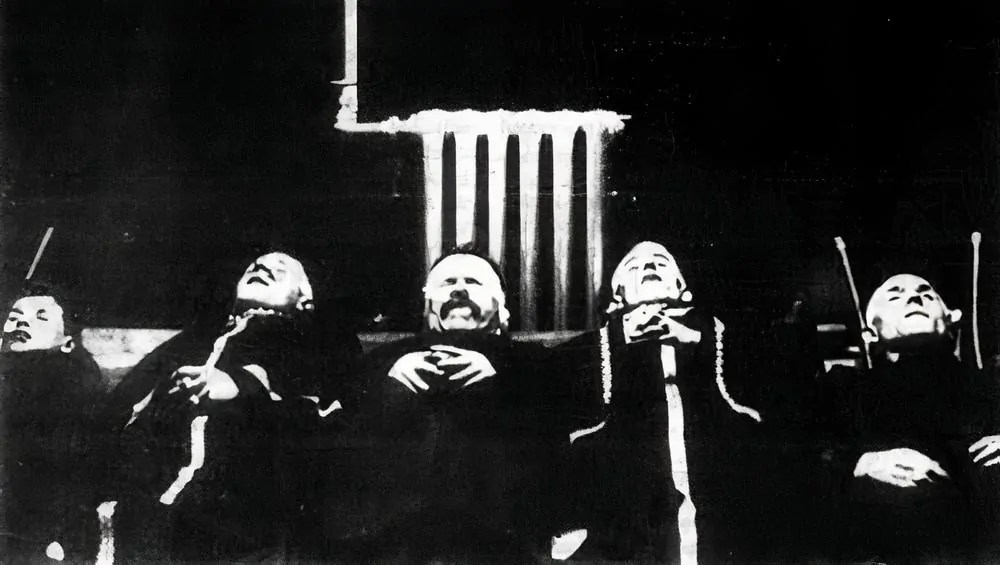
The victims of the McMahon family killings, prepared for their burials (Freeman’s Journal, 28 March 1922)
This photo of the dead men, lying in the mortuary of the Mater Hospital, prepared for their burials, was accompanied by photos of the two male survivors, John and Michael McMahon, in their hospital beds.
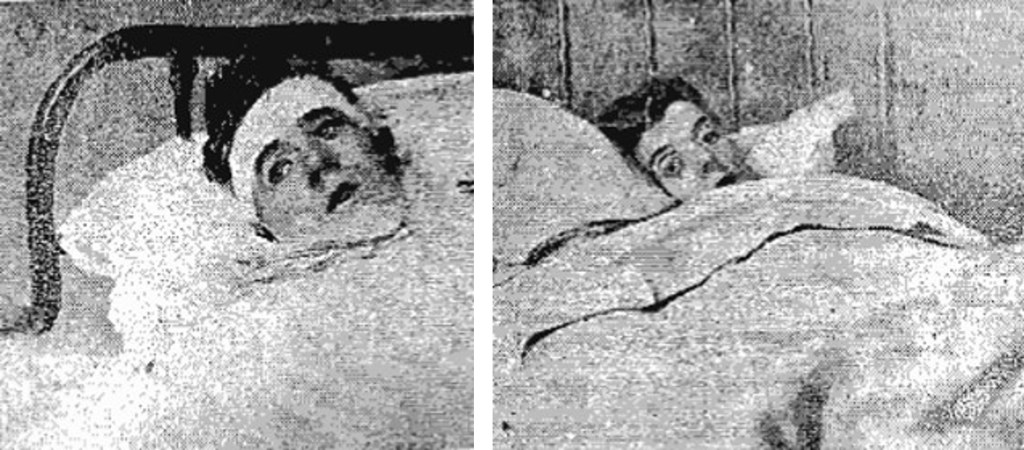
John and Michael McMahon in hospital after the attack (Freeman’s Journal, 28 March 1922)
The provenance of these images can be surmised with a reasonable degree of certainty. A member of the Belfast IRA, Thomas Galway, had worked as a hospital lab clerk so could provide contacts in the Mater; the Intelligence Officer of the 3rd Northern Division, Frank Crummey was a key northern ally of Michael Collins, passing him intelligence on developments in Belfast; Crummey arranged for a photographer to be secretly admitted to the Mater and then passed the resulting photos to Collins; finally, Collins placed the photos with the Freeman’s Journal.6
This went beyond news reporting and represented a clear act of propaganda by the Provisional Government, aimed at James Craig’s unionist government.
Within a week, the whole sequence of events would be repeated in another mass killing of nationalists involving Special Constables. As had happened before, an eyewitness, Gerald Tumelty, was left alive to tell what had happened:
“I heard footsteps on the stairs and two men came into the room. One of the men lit a match and I then saw that he was in plain clothes and the other man was in the uniform of a policeman. The man in plain clothes asked my grandfather his name and he answered ‘William Spallen’. He then raised his revolver and fired three shots at my grandfather. This man snatched money which was in my grandfather’s right hand … the money which he had for funeral expenses … I was 12 years old on the 11th Feb. 1922 … I know that if I swear a lie I will go to Hell … I could recognise the man in plain clothes as I had seen him before on the Old Lodge Road.”7
Three other men were killed in nearby houses. The following morning, a photographer was once again surreptitiously admitted to the Mater Hospital morgue to take photos for propaganda purposes, but the scene he captured was perhaps too graphic for the sensibilities of newspaper editors and their readers.
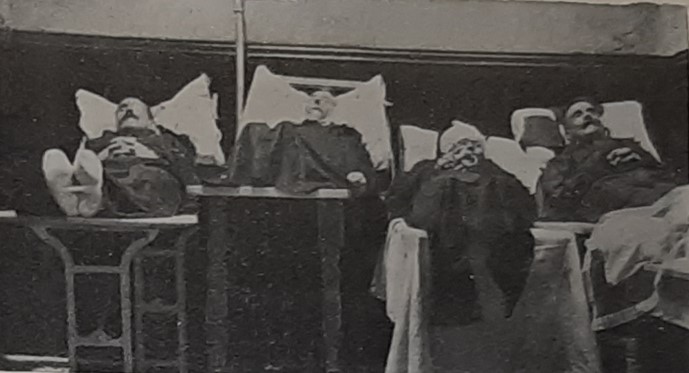
L-R: John McCrory, William Spallen, Bernard McKenna, Joseph Walsh (Irish Bulletin [London Edition] 24 May 1922); © PRONI CAB/6/89; Reproduced by kind permission of the Deputy Keeper of Records, PRONI
The dead men were lined up in the exact same spot as the McMahons – behind William Spallen’s body can be seen the same radiator that was in the picture of the McMahons. This time, the photos were taken before the undertakers had attended to the corpses, which remain bandaged and crudely draped in blankets.
The message conveyed was clear: “Belfast Catholics are being brutally slaughtered.”
In an obvious echo of the McMahon images, the main photo of the victims of the Arnon Street killings was accompanied by two others, one of Michael Walsh, son of one of the victims, captioned “wounded by Orange gunmen”, which implies that it was taken early on 2 April, as he died later that day, and one of his infant cousin, Robert, who was shot dead by a sniper the morning after the initial attack.8
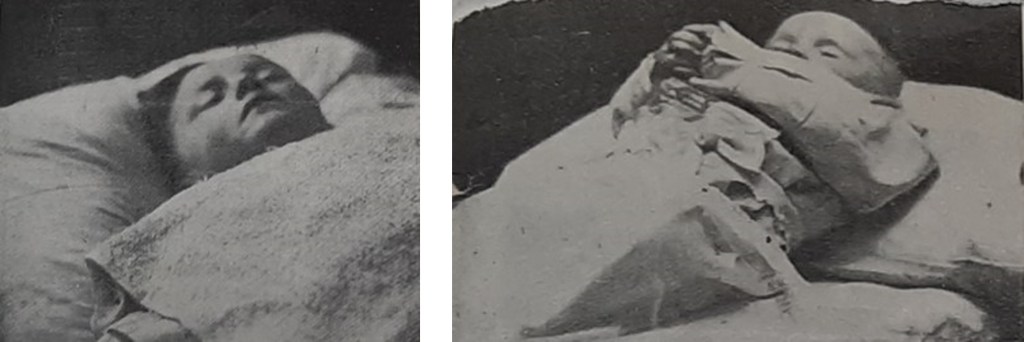
L: Michael Walsh, fatally wounded in bed beside his father; R: Robert Walsh, his cousin, killed by a sniper the following day (Irish Bulletin [London Edition] 24 May 1922); © PRONI CAB/6/89; Reproduced by kind permission of the Deputy Keeper of Records, PRONI
As before, the Provisional Government made overt propaganda use of these images. It had re-commenced publishing the Weekly Irish Bulletin in late May 1922, resurrecting a key pre-Treaty propaganda tool of the republican movement, but this time focussing on events in Belfast, so it was sub-titled (Belfast Atrocities). A separate London edition, simply titled Irish Bulletin, was published, and it was in this that the Arnon Street photos were printed.
The unionist Government of Northern Ireland also made use of the press for propaganda purposes. With difficult questions being asked in both London and Dublin about the conduct of the Special Constabulary, the Belfast Weekly Telegraph printed a photo of a group of C1 Specials, probably the most violently sectarian element of the organisation, thus allowing the government to suggest to the paper’s readers, “There are strong armed men, prepared to defend Ulster against her foes.”
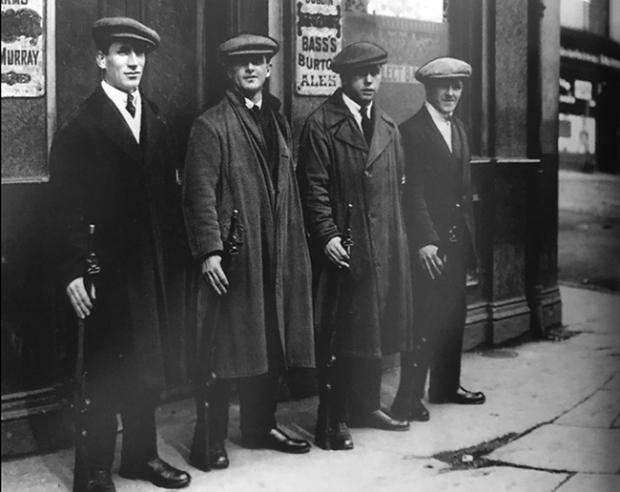
C1 Specials on Albertbridge Road (Belfast Weekly Telegraph, 22 April 1922)
Between April and June 1922, photographers captured the scene of many of the arson attacks that were mounted in Belfast. At Easter, in mid-April, most of the Catholic residents of Antigua and Saunderson Streets in the Marrowbone were burned out of their homes by loyalist mobs, with the Topical Press Agency showing the devastation the following morning.
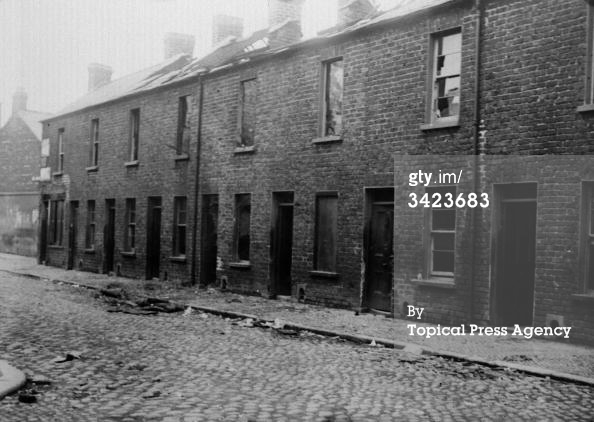
Burned-out houses in Antigua Street (© Getty Images – Topical Press Agency)
The IRA mounted an arson campaign in Belfast city centre from late May, targeting unionist-owned businesses. The Belfast Telegraph illustrated its news reporting with numerous images of fireman fighting the blazes.
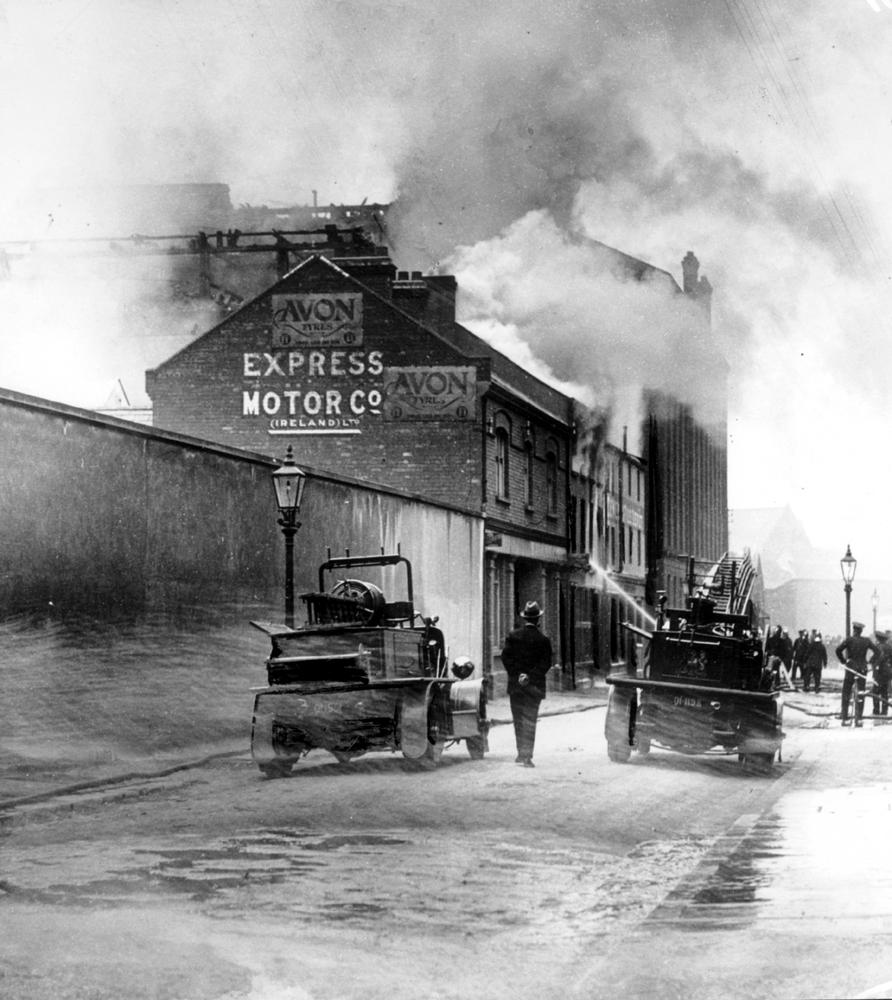
IRA arson attack on J.P. Corry’s, Talbot Street (Belfast Telegraph, 29 May 1922)
So extensive was the IRA campaign that news agencies also covered it, such as this example from the Bettmann Agency.
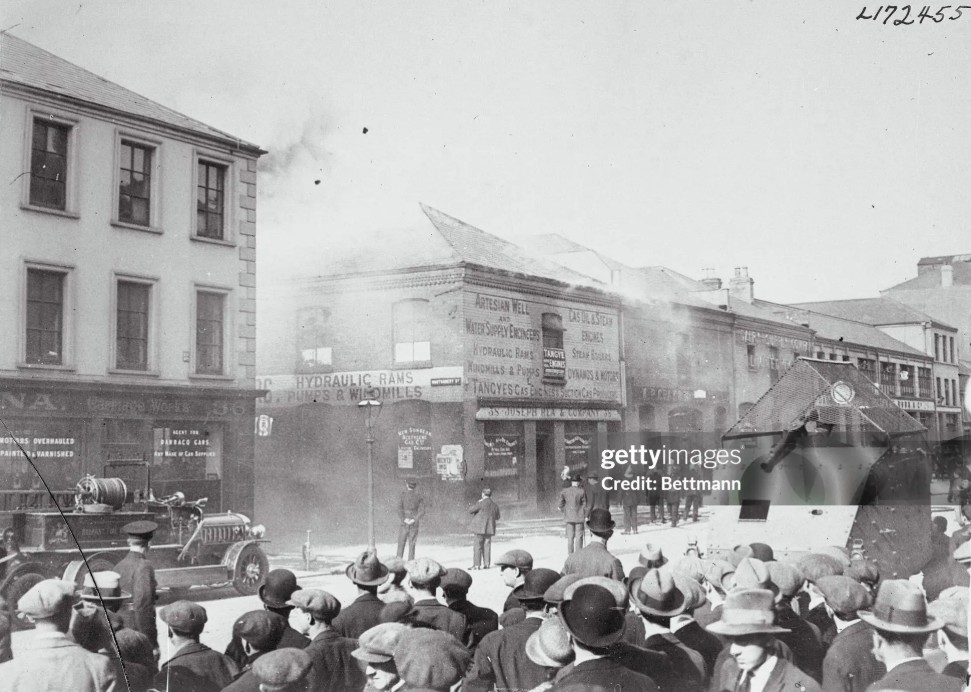
IRA arson attack on Joseph Rea & Co. Engineering, Chichester Street (© Getty Images – Bettmann Agency)
Drawings
The ILN began publication before the use of photography had become widespread and as late as the 1920s, it still carried line-drawn illustrations as part of its news coverage.
As well as the photo of burning beer barrels seen previously, its 31 July 1920 edition, which covered the initial outbreak of violence, also featured a two-page spread with a drawing of a mob looting a pub.
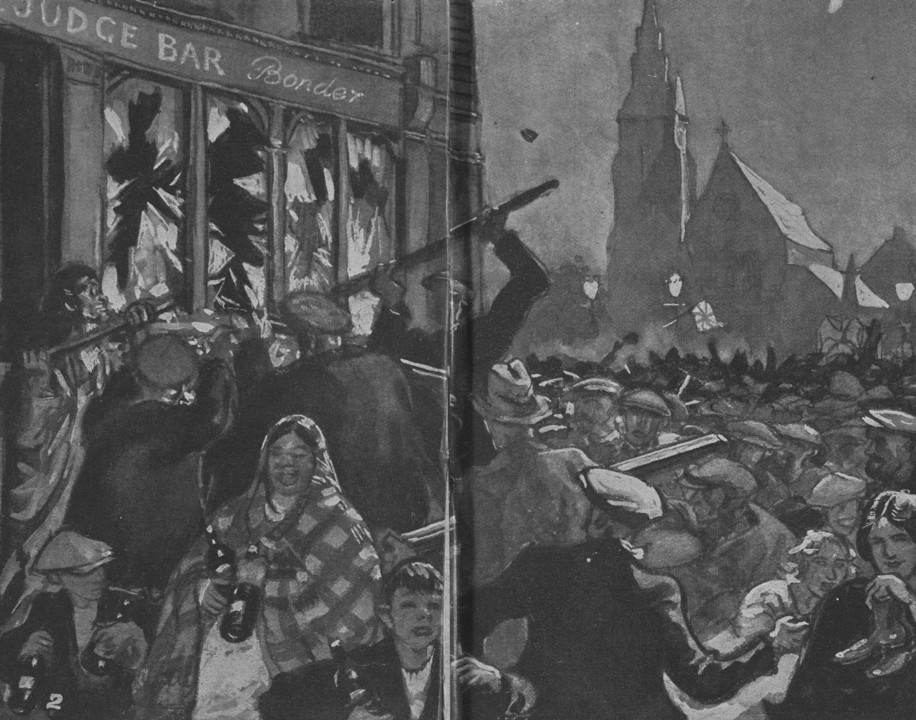
A pub being looted (Illustrated London News, 31 July 1920)
Another two-page spread followed in October, after the outbreak of serious rioting in the Marrowbone district.
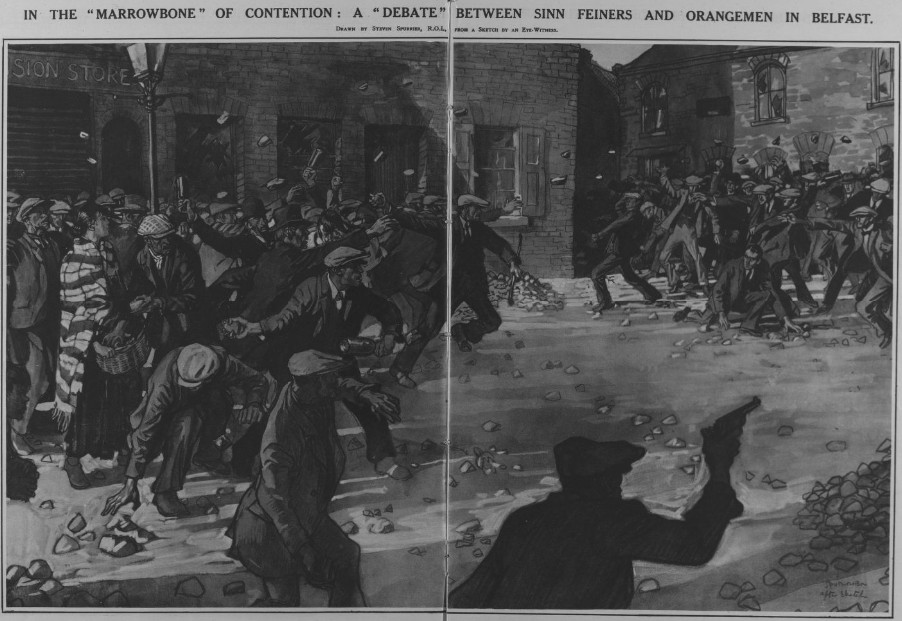
Rioting in the Marrowbone (Illustrated London News, 9 October 1920)
The ILN also captured the terrors of everyday life in Belfast, giving front-page prominence in April 1922 to a scene of passengers cowering from gunshots on the floor of a tram.
Although this practice did occur on trams, the earlier drawings, although depicting actual events, were also somewhat fanciful. The detail of the beaming woman and children, clutching their stolen bottles of beer, panders to racist stereotypes about the drunken Irish. In the Marrowbone scene, the fighting is shown taking place at implausibly close quarters (compared to actual rioting, as photographed in York Street), while the production of revolvers such as by the silhouetted figure in the foreground, inevitably caused rioting mobs to scatter rather than to intensify their efforts. The woman helpfully carrying a basket of rocks to provide ammunition is presumably meant to be a member of Cumann na mBan.
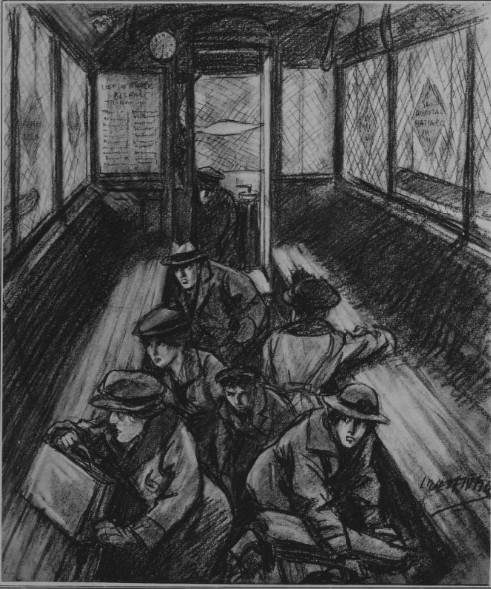
Tram passengers take cover (Illustrated London News, 1 April 1922)
Propaganda did not rely only on photography. One striking example, illustrating that political murals in Belfast long pre-date the Troubles, took obvious inspiration from a famous Great War recruiting poster, down to the similarly windblown tresses of the two similarly apron-clad women shown carrying rifles. It appeared on a wall in Carnalea Street, just around the corner from where the photo of the Imperial Guards was taken, and seems to be saying, “There are strong armed women, prepared to defend Ulster against her foes.
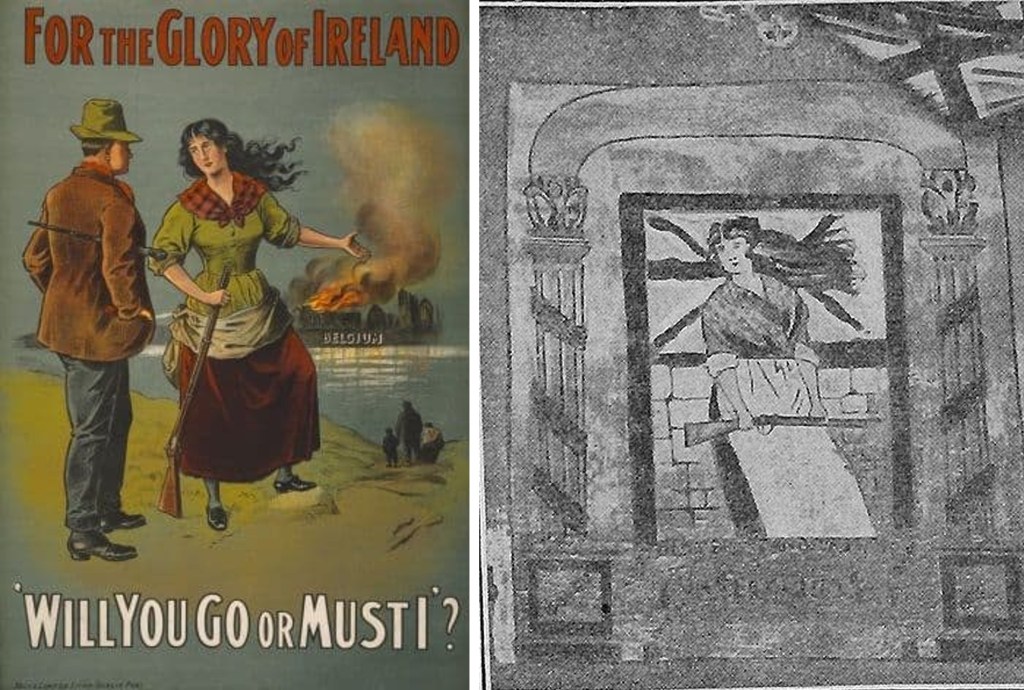
(L): Great War recruiting poster; (R) Loyalist mural in Carnalea Street (Shankill Area Social History Group, Facebook)
Cartoons
What they lacked in terms of photographs, the southern newspapers made up for with their use of political cartoons. Both the main nationalist titles, the Irish Independent and the Freeman’s Journal, had a cartoonist on their staffs, Gordon Brewster and “Shemus” (Ernest Forbes) respectively. Both men used caustic wit to provide acerbic political commentary and northern unionists were often the targets of their work.
The first example, which appeared the day after the initial outbreak of the Pogrom, refers to Carson’s threat, made on 12 July, that he would revive the UVF to defeat “Sinn Fein” if the government didn’t take tougher action.
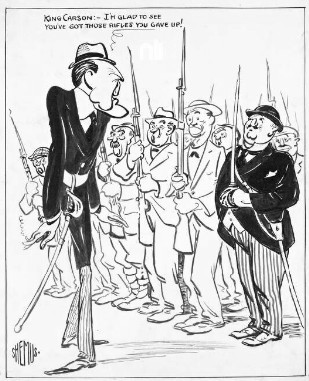
King Carson: I’m glad to see you’ve got those rifles you gave up! (Freeman’s Journal, 22 July 1920)
In the spring of 1922, as violence in Belfast approached a crescendo, the Sunday Independent ran a series of barbed commentaries on what was happening.
On 19 February, it suggested that the British Colonial Secretary, Winson Churchill, was merely singing a tune composed by the northern Prime Minister, James Craig.
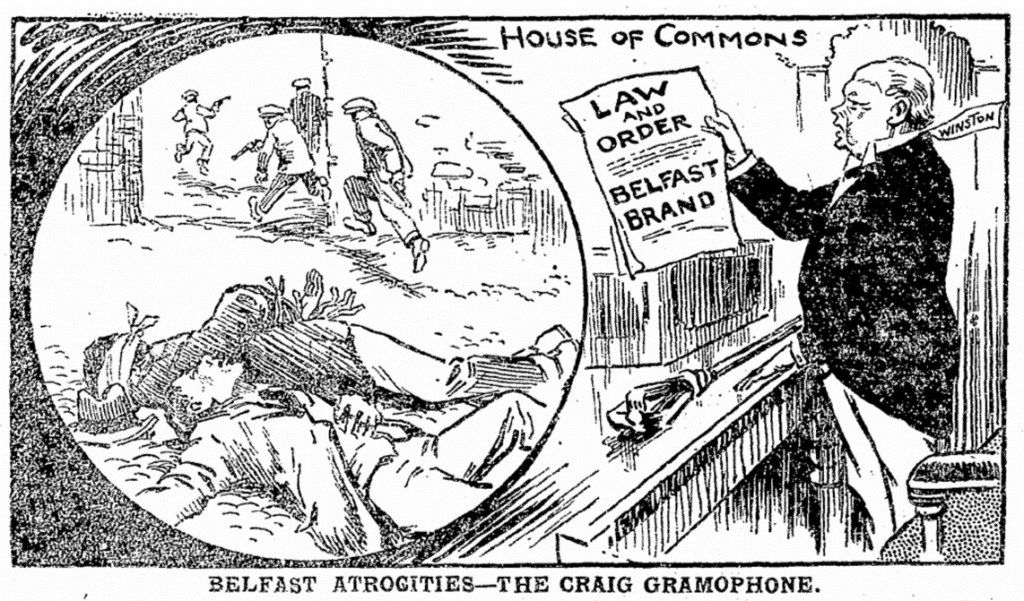
Belfast atrocities – the Craig Gramophone (Sunday Independent, 19 February 1922)
On 12 March, it accused loyalist paramilitaries, political unionism and the Specials of literally dancing arm-in-arm with each other as they put the Pogrom into effect.
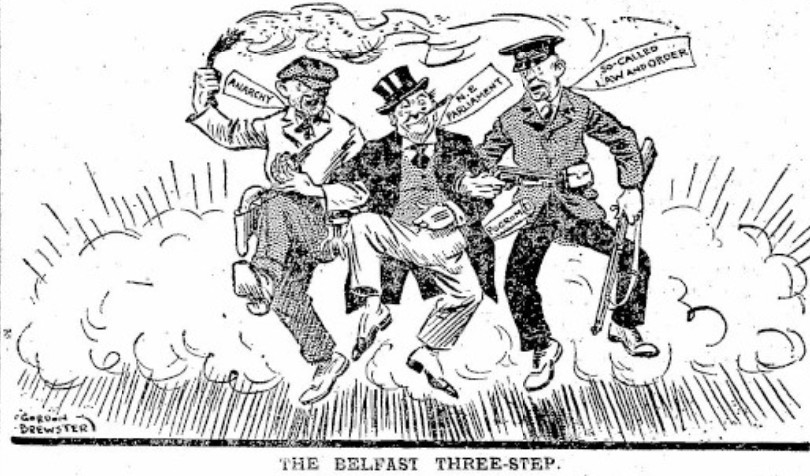
The Belfast three-step (Sunday Independent, 12 March 1922)
The following week, it said that the Parliament of Northern Ireland was providing cover for loyalist paramilitaries and did not want the truth of events in Belfast to emerge.
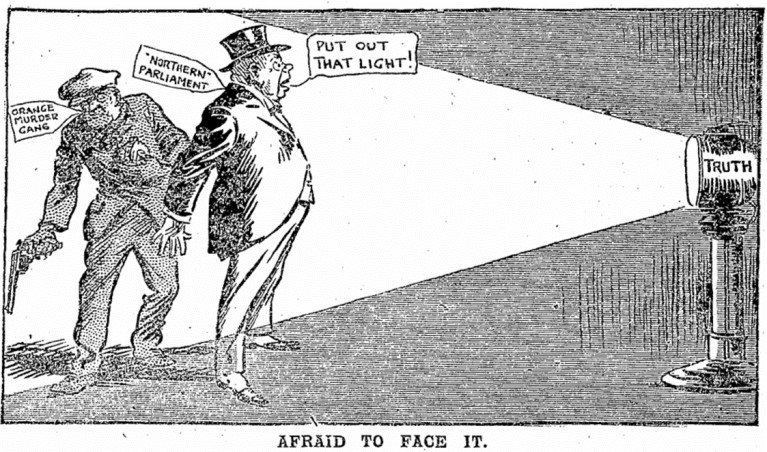
Afraid to face it (Sunday Independent, 19 March 1922)
On 24 May, “Shemus” presented a multi-layered, nightmare vision in which Craig resists the devil’s attempts to lure him into the inferno, as a ghostly man with an armband marked “Special” fires a revolver, a demon wearing a sash grasps a firebrand, and Field Marshall Henry Wilson tries to climb up out of the abyss; in the caption, Craig tells the devil, “But why should I climb the long steep hill into hell with you – while things here in Belfast are going so well?”
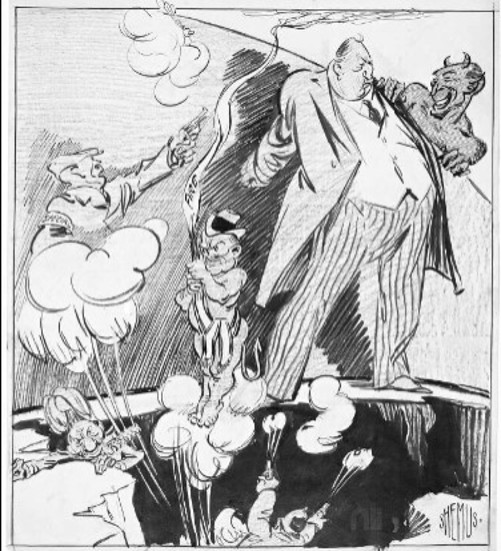
The lid off (Freeman’s Journal, 27 May 1922)
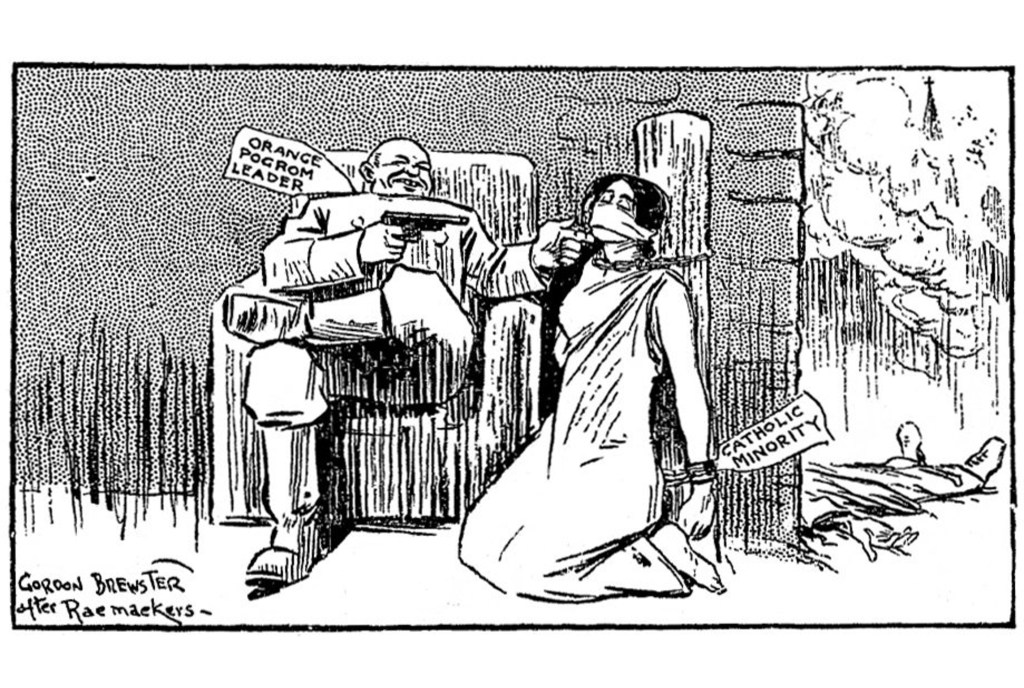
The following day, Brewster had his own take on the theme of hell on earth, as he depicted smoke rising from burned-out Catholic homes and nationalists being marched off to be exterminated in the background, while in the foreground, Craig is dwarfed by a grotesquely large Orange thug.
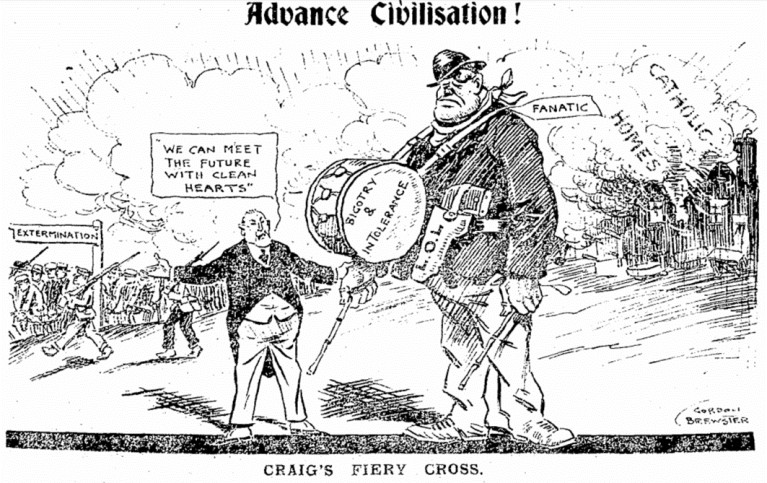
Craig’s fiery cross (Sunday Independent, 28 May 1922)
The following Sunday, the focus shifted back to London, with the British Treasury’s funding of the Specials and, by extension, of the Pogrom itself the means for deepening the partition of the island.
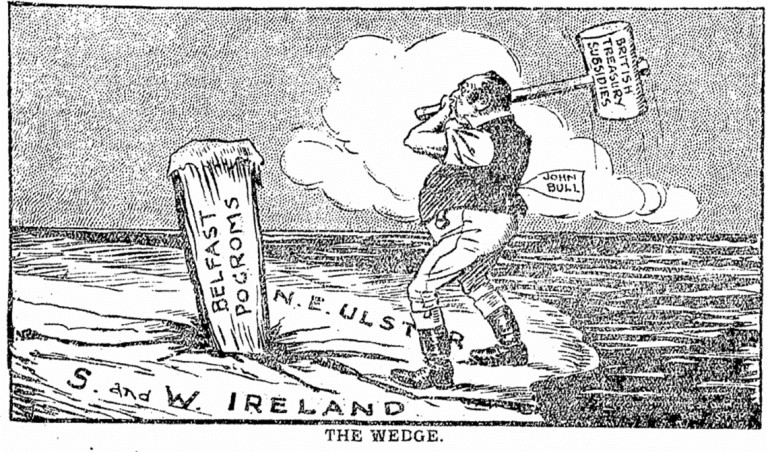
The wedge (Sunday Independent, 4 June 1922)
In conclusion, it is clear that images of the violence in Belfast were used for different purposes by different organisations. The international press – British, American and French – used photos as visual supplements to news reporting that was broadly objective, adding extra visual depictions of what was happening. The much more partisan local press, in both Belfast and Dublin, used photos and cartoons as vehicles to provide both implicit and overt political commentary on events. The two governments in Belfast and Dublin, made use of photos as weapons of propaganda, with the Provisional Government resorting to increasingly graphic images as the catastrophe facing Belfast nationalists deepened.
References
1 Catherine McGivern to Military Pensions Board, n.d., Military Archives (MA), Military Service Pensions Collection (MSPC), DP7608 Francis McCann.
2 Testimony of John Duffin, Military Court of Inquiry in Lieu of Inquest, 10 May 1921, The National Archives (UK), WO/35/149A.
3 Deposition of Patrick McMahon, 5 January 1922, Public Record Office of Northern Ireland (PRONI), BELF/1/1/2/67/8 David Duncan – shooting at Patrick McMahon and murdering James McIvor.
4 Northern Whig, 25 November 1921.
5 Statement of John McMahon, 24 March 1922, PRONI, HA/5/193 Murder of Owen McMahon and family, and Edward McKinney.
6 MA, MSPC, MSP34REF10820 Thomas Galway.
7 Statutory declaration of Gerald Tumelty, 2 April 1922, National Archives of Ireland, Northern Ireland minorities, NEBB/1/1/10.
8 Irish Bulletin (London Edition) No. 25, 24 May 1922, PRONI, CAB/6/89 Correspondence and papers re Field Marshall Sir Henry Wilson.


Leave a comment