Estimated reading time: 20 minutes
The introduction of internment
On 7 April 1922, the Civil Authorities (Special Powers) Act (Northern Ireland) 1922 came into force. Commonly known as the Special Powers Act, it gave the Minister of Home Affairs, Richard Dawson Bates, the power to intern without trial any person who was “suspected of being about to act in a manner prejudicial to the preservation of the peace and the maintenance of the order in Northern Ireland.”1
Lists of people to be interned were drawn up almost immediately – for example, Joseph McPeake, Adjutant of the IRA’s 2nd Battalion in Belfast, was “recommended for internment on 18-4-22.”2
The police had two main sources of information on which to base their lists. The first was members of the nationalist community in Belfast – Séamus Woods, O/C of the 3rd Northern Division, complained that “the anti-Irish element of the population are taking advantage of the situation and are giving all available scraps of information to the enemy. Several of our dumps have been captured in the last few weeks and in practically every case the raiding party went straight to the house.” This is also reflected in police comments in internment files, with numerous comments such as: “Positive information from one of his own party who lives in the immediate locality, and is anxious for peace, that this man was seen with others actually taking part in the recent shootings.”3
The second source was IRA documents captured during raids, such as those on the 3rd Northern Division headquarters in St Mary’s Hall in February 1922, the Belfast Brigade headquarters in Rathbone Street in the Market on 8 July 1922, arms dumps in Milan Street in the Lower Falls on 1 July and in Dunmore Street in Clonard the following October. As well as weapons and ammunition, the police seized documents giving, not just IRA members’ ranks or initials, but often their full names and even addresses.
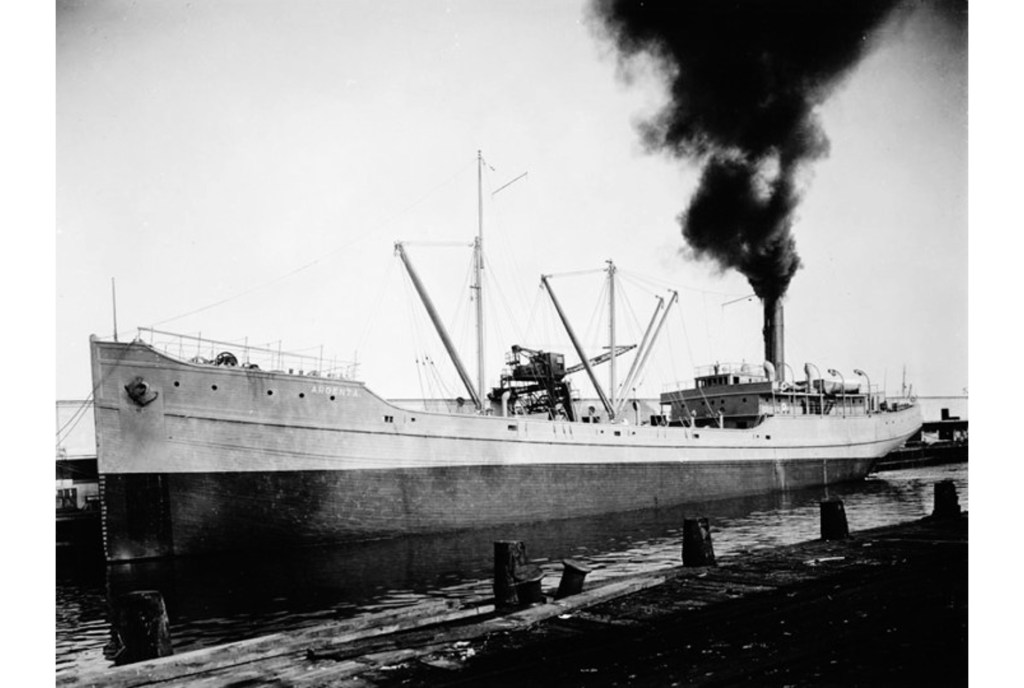
It is commonly, although mistakenly, thought that the provisions for internment were brought into effect in response to the IRA’s killing of Unionist MP William Twadell on 22 May. In fact, the Cabinet of Northern Ireland had already decided to implement internment two days earlier, after the launch of the IRA’s “northern offensive.” The unionist government’s Military Adviser, General Arthur Solly-Flood, told the cabinet meeting of 20 May that he had procured a ship that could be used to detain internees and Bates was instructed to draw up regulations which would allow the S.S. Argenta to be “treated as one of His Majesty’s Prisons.”4
Widespread arrests began on the night of Twadell’s killing, marking the start of what republican veterans would later describe as “the big round-up.”
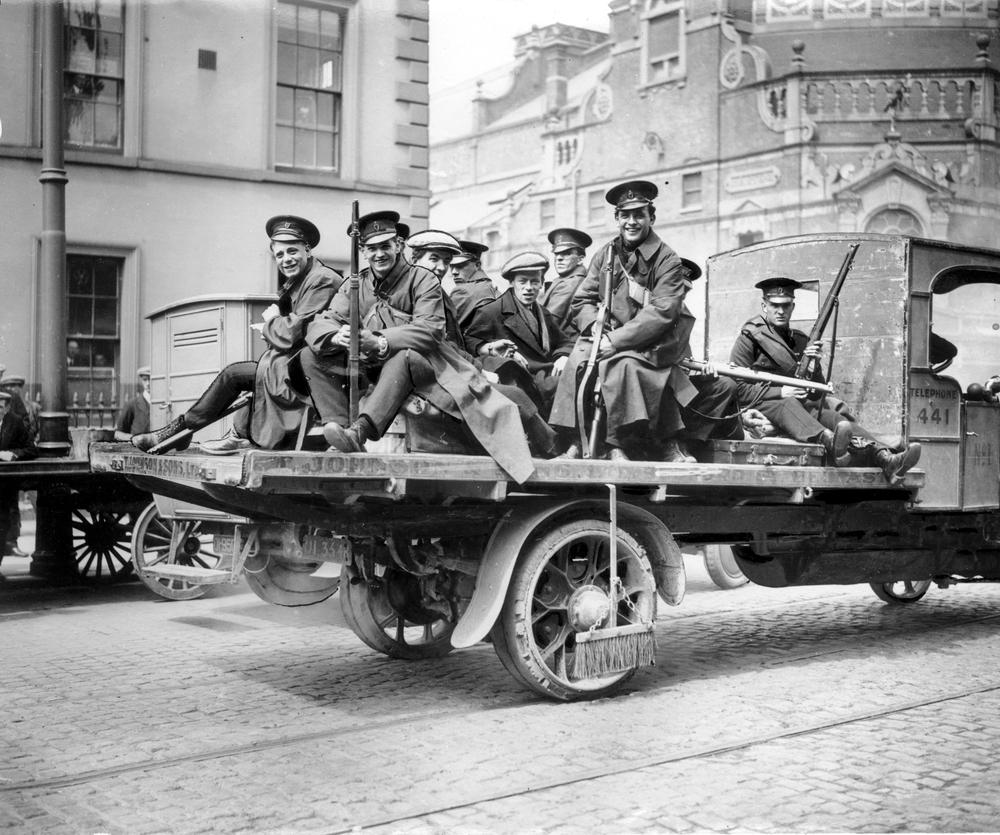
“The big round-up:” internees being driven through Belfast (Belfast Telegraph, 30 May 1922)
In total, 728 people had been interned across the north by the time the last prisoners were released. Nineteen of those were loyalists, including several Special Constables, about whom I have already written. Denise Kleinrichert has written about the general implementation and administration of internment in her book, Republican Internment and the Prison Ship Argenta 1922, and this post will not attempt to re-tread that ground.5
Instead, the focus here will be on the experiences of the hundreds of Belfast nationalist men and women – not all of them republicans – against whom internment orders were issued.
Of a sample of 165 Belfast internees, over 40% were detained during May, June and July 1922. However, the northern authorities continued to arrest and intern IRA and Fianna members well into 1923 – some were suspected of trying to re-organise the Belfast IRA after the end of the Pogrom, while others were senior IRA figures who had been sought since before the introduction of internment: Séamus Woods was only detained in November 1923.6
Over half of those interned, 56%, were aged in their 20s, while a further 17% were in their late teens – the latter figure partly reflects former Fianna members “graduating” to the IRA. The youngest was aged 16 – Thomas O’Reilly from Carrick Hill, whose file in the Military Service Pensions Collection file shows that he was an officer in the Fianna. The oldest was Joseph Hawkins from the Market, who was aged 54; his son, also named Joseph, had been in the IRA and was most likely the man sought by the authorities – Joseph Senior had no republican connections.7
Avoiding internment
Not everyone who was intended to be interned ended up being incarcerated – there were several means by which people avoided it.
The simplest was by not being caught.
In December 1920, William Carmichael and his brother Robert had been convicted of shooting with intent to kill during rioting around the Marrowbone, or ’Bone, the previous October – each was sentenced to 6 months’ imprisonment. Internment orders were signed for the two men and their brother John on 31 July 1922, but William’s was never enforced as he had gone to the Curragh and joined the Provisional Government’s National Volunteer Reserve two weeks previously. John and Robert were not so lucky – they remained interned until April and July 1924 respectively.8
John McDermott from the Falls Road escaped internment through a legal loophole.
During the trial of Desmond Crean, an IRA Intelligence Officer, on 1 June 1922, police searched McDermott, who had accompanied Crean to court: they found a Sinn Féin membership card on him and arrested him. It was not until after his arrest that the authorities realised that Sinn Féin had not been included in the list of republican organisations proscribed under the Special Powers Act. Two weeks later, Royal Ulster Constabulary (RUC) City Commissioner John Gelston recommended that McDermott be interned anyway; challenged over the reasons for his recommendation, the most that he could offer was that “This man is of superior intelligence to the majority of IRA men … I consider him active and would accordingly be dangerous, therefore I adhere to my former recommendation that he should be interned.” Despite this, McDermott was released on 1 August.9
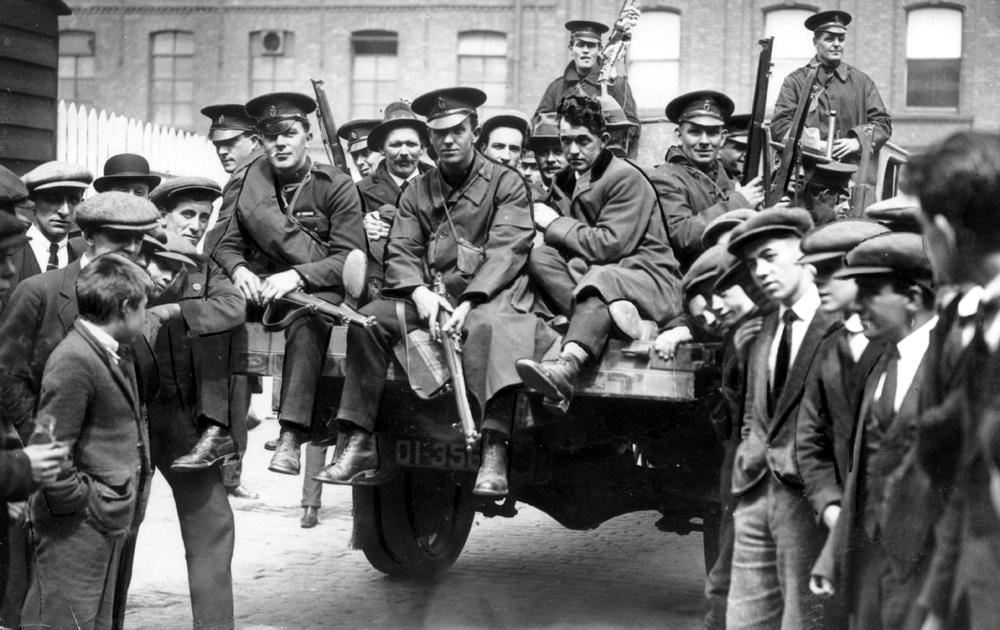
“The big round-up:” internees being driven through Belfast (Belfast Telegraph, 30 May 1922)
Samuel Maguire from the Pound had no compunctions about pointing out to the authorities that he was a victim of mistaken identity and that it should have been his brother who was interned instead.
He was arrested on 22 July on suspicion of having carried out an armed robbery on behalf of the IRA and was interned on 5 August. He appealed, saying, “My brother works in England. He was arrested for a hold up and tried by court martial and sentenced to 15 years penal servitude, released after the truce. He was caught in the act. His name is Laurence.” The northern government’s Inspector of Prisons, E.W. Shewell, agreed that Samuel was innocent: “His dossier appears to have been somewhat ‘bolstered up’ by reference to suspicions of having taken part in malicious burnings and being the leader of a gang of hold-up men … He should be released I think and it is doubtful whether he should ever have been interned.” Maguire was released on 16 September. However, he had been economical with the truth – he was a member of the Fianna and far from working in England, his brother had been a member of an anti-Treaty IRA column operating near Dundalk.10
Patrick Quinn was also a victim of mistaken identity, but in a very different sense.
In the raid in Rathbone Street, the police captured a large quantity of IRA documents, including receipts for arms and money issued. Among these was a receipt signed by a member of the local IRA company, Patrick Quinn from Eliza Street. As a result of this discovery, a man named Patrick Quinn was arrested – but he was from nearby Cromac Street and had no connection with the IRA. He maintained his innocence and a comparison of the handwriting of the two Patrick Quinns suggests that he had a watertight case; however, he remained interned until July 1924. Patrick Quinn from Eliza Street, the man the authorities originally wanted to intern, joined the National Army in November 1922.11
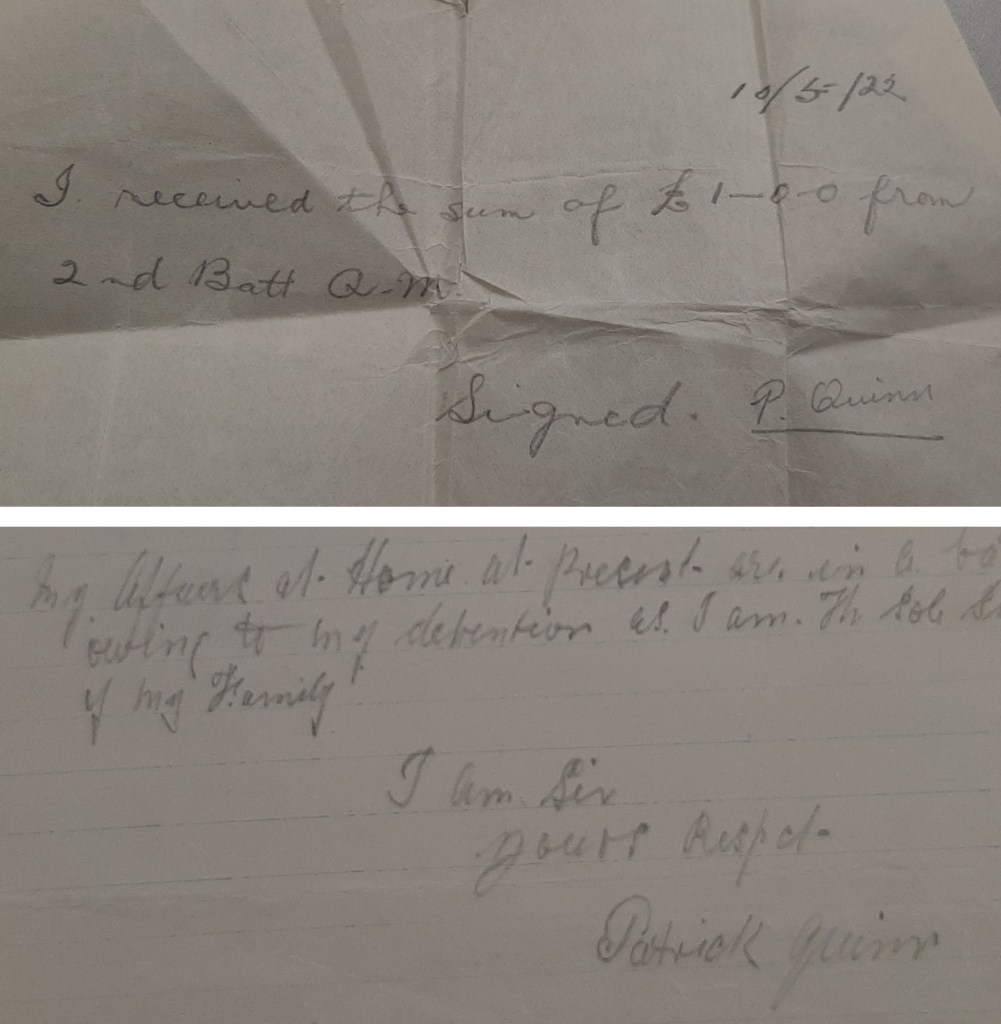
(Top) Handwriting of Patrick Quinn from Eliza St on an IRA receipt; (bottom) handwriting of Patrick Quinn from Cromac St in a letter appealing to be released; the capital letter Qs in each case are distinctively different (© PRONI HA/5/961A & HA/5/2123; Reproduced by kind permission of the Deputy Keeper of Records, PRONI)
James Orr from Carrick Hill was too young to be interned.
He was arrested on 31 July and the police reported, “This boy is the recruiting officer for the Fianna, is very active. He admits in his interrogation that he has for the past six weeks been in the gun squad and that he is instructor in revolver (stripping and assembling).” They recommended his internment, but Shewell realised that because Orr was aged under 16, the provisions of the Children’s Act applied, so he could not be held in a prison, only a place of juvenile detention. However, sending him to a reformatory was impractical as he was presumed to be too unruly and would most likely abscond. Police investigations revealed that he would turn 16 on 20 September and therefore be subject to internment, but they believed, “he is no worse than hundreds of others, I think no useful purpose would be served by his internment, nor do I think it would have much effect on the Fianna.” On 15 September, he was put on a train to Dublin, where his sister lived, and barred from re-entering the north for twelve months.12
Francis Burns from Ballymacarrett “avoided” internment by being sent to jail for a sentence that was probably shorter than the time he would have spent interned.
On 11 July 1922, British troops spotted him and another man carrying rifles in Clyde Street; the soldiers pursued them and caught Burns, but only after he had got rid of the rifle, while the other man escaped. He appeared in court on 28 July and was remanded on bail. He was re-arrested on 29 September and interned on 21 October, but on 27 November, appeared in court on the original charge and was found guilty. He was sentenced to nine months’ hard labour and fifteen strokes of the birch and the order for his internment was revoked. However, the authorities were not completely finished with him: on 27 November 1925, having been named by the police as being the Quartermaster of the re-organised IRA in Ballymacarrett, he was interned.13
Burns was one of several arrestees who were prosecuted under the Firearms Act instead of being interned. Others IRA members simply slipped through the RUC’s fingers: John McArdle from Clonard was arrested on 2 June 1922 but released the following month – he was the Divisional Engineer of the 3rd Northern Division.14
To a man, those arrested denied that they were IRA members; some admitted they had been once, but not since the Truce or the Treaty. The most strident denial was probably that of John McLoughlin from the Lower Falls – the notes of his interrogation by police reveal that he “Has Bolshevist and Communistic views. Says all working men ought to pull together to overthrow all capitalists … Indignantly repudiates the idea of belonging to the IRA or any similar organisation, which he says are ‘no good’ to him.” McLoughlin’s downfall was that he was arrested in the company of two men who the police knew, from captured documents, to be IRA members – one a battalion Quartermaster, the other a company Quartermaster. The distinction between red and green subversives was not one that overly troubled the police, who remained adamant that McLoughlin was in the IRA. He was interned until November 1923.15
In some cases, men’s protests of innocence were genuine – of the sample of 165 nationalist internees, eighteen had no documented involvement with either the IRA or Fianna. These included some petty criminals – the RUC used internment as a convenient way of taking them out of circulation. The most extreme such case was that of James Davey, also from the Lower Falls. He had a long criminal record involving larceny and burglary, and police suspected he was the leader of a criminal gang that had co-operated with the IRA. However, in November 1921, he had provided information to the police that led them to an IRA jail in which a police spy, Arthur Hunt was being held. Hunt was freed but when word of Davey’s involvement leaked out, the IRA tried to shoot him in response, so Gelston saw to it that Davey was given money to flee to England. But Davey’s return to Belfast suggested to the RUC that he wasn’t as afraid of the IRA as he had made out, so he was interned on account of his gang’s dealings with the IRA. In March 1923, Gelston, perhaps regretting his earlier generosity of spirit and finances, wrote of Davey, “This man’s character is so depraved that I could not recommend his release.”16
Organisation of internees
The internees quickly organised themselves, but even in internment, the debilitating split in the republican movement over the Treaty the previous spring was replicated.
On 26 August, Seán Sheehan, a member of the 1st Midland Division who had been arrested during a cross-border raid in Fermanagh the previous February, managed to get a letter smuggled out – possibly via one of the men’s chaplains – to Richard Mulcahy, Commandant-in-Chief of the National Army in the south since the killing of Michael Collins. By that stage, between the Argenta and the internment camp at Larne Workhouse, there were 339 internees from across the north. Sheehan broke this total down as follows: 184 IRA men loyal to GHQ, 28 who he described as “Executive,” 23 neutral and 104 civilians, “70% in sympathy with GHQ.”17
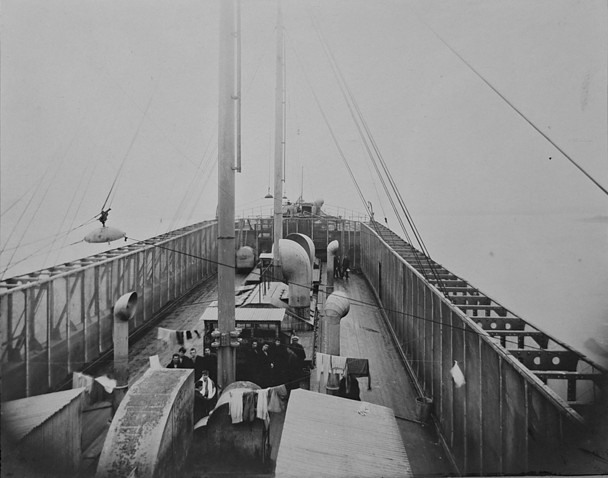
Internees on the deck of the Argenta (© PRONI HA/32/6/5; reproduced by kind permission of the Deputy Keeper of Records, PRONI)
By the time Sheehan wrote again the following October, the total had grown: “About 300 of the 450 internees are Army officers and men and at least 250 of these are loyal to GHQ.” In this letter, he referenced an Army Council which had been set up by the pro-GHQ men on board.18
A further letter in January clarified that this group consisted of all officers of battalion rank or higher including, from Belfast: Frank Crummey (Divisional Intelligence Officer, 3rd Northern Division), Seán Keenan (Vice O/C, Belfast Brigade), Charles McWhinney (Signaller, Belfast Brigade), Frank Love, (Quartermaster, 1st Battalion) and Henry Crofton (Quartermaster, 2nd Battalion).19
The pro-Executive internees had a parallel Army Council. In an unpublished memoir, Two Years on a Prison Ship, the leading Sinn Féin figure Cahir Healy – twice elected as a Westminster MP for Fermanagh and Tyrone while interned – described how the divide within republicanism manifested itself on the Argenta:
“Gradually, there arose a political atmosphere which rendered the port side of the ship to be preferred by one section and the starboard side by another, although, of course, the distinctions were not rigidly adhered to. These matters indicate how far the leaven of the old dissensions had eaten into our lives.”20
To present a united front to the authorities, a third group, the Ship’s General Council, also existed. This dealt with the Governor on “domestic matters” of administration and routine. It was chaired by James Mayne, a solicitor’s clerk from Tyrone – he was deeply distrusted by the pro-GHQ Army Council, who felt that “all Mayne’s activities are directed towards showing that he has authority to act on all occasions and in all circumstances for the internees as a whole. This is an absolute falsehood.”21
“This boat will have to go into the air”
Not all internees were resigned to their situation, and some tried to find ways of fighting back, treating internment as a new front in their war against the northern government.
In August 1922, the censor on the Argenta intercepted a letter from an internee to a relative, asking them to leave certain items at a safe house in Larne, where the ship was at anchor – he would then arrange to have them smuggled onto the ship; the alleged contents of the letter were leaked to the unionist press in mid-September:
“I want 14 lbs of guncotton [an explosive], 1 fuse, 1 detonator. If he can’t get that weight, if he sent all he could get, and make it up with war flour [a homemade explosive]; if no guncotton, he could send all war flour; but I prefer cotton, as the bottom of this tub is 3 or 4 feet think. We are putting her in the air.”22
The Governor of Larne Internment Camp, A.D. Drysdale, who was also responsible for the Argenta, initially took the scheme as a serious threat, but a civil servant felt it was unlikely, for an obvious reason: “I am doubtful as to whether there is any real danger of an attempt being made to blow up the ship. It has too many good Sinn Feiners on board.”23
However, at the start of December, a new plan was made by some of the internees to scuttle the ship. There are identical notes on the files of Samuel Largey, Peter Trainor and James Campbell, “This man was connected with an attempt to damage and possibly scuttle the S.S. Argenta on 2nd December 1922.”24
Drysdale was alerted to this plot by the Governor of Derry Gaol, who had been informed of it by a transferred internee. The warders made a detailed search of the Argenta and found that a hole measuring 3 feet by 2 feet had been cut into the deck under one of the bunk beds in room S2, one of the areas, enclosed by wire fencing and so known as cages, in which the men lived and slept. Drysdale said the hole, which “was so skilfully concealed that only an expert could detect it,” gave access to the hold of the ship.25
There was evidently some substance to the report that reached Drysdale, as Kleinrichert was told by a relative of one of the men involved,
“A bomb was made by some of the men using a pillowcase filled with ashes, inserting a candlewick and placing it in the hollow of a timber which had been dug with the use of sharpened table knives. Samuel Largey, a small young man of eighteen years, was elected to crawl up part of the way into the area of the timber to plant the bomb. The warders were alerted to the plan, discovered the bomb and the Specials subjected Largey to quite a beating.”26
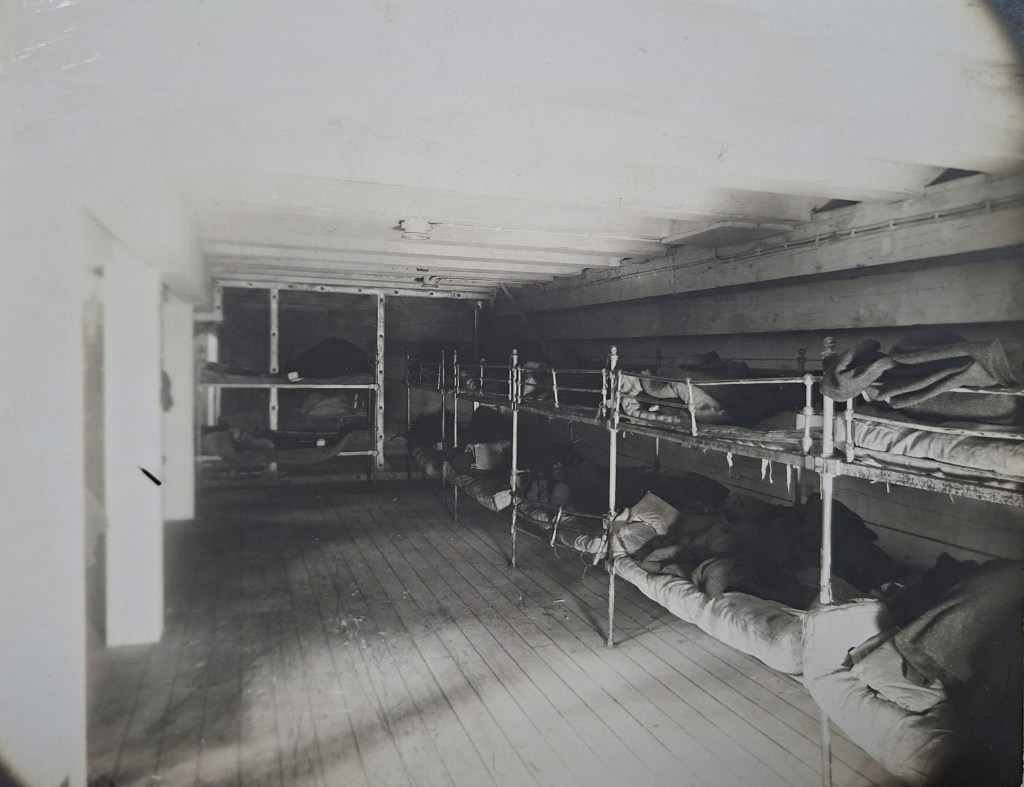
Cage S2 on the Argenta: a hole was cut in the deck of this room as part of a plan to scuttle the ship (© PRONI HA/32/6/3; reproduced by kind permission of the Deputy Keeper of Records, PRONI)
There were unsuccessful attempts to escape. According to Kleinrichert,
“Chuck Brown … drilled a hole through the side of the hull from below deck and realised he had made a grave error as the location he had chosen was below the water line and the hole permitted the sea water to gush into the quarters. The other internees held his body up against the deluge until the warders could get it repaired.”27
John Wallace, an ex-serviceman from the Marrowbone, appeared to be planning a similar effort. He sent a seemingly innocuous postcard to his fiancée, but it had been cut in half with a knife then stuck back together, concealing an inner message. He gave her instructions for how to make a concealed compartment in a suitcase he had at home and asked her to hide some contraband in the false bottom: “I want a brace and two inch bits, two wood chisels.”28
However, the censor spotted the doctored postcard, noted the hidden message and the authorities allowed the correspondence to continue, but after Wallace was spotted by warders attempting to interfere with wires on the Argenta, he was quickly transferred to Derry Gaol and had his privileges withdrawn as a punishment, thus nipping his escape plan in the bud.
An escape plan from Larne Workhouse was put into effect in December 1924, shortly before the last internees remaining there were finally released. A tunnel was being dug when the men hit a water pipe and had to abandon the attempt. Patrick Nash was one of the tunnellers – according to his brother, “While engaged in this, he received a very bad wetting, resulting in pleurisy.” Nash died from this pleurisy on 31 January 1925, just over five weeks after his release.29
The only successful escape from the Argenta was a fictional one. In David Martin’s novel, The Road to Ballyshannon, two internees notice a dolphin swimming alongside the ship as it sits at anchor. Realising that there must be a hole in the security netting surrounding the ship, they watch the dolphin carefully over a period of time to locate the hole. The pair are never named, but remain “the man,” a Brigade O/C from Tyrone, and “the boy,” a much younger IRA member from Antrim. One night, after smearing themselves in grease to ward off the cold of the water, they manage to swim to shore and then set out by foot for Donegal, where they plan to join up with the anti-Treaty IRA then fighting the Civil War.30
The Advisory Committee
A more legitimate route to freedom was offered by the Advisory Committee, a group set up by the northern government and chaired by Shewell, which heard internees’ requests for release.
Initially, in line with a broader policy of non-recognition of the Government of Northern Ireland, the internees adopted a policy of non-recognition of the Committee. Cahir Healy illustrated the depth of internees’ hostility to the Committee:
“We held seven ‘cage’ meetings and endeavoured to get a pledge that none of our number would go before the Committee. Many had, however, already sent in their applications, and these were asked to withdraw. Over 30 persisted in going before the Committee … The men in the other seven cages refused to have them back, to live with or associate with them. Thus, a new situation developed, which the Governor met by putting the ‘Committee men’ into cage P1 – up near the latrines. To do the men justice, they possessed no desire for association with the others any longer, and for two weeks or more stayed below the entire day, only going on deck for exercise between eight and nine in the evening when the rest of the internees had been locked up … When the thirty had been a short time in the special cage set apart for themselves, one or two began to feel their position and went on deck during the day. The others avoided them. One internee, however, from County Derry, was discovered talking to a P1 man and he was forthwith taken on deck, tied to the mast and a card placed above his head, on which was printed ‘A warning to traitors!’”31
The thirty who had appeared before the Committee – to no avail, as they were not released – were eventually transferred from the Argenta to Larne Internment Camp.
But in January 1923, seven teachers on the Argenta applied to be heard by the Committee, claiming to have been advised to do so by Eoin MacNeill, the Free State Minister for Education. Mayne called a mass meeting, at which tempers quickly flared. As a result, five of the teachers withdrew their applications, leaving only Crummey and Philip Ryan. But the Committee decided not to recommend either man’s release: Crummey remained interned until the following April and Ryan until July.32

Cartoon drawn by Phillip Ryan in an internee’s autograph book; (© National Library of Ireland Ms 42,784 Autograph book of Irish Republican prisoners; reproduced courtesy of the National Library of Ireland)
The question of applying to be heard by the Committee remained a source of bitter tension:
“It seems that there is a strong feeling of resentment against these men because they have appeared before the Advisory Committee … the five internees referred to have reported to have been threatened with injury during the night and are afraid to sleep in the pens with the other men. Last night and tonight they occupied S3 which is set apart for the chapel … I think it would be advisable to bring the men back to the camp for their own safety after the morning rollcall has been received otherwise it might be necessary to employ a force of armed Constabulary in the internees’ quarters which would not be desirable.”33
Internees went to extraordinary lengths to dissuade wavering individuals from resorting to the Committee. In December 1922, five internees – including the destructive Samuel Largey and James Campbell – were transferred from the Argenta to the sick bay of the internment camp in Larne Workhouse, suffering from scabies. However, Drysdale had doubts about the men:
“The Medical Officer informs me that in his opinion internee Joseph McClure has been simulating skin trouble … McClure has been boasting that he pricked his arms and produced a certain amount of irritation in the skin in order to be removed to the Workhouse and I have a strong suspicion that this has also been done by others. The motive, I think, was to intimidate internees who wished to go before the Advisory Committee.”34
Internees’ families could also urge them not to give in to the temptation to request a hearing – Hamilton Young’s cousin Rose wrote to him, saying,
“Before I would go out on bail if I were an Irishman I would rot first for a good Irishman with the Irish blood in him would rather have death than dishonour, and thank God I can say that about you and God will reward all on that ship because yous all on that ship are Catholic.”35
Some republicans remained stubbornly opposed to the Committee. Even as late as February 1924, Edward Steenson, an IRA member from Ballymacarrett, when informed of conditions for his potential release, replied, “I don’t want my case considered and I won’t comply with any conditions.”36
For those who did go before the Committee, it was a largely futile exercise: by April 1923, the Committee had reviewed a total of 205 internees’ cases, but had only recommended the release, with stringent conditions attached, of 35.37
Appeals for help from non-republicans
Internees or their families would often turn to notable figures, including implacable opponents of republicanism, hoping that an intercession from them might prompt a release.
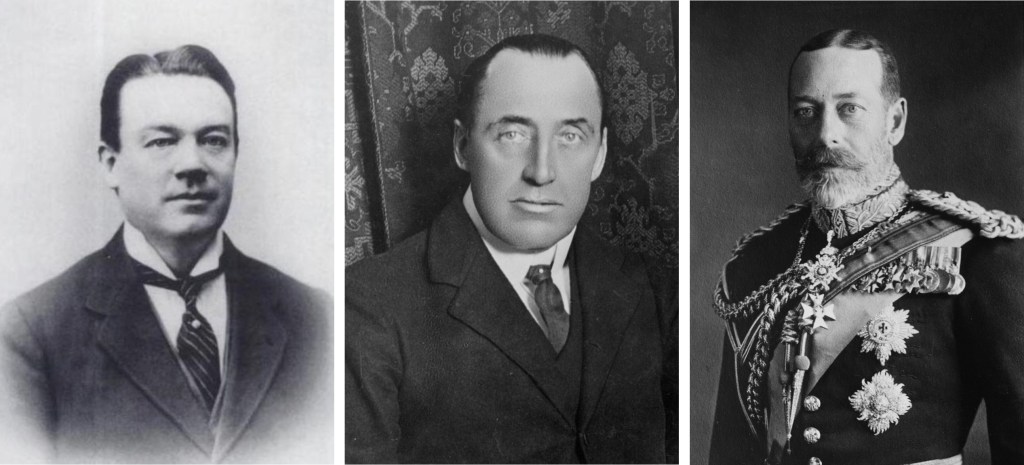
Non-republicans were asked to intervene on behalf of internees (L-R Joe Devlin, Edward Carson, King George V)
Joseph Doran was one of three men arrested on suspicion of an attempted arson attack on Ferguson’s Garage in the Market on 18 June 1922. He was fined for a curfew violation, but although the fine was paid, a detention order was issued to keep him in Crumlin Road Gaol. His mother was concerned over his continuing imprisonment, so on 13 July, she wrote to Westminster MP Joe Devlin: “He is still confined to prison since he was arrested so if I am not intruding on your valuable time, I would be very thankful if you could bring this case before the proper authorities to see the reason why he was detained.”38
Devlin contacted the Colonial Office in London, who in turn made enquiries to the Secretary to the Northern Ireland Cabinet in mid-August. What Mrs Doran didn’t realise was that just over a week before she wrote to Devlin, Bates had signed an internment order against Doran, so by the time she wrote the letter, her son was no longer in Crumlin Road but had been transferred to the Argenta.
Raymond Burke was a prominent businessman and one of Devlin’s key supporters in Belfast – the Craig-Collins Pact signed in London in March 1922 was largely based on draft proposals which he and another Catholic businessman, Hugh Dougal, had presented to the unionist Prime Minister, James Craig. Burke was also the honorary American Consul in Belfast, so he may have been seen as a potential quasi-diplomatic source of assistance. The internment files are full of instances of Burke raising the cases of IRA and Cumann na mBan internees, enquiring whether there were grounds for their release, but in every instance, he was told that there were none.39
Some such appeals went beyond nationalist figures. John McKee, one of three interned brothers, wrote to Reverend J.W. Gibson, the minister at Broadway Presbyterian Church, reminding him that he had helped prevent the sectarian eviction of Protestants living in the area:
“I remember a few years ago there were some trouble at Broadway and a few boys from about Mill Street came up and ordered that all the flock around your church to leave. So myself and a few other boys who live in your district went down and told Rev. Father Convery and he came up to Broadway and we managed to get the crowd under control.”40
The clergyman passed the letter to Richard Lynn, editor of the Northern Whig, who then forwarded it on to Samuel Watt, Secretary of the Ministry of Home Affairs, only to be told, “I do not think, at present, there is any prospect of their being released.”41
Appeals made directly to unionist politicians fared little better, although it is perhaps surprising that those appeals were even passed on. John Flanagan’s wife wrote to an Independent Unionist MP, Philip Woods, a former officer in the 36th (Ulster) Division, who had won the seat formerly held by Twadell; she highlighted the fact that her husband had been wounded while serving in the British Army during the Great War. Prompted by the local Catholic parish priest, a Unionist Party alderman on Belfast Corporation, Oswald Jamison, interceded in vain on behalf of brothers James and Charlie Connolly from the Market. Both Woods’ and Jamison’s enquiries were gently rebuffed.42
A month after her husband John was interned, Bridget O’Donnell from the Marrowbone wrote to Craig, “as my husband was my only support I appeal to you as Prime Minister for his release from prison. I plead to you to use your influence hoping you will consider my case and help a heartbroken wife and thanking you in anticipation.” Craig forwarded her letter to the Ministry of Home Affairs, who did not respond.43
The wife of Peter McGurk from the Market went even higher in the Unionist Party pantheon than Craig, appealing to Edward Carson and pleading impoverishment as a result of her husband’s internment: “I am just till the door I have two children and his dying mother till keep and I am not to well myself for I am run down and not a penny coming in.” Following a police investigation, Bates wrote to Carson, “[Her] statement that she is in poverty owing to his internment and that her house is in danger of being sold is incorrect. She is in constant employment and occupies a well furnished house, and her children appear to be well clothed and fed.”44
The mother of John Magee from Great Patrick Street went to the very top of the British establishment, pointing out to King George V that “He joined up during the Great War having served under age with the R[oyal] I[rish] Fusiliers, latterly furnishing his service in Your Majesty’s Navy.” Her letter was forwarded to the Ministry of Home Affairs; they told her that her son could apply for release to the Advisory Committee.45
Part 2 of this post will examine the effects of internment on the men themselves, in terms of medical issues, family poverty, their relationships with loved ones and the impact of bereavements of family members.
1 Wording of Internment Orders.
2 Arrest record, 14 March 1923, Public Record Office of Northern Ireland (PRONI), HA/5/2344 McPeak [sic], Joseph, Little May St, Belfast. Future footnotes will omit “Belfast” when the file name includes a street address.
3 Report on situation of No. 1 (Belfast) Brigade, 20 July 1922, Richard Mulcahy Papers, UCD Archives, P7/B/77; Persons recommended for internment, n.d. PRONI, HA/5/2167 Herron, James, Independent St.
4 Cabinet conclusions, 20 May 1922, PRONI, CAB/4/43 Cabinet meeting 20 May 1922.
5 Denise Kleinrichert, Republican Internment and the Prison Ship Argenta 1922 (Dublin, Irish Academic Press, 2001) p74.
6 Arrest record, 15 November 1923, PRONI, HA/32/1/405 James Woods, Ballyhornan, Ardglass, Co. Down.
7 Raid report, 6 June 1922, PRONI, HA/5/957C Internment of Thomas O’Reilly, Alton St; John Maguire to Military Service Registration Board, 8 July 1935, Military Archives (MA), Military Service Pensions Collection (MSPC), DP2852 Thomas O’Reilly (2RB713); Joseph Hawkins to Advisory Committee, 1 November 1923, PRONI, HA/5/1493 Hawkins, Joseph, Stanfield St.
8 MA, Historical Section Collection (HSC), HS/A/0899, Register, showing service number, rank, name, home address, date of attestation, age, unit to which posted, army qualifications, religion and date of discharge; PRONI, HA/5/2070 Carmichael, William, Parkview St, HA/5/2072 Carmichael, Robert, Parkview St & HA/5/2071 Carmichael, John, Parkview St.
9 City Commissioner, RUC, to Inspector General, RUC, 13 July 1922, PRONI, HA/5/1824 McDermott, John, Belfast. Future footnotes involving these officers will omit “RUC.”
10 Samuel Maguire to Advisory Committee, n.d., & Inspector of Prisons to Henry Toppin, Ministry of Home Affairs (MHA), 11 September 1922, PRONI, HA/5/961K Internment of Samuel Maguire, Derby St; Nominal Roll, Na Fianna Éireann, 1st Battalion, Belfast Brigade, MA, MSPC, FE/34; MA, MSPC, DP5967 Laurence Maguire.
11 PRONI, HA/5/2123 Quinn, Patrick, Cromac St; https://www.militaryarchives.ie/collections/online-collections/irish-army-census-collection-12-november-1922-13-november-1922
12 Arrest report, 31 July 1922, Inspector of Prisons to Military Advisor, 13 August 1922 & City Commissioner to Inspector General, 18 August 1922, PRONI, HA/5/961R Internment of James Orr, Unity St.
13 PRONI, HA/5/647 Internment of Francis Burns, White St.
14 PRONI, HA/5/1794 McArdle, John, Clonard Gardens. The PRONI e-catalogue lists 266 files of Belfast men that could potentially be internment files, but of the 194 files viewed to date (73%), 35 relate to men who were not interned.
15 Interrogation of John McLoughlin, n.d., PRONI, HA/5/2137 McLoughlin, John, Sultan St.
16 City Commissioner to Inspector General, 29 March 1923, PRONI, HA/5/1878 Davey, James, Baker St.
17 Seán Sheehan to Minister of Defence, 26 August 1922, MA, Department of Defence A Series (DODAS), DOD/A/07586 SS Argenta position of prisoners on board.
18 Seán Sheehan to Minister of Defence, 30 October 1922, MA, DODAS, DOD/A/07586 SS Argenta position of prisoners on board.
19 Seán Sheehan to Minister of Defence, 14 January 1923, MA, DODAS, DOD/A/07586 SS Argenta position of prisoners on board.
20 Cahir Healy, Two Years on a Prison Ship (unpublished, n.d.), p184, PRONI, Cahir Healy Papers, D2991/C/26 An autobiographical sketch by Healy relating to his experiences on board the prison ship ‘Argenta’.
21 Seán Sheehan to Minister of Defence, 14 January 1923, MA, DODAS, DOD/A/07586 SS Argenta position of prisoners on board.
22 Anonymous letter reprinted in Belfast News-Letter, 15 September 1922, PRONI, HA/32/1/78 Prison ship plot to destroy SS Argenta with explosives.
23 A.P. Magill to J.W.E. Poynting (both MHA), 8 November 1922, PRONI, HA/32/1/78 Prison ship plot to destroy SS Argenta with explosives.
24 T.P.B. Townsend (MHA) file note, 12 December 1922, in each of PRONI, HA/5/1508 Largey, Samuel, California St; HA/5/1497 Trainor, Peter, Barrack St; HA/5/1941 Campbell, James, Great Patrick St.
25 Governor, Larne Internment Camp, to Secretary, MHA, 3 December 1922, PRONI, HA/32/1/84 Prison ship attempt to scuttle SS Argenta.
26 Kleinrichert, Republican Internment, p163.
27 Ibid., p162.
28 Intercepted postcard from John Wallace to Lucy Hunter, 16 November 1922, PRONI, HA/5/2099 Wallace, John, Ardilea St.
29 George Nash application form, MA, MSPC, DP2605 Patrick Nash.
30 David Martin, The Road to Ballyshannon (London, Sphere Books, 1983).
31 Healy, Two Years on a Prison Ship, pp26-29, PRONI, Cahir Healy Papers, D2991/C/26.
32 Frank Crummey to Frank O’Duffy, Secretary, Ministry of Education (Free State), 25 January 1923, MA, DODAS, DOD/A/07586 SS Argenta position of prisoners on board.
33 Governor, Larne Internment Camp, to Secretary, MHA, 21 June 1923, PRONI, HA/5/2067 McLaverty, Michael, Clowney St.
34 Governor, Larne Internment Camp, to Secretary, MHA, 4 December 1922, PRONI, HA/5/1941 Campbell, James, Great Patrick St.
35 Intercepted letter from Rose [no surname] to Hamilton Young, 13 August 1923, PRONI, HA/5/2171 Young, Hamilton, Saul St. All letters written to internees or politicians by members of the public are transcribed exactly as they were written, with no corrections made to spelling or punctuation.
36 E.W. Shewell file note, 14 February 1924, PRONI, HA/5/2091 Steenson, Edward, Foundry St.
37 Kleinrichert, Republican Internment, p184.
38 Mrs Doran to Joseph Devlin MP, 13 July 1922, PRONI, HA/5/1869, Joseph, Grace St.
39 See for example (all PRONI): HA/5/1520 Murray, William P., Chemical St; HA/5/961X Internment of William Ferris, Osman St; HA/5/961F Internment of Kathleen Dooley, Unity St; HA/5/2067 McLaverty, Michael, Clowney St; HA/5/2212 & HA/5/2213 McKee, Charles & McKee, Henry, Falls Rd; HA/5/1791 Crummey, Francis, Raglan St; HA/5/957F Internment of George McCann, McMillen’s Place; HA/5/682 Internment of Francis McFerran, Joy St.
40 John McKee to Reverend J.W. Gibson, 1 January 1923, PRONI, HA/5/2214 McKee, John, Falls Rd.
41 Secretary, MHA to Richard Lynn, 16 January 1923, PRONI, HA/5/2214 McKee, John, Falls Rd.
42 Mary Flanagan to Philip Woods MP, n.d., PRONI, HA/5/1976 Flanagan, John, Kilmood St; Alderman Oswald Jamison to Minister of Home Affairs, 31 January 1924, PRONI, HA/5/1538 Connolly, James, Joy St.
43 Bridget O’Donnell to James Craig, 26 June 1922, PRONI, HA/5/1783 O’Donnell, John, Ardilea St.
44 Ellen McGurk to Edward Carson, n.d., & Minister of Home Affairs to Edward Carson, 7 March 1923, PRONI, HA/5/1986 McGurk, Peter, Stanfield St.
45 Mary Magee to King George V, 1 August 1922 & J.W.E. Poynting to Mary Magee, 9 August 1922, PRONI, HA/5/1933 Magee, John, Great Patrick St.


Leave a Reply