Estimated reading time: 20 minutes
This post was largely inspired by Gerard Shannon’s excellent recent biography of Rory O’Connor
Besieged in the Four Courts
Soon after the siege of the Four Courts began on 28 June 1922, Ernie O’Malley realised that apart from being outgunned, the position was woefully undermanned:
“We had not sufficient men. There were between a hundred and eighty and a hundred and ninety men in the garrison, but to hold the Courts under present conditions we would have needed at least two hundred and fifty. Practically all were on duty at a time. The reserves of each section for counterattack were very small, and we had no central reserve to fall back on.”1
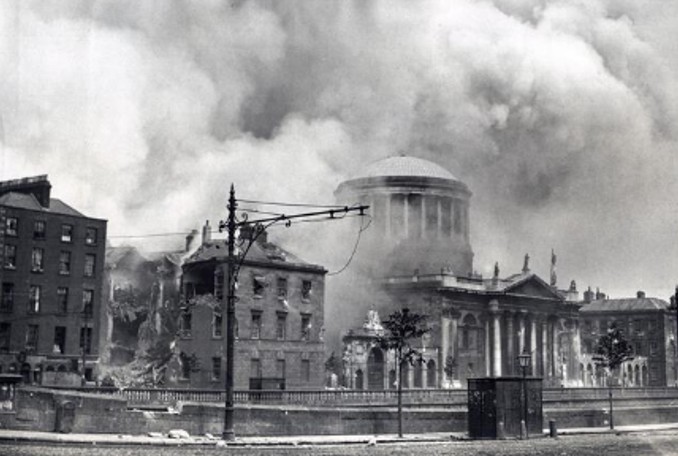
The Four Courts under attack
Meanwhile, Liam Lynch returned to his divisional area in Munster and announced that he had resumed duty as IRA Chief of Staff from 29 June.2
That night, the leaders in the Four Courts discussed a possible way to escape the siege. According to O’Malley, “Later I saw McKelvey, Rory and Liam talking to Paddy O’Brien. ‘We’re discussing the sortie,’ said McKelvey as I stepped into the group. ‘Rory says that if we wait for the morning we can get out through the sewers. What do you think?’”3
O’Malley thought a lull in the shelling for the previous two hours meant that the National Army would probably attack at dawn and advocated an immediate breakout attempt, but Joe McKelvey thought the odds were stacked too heavily against them: “‘He said: ‘The Staters have armoured cars and Lancias in the streets; we have only one armoured car. It’s a long chance, that, of fighting our way out.’” The decision was to remain.”4
The following morning, the rising river tide flooded the sewers, making that escape plan unviable. By that stage, pro-Treaty National Army troops had fought their way into the complex and captured part of it, while the munitions block in which the anti-Treaty Executive had stored explosives and mines, with half a ton of TNT in the cellar, was on fire. Shortly after midday, this store exploded, providing one of the most iconic images of the Civil War.
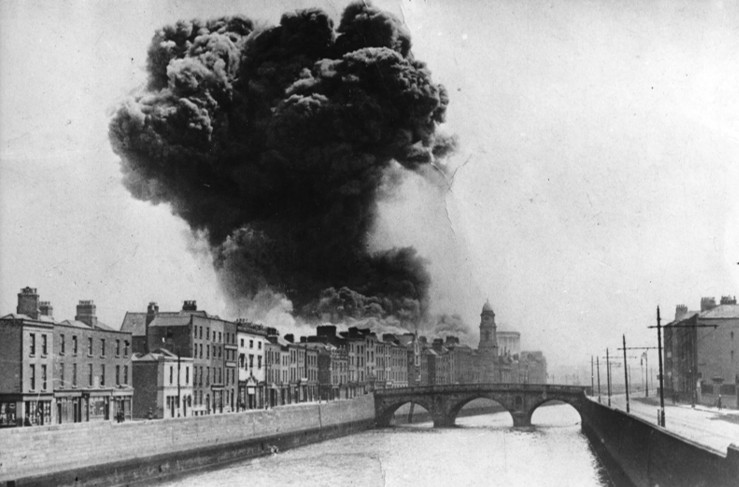
The explosion of the munitions store in the Four Courts (Irish Architectural Archive)
After the explosion, with ammunition running low and no hope of getting past the National Army, McKelvey and Rory O’Connor were in favour of surrendering but Liam Mellows and O’Malley were against it. The latter tried to persuade McKelvey to escape by subterfuge, but to no avail:
“‘I think you should leave, sir, with the wounded,’ I said, ‘I know they’ll get through. It would be better if senior members of the staff were not taken here.’ ‘That’s a rotten thing to say to me,’ he said, tears in his eyes. ‘You are asking me to desert the men.’”5
Eventually, McKelvey, the most senior officer, prevailed, telling the others, “‘The men have done their best … and it’s not their fault.’”6
During the afternoon, a Capuchin friar acted as intermediary as the garrison attempted to negotiate terms for a surrender, but the National Army insisted on unconditional surrender.
“A short time afterwards Liam Mellowes [sic], Joe McKelvey, Ernie O’Malley, with tears in their eyes addressed the men stating that to save the lives of such men they had decided to surrender. They informed the men that surrender was no dishonour, while they were compelled to surrender their guns, they would never surrender their principles.”7
At 4pm, the Four Courts garrison surrendered.
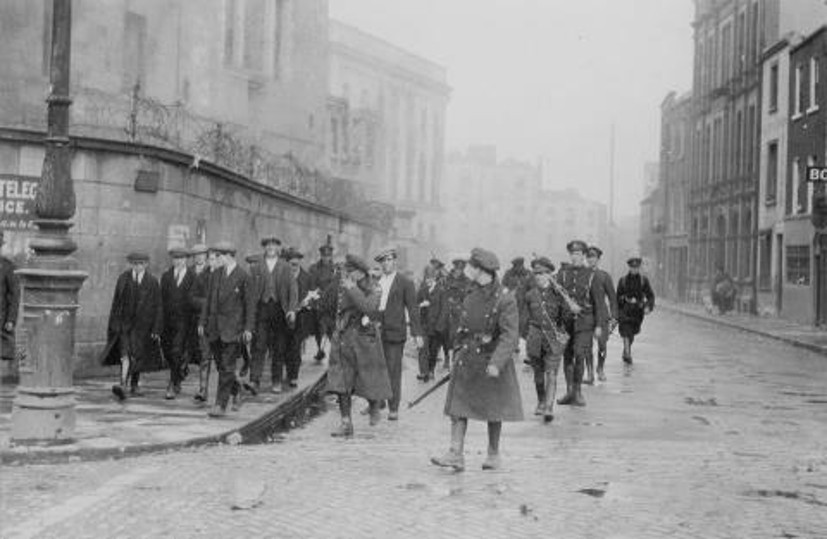
Surrendering members of the Four Courts garrison under National Army escort (www.theirishstory.com blog)
Due to the chaotic nature of the events then unfolding and the breakdown in communications between the Four Courts and anti-Treaty IRA units in the countryside, there was considerable confusion about McKelvey’s standing at this time: the Four Courts surrendered on 30 June, but in the 1930s, an attempt was made for Military Service Pension purposes to list the names and ranks of the anti-Treaty GHQ Staff as of 1 July. Eleven former senior IRA officers gave their views – three (including O’Malley) believed that McKelvey was still Chief of Staff, while four thought he had reverted to his former role as Deputy Chief of Staff.8
In Mountjoy Jail
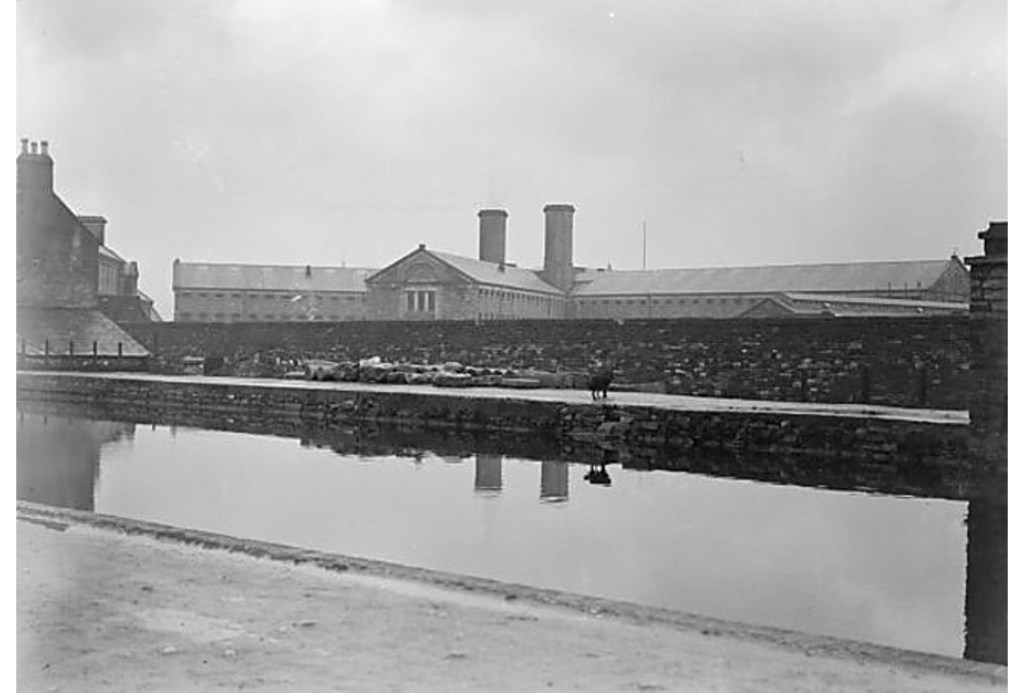
Immediately after the surrender of the Four Courts, O’Malley and two others managed to escape from the nearby Jameson Distillery to which the prisoners were initially taken. The remainder were then brought to Mountjoy Jail.
There, McKelvey shared a cell with Mellows. However, it was most likely the influence of a third cellmate, Peadar O’Donnell, that saw the pair begin an ideological journey that is well-known in Mellows’ case but less recognised in McKelvey’s.9
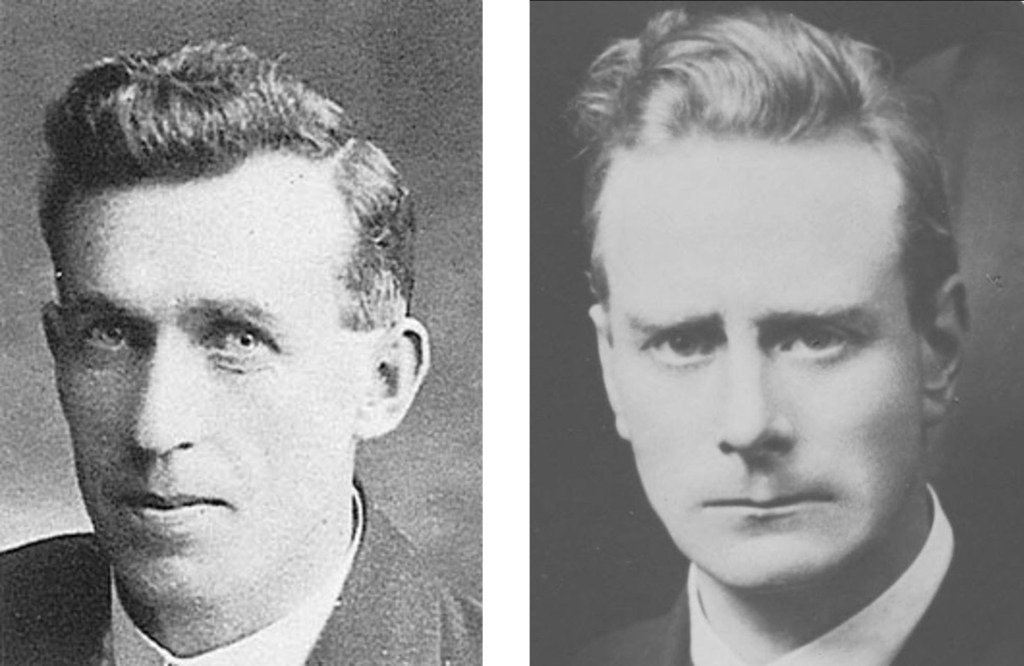
McKelvey’s cellmates in Mountjoy Jail, (L) Peadar O’Donnell and (R) Liam Mellows
Prior to joining the IRA, O’Donnell had been a trade union official and in 1919, he “organised one of Ireland’s first ‘soviets’ when the attendants and nurses of the Monaghan District Lunatic Asylum occupied the grounds and appointed O’Donnell as governor until their demands were met.” Adrian Grant has found evidence in the archives of the Comintern that O’Donnell joined the infant Communist Party of Ireland (CPI) before the outbreak of the Civil War.10
The CPI, led by James Connolly’s son Roddy, emphasised the class interests that lay behind the signing of the Treaty in the hope of attracting support from anti-Treaty members of the IRA:
“CPI leader Connolly believed that … the IRA ‘in large numbers’ was drifting in the party’s direction. Whilst there was no evidence to sustain this claim, made in connection with an appeal to the Comintern for funding, three senior IRA officers – Liam Mellows, Joe McKelvey and Peadar O’Donnell – were sympathetic to the CPI, with O’Donnell actually joining it and winning for it some influence in his brigade.”11
According to Grant, the CPI offered half of their newspaper, the Worker’s Republic, to the IRA Executive to publish articles, in the hope that republicans would also read the communist half and begin to take on board the CPI’s political arguments. Intriguingly, before the Four Courts were even occupied, the CPI reported to Moscow that, “There was a belief that the paper was affecting republicans who were moving from a purely nationalist outlook to a class one and terming themselves ‘social’ republicans.”12
In Mountjoy, where inmates were allowed to have newspapers sent into them, a discussion group evolved, involving Mellows and “northerner Joseph McKelvey, Corkman Richard Barrett, Donegal republican-socialist Peadar O’Donnell and several other republicans in the trade-union movement. The radical tenor of their musings was influenced by the Workers’ Republic.”13
In October, the CPI reported to the Comintern that Mellows was, “Of course not a communist as yet, though he is tending towards us and had signified his intention of joining the Party.” Charlie McGuire, who has also researched the Comintern archives, has written that Mellows was not alone in this: “[He] had, along with Joe McKelvey, indicated a desire to join the party.”14
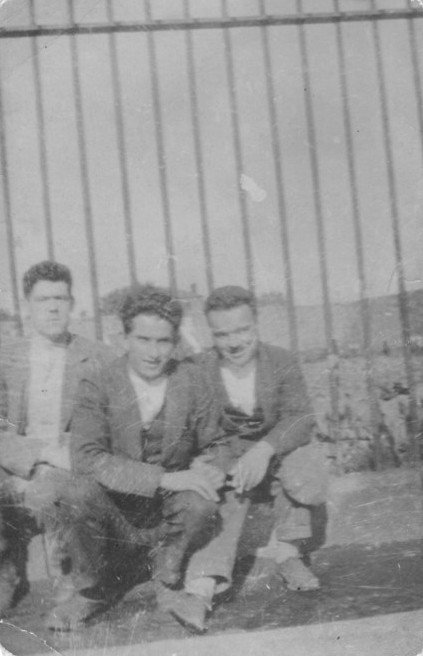
McKelvey (R) in Mountjoy Jail (© Kilmainham Gaol Museum, KMGLM 20pc-3N25-5)
This time, the CPI did have evidence to sustain their claim.
O’Malley had written to Mellows, seeking guidance in political matters that he could not get from Lynch, whose focus was entirely military. On 26 and 29 August, Mellows replied, in documents that were smuggled out of Mountjoy; however, the documents were captured and subsequently printed by the Provisional Government’s Publicity Department in the Freeman’s Journal on 22 September.
Mellows made no bones about referencing the CPI’s newspaper:
“The programme of democratic control (the social programme) adopted by Dáil coincident with Declaration of Independence, January 1919, should be translated into something definite … Would suggest, therefore, that it be interpreted something like the following which appeared in the ‘Workers’ Republic’ of July 22nd last: ‘Under the Republic all industry will be controlled by the State for the workers’ and farmers’ benefit. All transport, railways, canals, etc., will be operated by the state – the Republican State – for the benefit of the workers and farmers. All banks will be operated by the state for the benefit of industry and agriculture, not for the purpose of profit-making by loans, mortgages, etc. That the lands of the aristocracy (who support the Free State and the British connection) will be seized and divided amongst those who can and will operate it for the nation’s benefit, etc.’”15
He went on:
“… the commercial interest, so called, money and the gombeen men are on the side of the Treaty, because the Treaty means imperialism and England. We are back to Tone – and it is just as well – relying on that great body, ‘the men of no property.’ The ‘stake in the country’ people were never with the Republic. They are not with it now – and they will always be against it – until it wins.”16
Although the documents themselves were written and signed by Mellows and have since become known as his Notes from Mountjoy, they can also be seen as the common output of the prison discussion group of which McKelvey, O’Donnell and he were members.
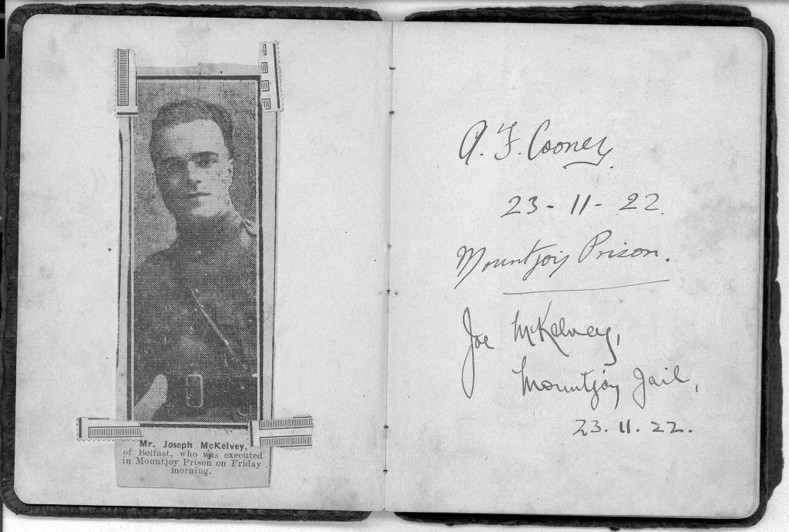
McKelvey’s signature in an autograph book belonging to a fellow prisoner in Mountjoy Jail (www.irishvolunteers.org blog)
In Mountjoy, the Worker’s Republic was not the prisoners’ only reading material – books were also shared and passed around. One that was popular was a novel by E.L. Voynich, The Gadfly, which follows a revolutionary in 1840s Italy; at the end of the book, the key protagonist is sentenced to be shot by firing squad – however, the execution is botched and the man has to face two volleys in succession.
According to O’Donnell, McKelvey was haunted by this image: “And on McKelvey this book made such a deep impression that he often commented on it and expressed the hope that if ever he had to face the firing party his killing would be more efficiently carried out than in the case of The Gadfly.”17
Execution
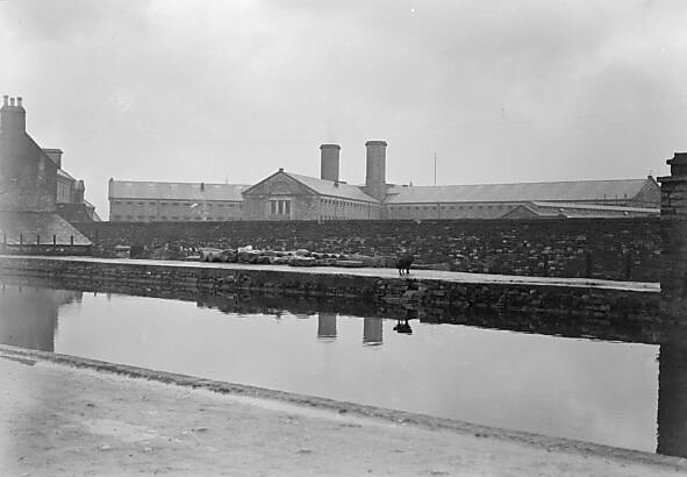
Mountjoy Jail
On 28 September, frustrated by the National Army’s failure to crush the anti-Treaty IRA’s guerilla campaign, the Provisional Government succeeded in having the Army (Special Powers) Resolution passed in the Dáil. Although it has since been referred to as the “Emergency Powers Act” or the “Public Safety Act,” these are misnomers; as legal historian Seán Enright has noted, “It was none of these things. It had no legal standing and was simply a resolution passed by the Dáil.” Until the Free State came into existence, which was not due to happen until 6 December, the Dáil had no authority to pass legislation.18
The resolution allowed the National Army to establish military courts to try people captured attacking government forces, in possession of arms and explosives or engaged in the destruction of property. The punishment for those convicted of such offences could include the death penalty.
After a number of republicans, among them Erskine Childers, were executed during November, Lynch issued an order to the IRA that all members of the Provisional Government who had voted for what he called the “Murder Bill” were to be shot on sight; similarly, the homes of any TDs who had voted for it were to be burned.19
On 7 December, pro-Treaty TD Seán Hales was shot dead on Ormond Quay in Dublin; the Deputy Speaker of the Dáil, Pádraic Ó Máille was wounded beside him.
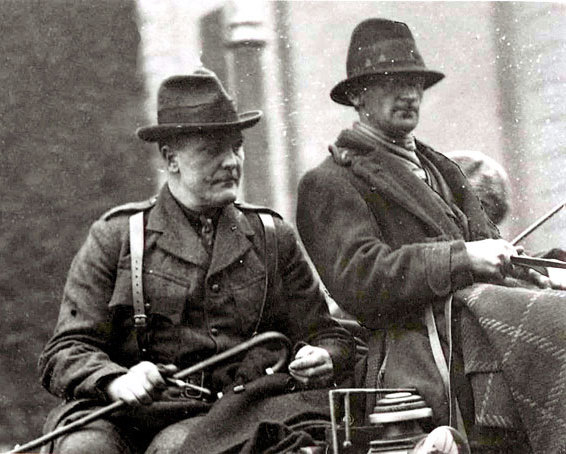
Seán Hales (L), photographed on 7 December 1922, the day he was killed
The Provisional Government decided to respond. Ernest Blythe, who was Minister for Local Government, arrived late to that night’s meeting:
“As I moved from the door to my usual place at the table I heard a list of names being read out. They were the names of Mellows, Barrett, O’Connor and McKelvey. As I took my seat I gathered that the proposal was that they should be executed in the morning without any form of trial. It instantly struck me that the terror-striking effect of this would be greater than that of the measure which I myself had thought of proposing … After a very few minutes’ discussion Cosgrave proceeded to put the question round the table to ascertain whether or not those present agreed with the proposal. I was one of the first two or three to vote; Desmond Fitzgerald was before me. We both agreed to the suggestion. It then came to the turn of Kevin O’Higgins … He hesitated a little about assenting to the summary executions. He asked whether any other measure would not suffice. The answer he got from two or three was that it would not … he finally said, ‘Take them out and shoot them.’ The remaining members of the Cabinet then agreed to the executions.”20
O’Donnell subsequently recalled that, even as the government was meeting, “I distinctly remember McKelvey rolling over on his side, picking up The Gadfly which was nestling in a little stock of books and saying once more, ‘God, I hope they don’t mess up any of our lads this way.’”21
Later that night, the four men were taken from their cells to another part of Mountjoy and each was given a statement signed by Richard Mulcahy, the Minister for Defence and Commander-in-Chief of the National Army:
“You [name inserted] are hereby notified that, being a person taken in arms against the Government, you will be executed at 8am on Friday 8th December as a reprisal for the assassination of Brigadier Seán Hales, TD, in Dublin on the 7th December on his way to a meeting of Dáil Éireann and as a solemn warning to those associated with you who are engaged in a conspiracy of assassination against the representatives of the Irish people.”22
It has often been claimed that the four men selected for execution were picked on the basis of one from each province: McKelvey from Ulster, O’Connor from Leinster, Barrett from Munster and Mellows from Connacht. This does not stand up: although Mellows had commanded the Irish Volunteers in Galway during the Easter Rising, he had no other connection to Connacht – he was born in England and spent parts of his childhood in Wexford, Cork and Dublin.
Writing about the execution of Charlie Daly in Donegal in March 1923, Fearghal Mac Bhloscaidh has pointed out that, in relation to the IRA’s ill-fated northern offensive of May 1922,
“During the Civil War, the Free State killed every senior Republican Brother party to the northern intrigue, including the execution of Joe McKelvey and Daly … The Drumboe executions can be understood then, not merely as one of a series of extra-judicial Free State killings, but more speculatively as an exercise in conspiratorial housekeeping.”23
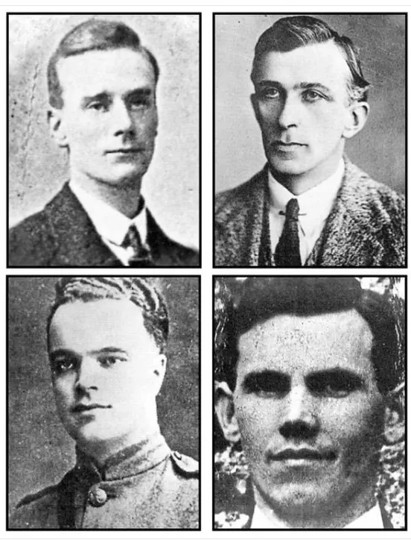
The four men executed in Mountjoy Jail on 8 December 1922: (top) Liam Mellows, Rory O’Connor, (bottom) Joe McKelvey, Dick Barrett
This argument is certainly persuasive in relation to McKelvey and Daly; both O’Connor and Mellows were also involved in the planning of the May 1922 “northern offensive” but Barrett was not, so the “housekeeping” argument does not explain why he was picked. John Dorney has suggested that he was targeted for having led a prison riot in Mountjoy and an attempted escape from the prison the previous October.24
There is an alternative explanation for why Barrett was included – his involvement in the Workers Republic-centred discussion group, as noted by Grant. However, this hypothesis is not satisfactory either, as it does not explain why O’Connor was selected; in addition, if the authorities were bent on wiping out the left-leaning group, why was O’Donnell spared? O’Donnell’s apparent reprieve almost became merely temporary – he was later sent to Finner Camp in Donegal and held hostage there, under a public threat of execution in the event of anti-Treaty IRA attacks on the National Army.25
In the early hours of the morning, McKelvey wrote to his mother Rose:
“I feel very much the fact that it is my own country men who have sentenced me to death, but I pray God that the deaths of those of us who are to be executed this morning may open their eyes to the dreadful crime of going against their own better natures, against everything they once held dear, and at the bidding of our one enemy, England, waging such cruel and relentless war against the Republic which once they would have died to uphold … Now, Mother, as the time is growing short, and as I want to see my comrades before we go, I must draw to a close. So good-bye, good-bye, dearest heart, and god bless you and keep you, my Mother. Give my heart’s love to all friends. Pray for me dearest. Your loving son, Joe.”26
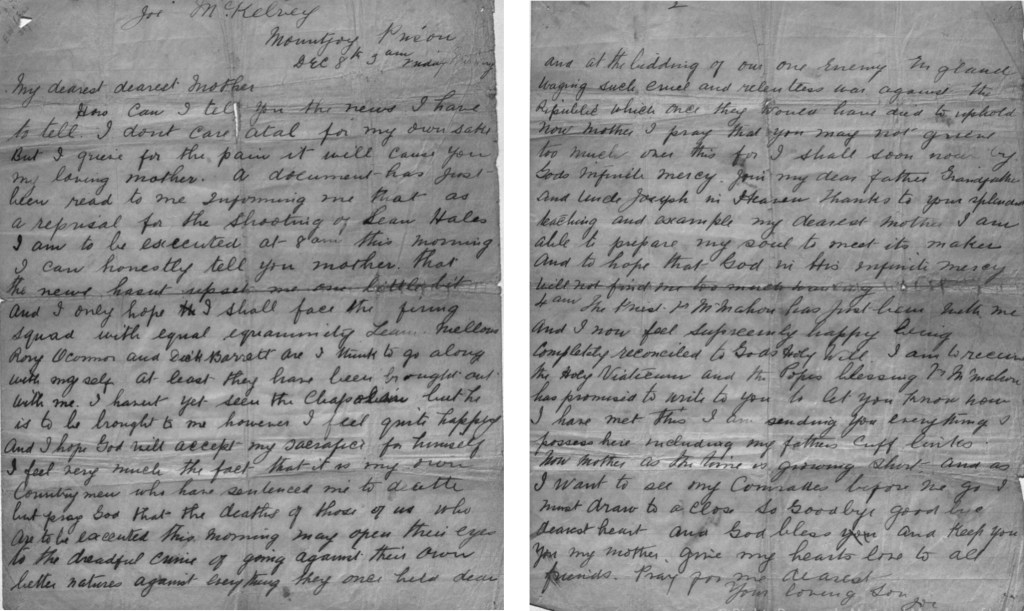
McKelvey’s final letter to his mother (© National Museum of Ireland, Ms 17,619/1)
Shortly before 8am, the condemned men were taken to the prison yard where McKelvey’s dread about the manner of his execution came to pass.
The officer in charge was Thomas Gunn, who had been an officer in B Company, 1st Battalion of the Belfast IRA – so McKelvey was going to be executed by a firing squad led by one of his own junior officers. The execution was bungled, with McKelvey only being wounded; according to Gunn’s granddaughter, her father:
“…heard from his father that he was present at the death of Joe McKelvey. My Dad remembers his father telling him that the first bullet shot him below the heart and that Joe asked for another and Grandad went up to deliver the shot but his finger froze on the trigger and that Hugo MacNeill delivered a second bullet and that Joe had asked for another.”27
This account was corroborated by Canon John Pigott, one of the priests called to attend to the prisoners: “McKelvey, who was conscious, needed attention and I heard him call ‘Give me another’, ‘and another’ and then there was silence … a great silence.”28
On 29 October 1924, McKelvey’s body was released to his family for reburial. Draped in a tricolour with the initials I.R. on it (for Irish Republic), the coffin was brought to Belfast; the Royal Ulster Constabulary refused to allow it to leave Great Victoria Street train station with the flag still on it. After lying in state in St Mary’s church overnight, the tricolour was put back on the coffin after the funeral mass the following morning, but a literal tug-of-war over the flag ensued between the police and the IRA coffin-bearer party. Eventually, the IRA agreed to the removal of the tricolour, but the hearse was immediately surrounded by girls carrying green, white and orange wreaths. At Milltown Cemetery, the tricolour was put back in place, but this time, the police made no effort to intervene.29
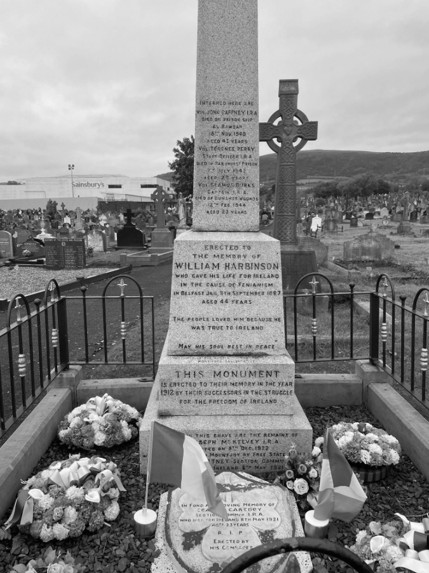
McKelvey’s grave at the Harbinson Plot in Milltown Cemetery, Belfast
After McKelvey’s funeral, his fiancée, Cassie O’Hara, “was presented with his uniform, which she preserved until her death.”30
Summary and conclusions
Joe McKelvey is mainly known for having been O/C of the 3rd Northern Division – this means that he is inevitably linked with the IRA’s role during the Pogrom. However, he had played a military role prior to the outbreak of the Pogrom: when Seán O’Neill became Belfast Brigade O/C in April 1919, McKelvey took his place as O/C of the Belfast Battalion, later participating in the burning of tax offices in Belfast at Easter 1920 and planning an attack on a police barracks in Crossgar, Co. Down in June of that year. When the battalion was split in two in September 1920, he became O/C of the 1st Battalion, reporting to O’Neill.
However, his republican involvement was not only military – his selection as leader of the new 3rd Northern Division in March 1921 owed much to his standing in the IRB: it enabled him to leapfrog O’Neill, who remained Belfast Brigade O/C but was now reporting to McKelvey, rather than vice versa as had previously been the case. Some even believed that McKelvey’s political connections trumped his military abilities – his own Quartermaster, Tom McNally, said, “Joe was a great lad, a good man for giving confidence but he was not a soldier,” while Frank Aiken’s Adjutant, John McCoy, felt that “Joe McKelvey was appointed to his command because he was IRB.”31
By the time the Treaty came to be signed, then passed by the Dáil, leading figures in the republican movement knew him as both an IRA Divisional O/C and an IRB Supreme Council member. When the IRA split, it was this dual prominence that led to his election to the IRA Executive – he was by no means simply chosen as a token northerner; the same considerations prompted Lynch to select him as Deputy Chief of Staff.
But for the last year of his life, little of McKelvey’s energy was directed to military matters, and political issues became more important.
By the time of the first planning meeting for the northern offensive, held in Clones on 21 April, he was in the Four Courts, and it was Séamus Woods who attended the meeting as O/C 3rd Northern. While McKelvey backed Tom Barry’s return-to-war motion at the third Army Convention, he was among the minority at that gathering, a minority with insufficient means to bring their plan to fruition and no option but to retreat to the Four Courts in high dudgeon, there to sulk at their own impotence. Even for the brief ten-day window in which McKelvey was IRA Chief of Staff, Paddy O’Brien was O/C of the Four Courts garrison. McKelvey’s only notable military role during the siege was, as the most senior officer in the building, to decide when the time had come to surrender.
He was centrally involved in the army unity talks held in late April under the auspices of the IRB. These came to nothing, possibly because McKelvey and his fellow anti-Treaty negotiators failed to see that their opponents were not as wholeheartedly committed to the talks as they were, or did not approach the talks with the same sense of good faith. The northern offensive, then in early gestation, offered the pro-Treaty leadership a more immediately tangible, if ultimately performative, way of maintaining army unity than circuitous nitpicking over which individuals would get which roles on a putative combined Army Council.
Meanwhile the new Irish Constitution, upon which so much rested in terms of keeping the two sides together, was still only in the drafting process. Even a crisis as grave as the split in the IRA was not sufficient to prompt the IRB to abandon its own anonymity, a bleak testament to the triumph of conspiratorial intoxication over real-world pragmatism.
The failure of the IRB initiatives, both internal and via the Army Officers Committee, may have created the context for the hitherto unheralded, but certainly startling, evolution in McKelvey’s political outlook that began in Mountjoy in the autumn of 1922.
The IRB had provided an ideological underpinning to the Irish Volunteers/IRA since the Easter Rising but now, both wings of traditional republicanism, political and military, were irreparably split. If McKelvey and Mellows had come to appreciate the limits of the IRB’s strategy, which had ultimately brought only partition, the Treaty, a Civil War and – in their view – abandonment of the Republic, they may have been keen to find an alternative guiding ideology for what remained of the IRA.
Enter Peadar O’Donnell. Reliance on a conspiratorial elite such as the IRB had failed to deliver the Republic. But the Bolshevik revolution in Russia only five years previously had shown that reliance on a mass, class-based movement – the “men of no property” – could successfully overthrow an empire. In the enforced confines of a cell in Mountjoy, O’Donnell was perfectly placed to preach the new gospel.
However, the extent to which McKelvey had travelled along this new path should not be overstated: he and Mellows had only applied for membership of the CPI, they were not yet members, and neither were they fully-fledged communists or socialists.
The sad irony of McKelvey’s execution is that it was for being a central figure, prior to the surrender of the Four Courts, who had acted in accordance with a traditional republican perspective which he perhaps no longer espoused as fervently when he was shot in December. By the time of his death, after having seen sectarian strife in Belfast and fratricidal strife in the south, there are clear indications that he had begun to leave that perspective behind in the search for a new ideology that might prove more fruitful.
References
1 Ernie O’Malley, The Singing Flame (Dublin, Anvil Books, 1978), p98.
2 Army Position: statement by Chief of Staff, 30 June 1922, Military Archives (MA), Military Service Pensions Collection (MSPC), RO/601 General Headquarters, IRA.
3 O’Malley, Singing Flame, p111.
4 Ibid.
5 Ibid., p117.
6 Ibid., p119.
7 Liz Gillis, The Fall of Dublin (Cork, Mercier, 2011), p82.
8 GHQ Staff, 1 July 1922, MA, MSPC, RO/601 General Headquarters, IRA.
9 C. Desmond Greaves, Liam Mellows and the Irish Revolution (London, Lawrence & Wishart, 1971), p362; Fearghal McGarry, ‘O’Donnell, Peadar,’ Dictionary of Irish Biography https://www.dib.ie/biography/odonnell-peadar-a6700. Greaves notes that McKelvey and Mellows were cellmates but does not include O’Donnell; McGarry says O’Donnell and Mellows shared a cell but does not include McKelvey.
10 McGarry, ‘O’Donnell, Peadar;’ Adrian Grant, Irish Republican Socialism, 1907-36 (Dublin, Four Courts Press, 2012), p138.
11 Charlie McGuire, Sean McLoughlin: Ireland’s Forgotten Revolutionary (London, Merlin Press, 2016), p92. I am very grateful to Donal Fallon for bringing this book to my attention.
12 Grant, Irish Republican Socialism, p139.
13 Gavin Foster, ‘22 September 1922: The Publication of Liam Mellows’s “Notes from Mountjoy,”’ https://www.rte.ie/centuryireland/articles/22-september-1922-the-publication-of-liam-mellowss-notes-from-mountjoy
14 Grant, Irish Republican Socialism, p140; McGuire, Sean McLoughlin, p100.
15 Freeman’s Journal, 22 September 1922.
16 Greaves, Liam Mellows, p365.
17 E.L. Voynich, The Gadfly (Teddington [Middlesex], Echo Library, 2007), pp197-199; Peadar O’Donnell, The Gates Flew Open, (Cork, Mercier Press, 2013), pp64-65.
18 Seán Enright, The Irish Civil War: Law, Execution and Atrocity (Newbridge, Merrion Press, 2019), p24.
19 Gerard Shannon, Liam Lynch: To Declare a Republic (Newbridge, Merrion Press, 2023), p232.
20 MA, Bureau of Military History, WS0939 Ernest Blythe.
21 O’Donnell, The Gates Flew Open, p65.
22 Gerard Shannon, Rory O’Connor: To Defend the Republic (Newbridge, Merrion Press, 2026), p223.
23 Fearghal Mac Bhloscaidh, ‘Charlie Daly: Republican Brothers, Partition & the “sham” northern offensive,’ in Irish Historical Studies, Vol. 49 Issue 175 (May 2025), pp89-109.
24 John Dorney, The Civil War in Dublin: The Fight for the Irish Capital 1922-1924 (Newbridge, Merrion Press, 2017), p217.
25 O’Donnell recounted his experience of this hostage period in his prison memoir, The Gates Flew Open. The National Army officer in charge of Finner Camp was my grandfather, Tom Glennon, then Adjutant of the National Army forces in Donegal. O’Donnell described my grandfather as “a kind of grub and I knew he would feed on me” (p103). When I told my late father what O’Donnell had written, he was quiet for a moment, then replied, “If I had been in Peadar O’Donnell’s shoes, I would probably have hated my father too.”
26 Joe McKelvey to his mother, 8 December 1922, National Library of Ireland, Joseph McGarrity Papers, Ms 17,619/1.
27 Email to author from Cathy Gunn, Thomas’ granddaughter, 14 March 2016.
28 Canon John Pigott, ‘1922 Executions Recalled,’ in Athenry Journal, Volume 8 (December 1992)
29 John Ó Néill, Belfast Battalion: A History of the Belfast IRA 1922-1969 (Wexford, Litter Press, 2018), pp18-20. The tricolour bearing the letters I.R. is on display at the Irish Republican History Museum, Conway Street, Belfast.
30 Margaret Ward, Rebel Women: Cumann na mBan in Belfast and the Glens of Antrim 1914-1924 (Belfast, Beyond The Pale Publications, 2024), p102.
31 Tom McNally interview with Ernie O’Malley in Síobhra Aiken, Fearghal Mac Bhloscaidh, Liam Ó Duibhir & Diarmaid Ó Tuama (eds), The Men Will Talk to Me: Ernie O’Malley’s Interviews with the Northern Divisions (Newbridge, Merrion Press, 2018), p107; John McCoy interview with Ernie O’Malley in ibid., p167.


Leave a comment