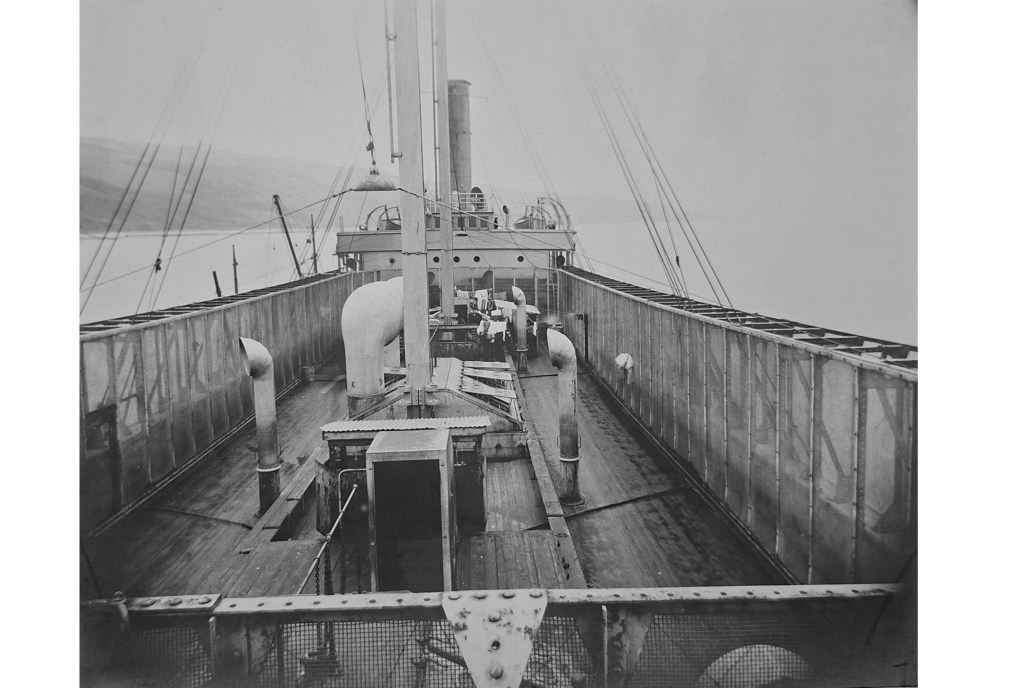
Main image: the deck of the Argenta; internees hanging up washing can be seen in the distance (© PRONI HA/32/6/6; reproduced by kind permission of the Deputy Keeper of Records, PRONI)
Part 1 of this post is available to read here.
Estimated reading time: 20 minutes
Medical issues
The cramped, unsanitary conditions in which the internees were held, coupled with the poor prison diet, meant that their health was badly affected, and in some cases, destroyed.
William Hyndman from the Marrowbone had been invalided out of the Royal Navy in 1920, after contracting pulmonary tuberculosis (TB) which was aggravated by his wartime service. Interned in June 1922, he asked to be released on medical grounds the following November: “I am not receiving treatment here as there is no facilities for cases of my nature … I have suffered very severely by my internment and illness.” A week later, Dr. J. Hall, the Medical Officer of Larne Internment Camp said, “In consideration for the man’s own health and the risk of infection of other internees I recommend his discharge.”1
Later that month, Hyndman was examined by the Chief Medical Officer of the Ministry of Home Affairs, Dr W.R. Dawson, who detected new signs of tuberculosis in his throat and immediately arranged for his transfer by ambulance to Crumlin Road Gaol where he was examined by a throat specialist. The jail’s Medical Officer wrote two alarmed reports which seemed to indicate that Hyndman’s condition was becoming terminal: “He is suffering from tubercular laryngitis and would require prolonged treatment under sanatorium conditions with doubtful consequences” and “In my opinion it would be judicious to discharge the prisoner owing to his condition which under the current circumstances will be progressively downwards.”2
A follow-up report from Dr Dawson included the startling line, “I do not consider him absolutely incapacitated for mischief at the moment though if he does not submit himself to treatment he will very speedily become so.”3
While the authorities were mulling over the significance of this, Hyndman threw himself on the mercy of the Minister of Home Affairs, Richard Dawson Bates, making promises that illustrated his intensified desperation, having just heard that his three year old son was also suffering from TB: “I will give three guarantees first I will forfeit my pension second I will forfeit my household third I will go under the penalty of death … if anything would happen him and me in prison I would never forgive myself.” He was released the following month.4
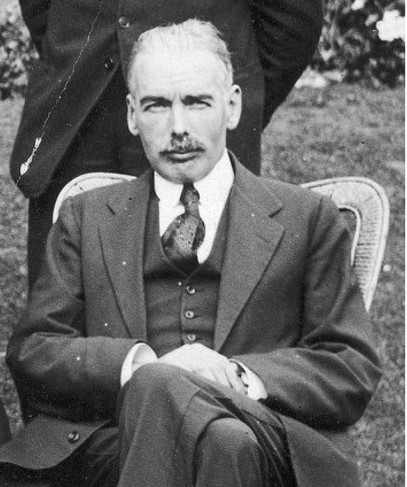
Minister of Home Affairs, Richard Dawson Bates
While the authorities might have argued that Hyndman already had TB when he was interned, they had no such excuse in relation to men who contracted the disease after being interned.
In early 1923, William Murray from Ballymacarrett was found to have severely swollen neck glands; initially, a diagnosis of adenitis was made, an illness that results from the body trying to fight off a virus or bacteria. He was transferred for an operation to the military hospital in Victoria Barracks in Belfast, but the army doctor reported that “Murray has had many tubercular glands dissected out of the side of his neck, but his neck is riddled with glands and he is quite unfit for treatment in an ordinary hospital. I strongly recommend his transfer to a sanatorium or some special tuberculosis hospital … His recovery will take at least a year.”5
Murray appeared before the Advisory Committee in November, which recommended his release, but the Ministry of Home Affairs and the RUC were unable to reach agreement on the conditions of his release.
Meanwhile, in January 1924, the Medical Officer of Derry Gaol, to which Murray had been transferred, reported that “His glands have increased in number, become much larger, so that he has difficulty in masticating his food.” Murray begged to be sent back to the Argenta, where he could at least exercise in fresh air on the deck: “My disease requires being in the open air all the time if possible … My disease does not do with being locked up in a cell 20 hours out of the 24 and no appetite for food.”6
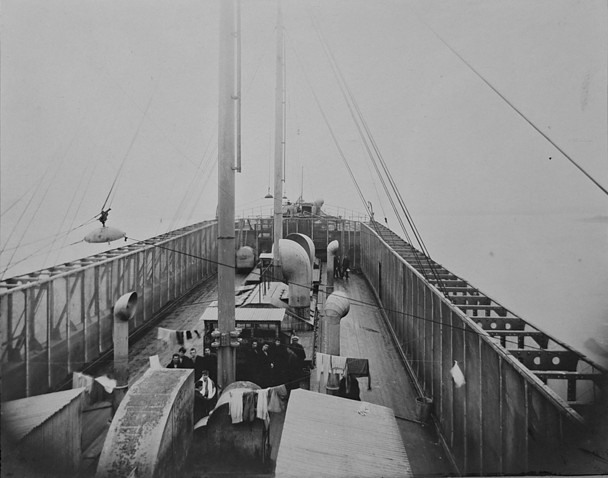
Internees on the deck of the Argenta, the only place they could exercise (© PRONI HA/32/6/5; reproduced by kind permission of the Deputy Keeper of Records, PRONI)
Instead, he was transferred to Crumlin Road Gaol, whose Medical Officer reported, “Owing to the extensive involvement at present, operation interference is not advisable.” As the swelling had now extended up Murray’s cheek as far as his ear, the doctor recommended his release on medical grounds. Murray was released on 7 February 1924, almost a year after the operation in the military hospital.7
Other prisoners who were diagnosed with TB, such as Hugh Corvin, from off the Springfield Road, and John O’Donnell, from the Marrowbone, were transferred to Larne Internment Camp, placed in single rooms to isolate them from all other internees and given separate utensils to use.8
O’Donnell was diagnosed as having pulmonary TB on 31 July 1923 and transferred from the Argenta to Larne just under two weeks later; by the end of August, the camp’s Medical Officer advised that “the question of his release ought to be considered as internment is prejudicial to his health.”9
Although civil servants were beginning to fear the consequences if O’Donnell died in custody, they insisted that he first go through the formality of an appearance before the Advisory Committee. He did so on 27 September and was released later the same day. By then, the authorities were so keen to be free of any liability for his medical condition that the question of sureties for bail was left to be resolved after his release.
The following March, O’Donnell’s union, the Irish Transport & General Workers Union (ITGWU), wrote to Bates, pointing out that due to the TB he had contracted while interned, O’Donnell was no longer capable of working and so ought to be paid compensation. The Ministry of Home Affairs blithely dismissed the union’s argument: “The conditions of life of the internees on the ‘Argenta’ have been found by experience to be conducive to health and there is no proof that the disease from which O’Donnell is suffering was attributable to those conditions.”10
However, the authorities did appear to harbour some degree of guilt: after a subsequent appeal by O’Donnell’s wife, the ministry quietly provided him with a letter of referral for treatment in Whiteabbey Sanatorium.11
O’Donnell died in June 1925. His widow applied for a dependent’s allowance under the southern Army Pensions Act, 1932: his death was accepted by the Army Pensions Board as having been “attributable to service” and she was granted an allowance of £67/10/- per year, with a further allowance of £18 per year payable to her daughter.12
At the end of August 1923, William O’Hara from the Lower Falls had an attack of haemoptysis – he began coughing up blood from his lungs. The Medical Officer on the Argenta wanted him brought to hospital immediately but there was no way of lowering him in a stretcher from the ship to a smaller vessel to bring him to shore; even if there was, the ministry’s Chief Medical Officer felt it would be dangerous to move him so soon.13
A week later, he was transferred to the prison hospital in Crumlin Road, where he was diagnosed with “intensive pulmonary tuberculosis;” he had several recurrences of haemoptysis and the view of the medical staff was that “A sudden severe haemoptysis resulting in death is a possible contingency.”14
O’Hara was released on medical grounds on 21 September, less than a month after his initial haemoptysis and without even having to appear before the Advisory Committee at the same sitting that recommended O’Donnell’s release – this was indicative of how quickly the Ministry of Home Affairs wanted O’Hara off their hands. He died from TB a day short of two years later. In 1942, the Army Pensions Board accepted that his death had also been “attributable to service” and awarded his mother a £100 gratuity for the loss of her son.15
Hugh Hennon, also from the Lower Falls, was only the third Belfast IRA internee to date whose subsequent death was deemed by the southern pension authorities to have been due to his military service. The family doctor described him as having been completely healthy before his arrest but said that when he was released in February 1924, he was “a complete wreck having developed nephritis [inflammation of the kidneys] and having no medical treatment. It became chronic after his release from prison. I had him admitted to the Royal Victoria Hospital but his case was hopeless.” Hennon died from a combination of fluid retention in his lungs and the kidney illness in September 1924.16
However, claims in respect of other internees who contracted diseases while interned were rejected by the Army Pensions Board.
After Thomas O’Reilly from Carrick Hill died from TB in 1926, his mother applied for a dependent’s allowance; she was told that the legislation then in force relating to people who had not served in the National Army only covered deaths up to mid-July 1925 – in effect, her son had not died quickly enough.17
James Tumelty from the Lower Falls died from influenza and scarlet fever in 1926; his mother was told his diseases were “not attributable to military service.” John Graham from Carrick Hill applied for a disability pension for the TB and bronchitis which he had contracted while interned; he was told his diseases were “not attributable to military service.” So was Charlie Connolly from the Market when he applied in respect of his heart disorder and bronchitis. John Magee from the Lower Falls got an identical rejection when he claimed for heart disorder and nervous debility.18
Mental health
As well as impacts on their physical health, internment could also affect prisoners’ mental health.
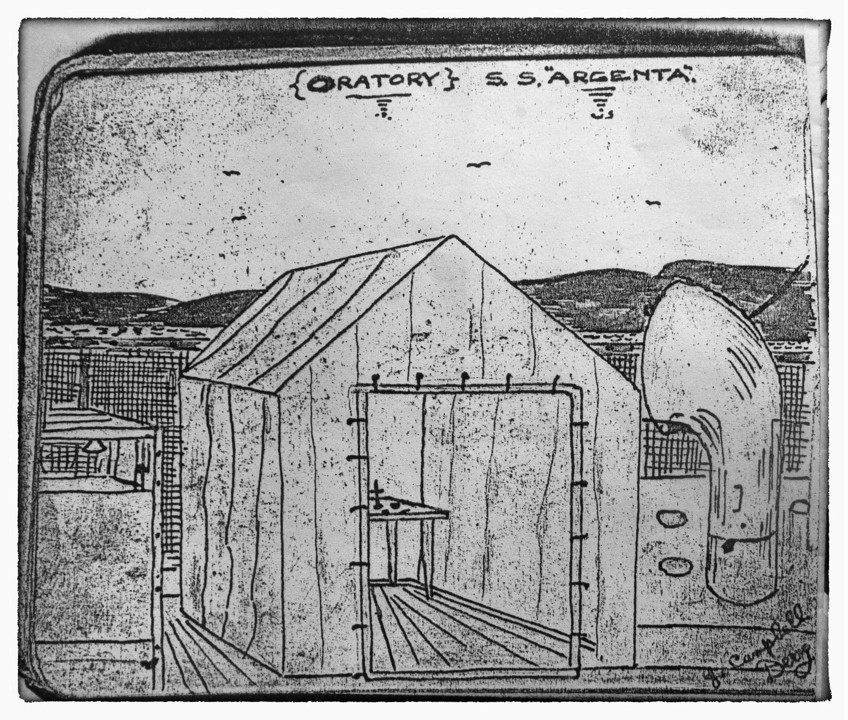
Internees’ oratory on the deck of the Argenta (Argenta Prison Ship group, Facebook)
In January 1923, A.D. Drysdale, Governor of Larne Internment Camp, raised concerns over Peter Ward from Library Street, using a magnificent euphemism: “This internee is reported for having committed a nuisance during the night in a milk can. As his mental condition seems doubtful, would you please state your opinion as to the degree of responsibility in which he can be held for misconduct?”19
Ward said he had suffered from epileptic fits following a fall leading to concussion while serving in the Merchant Navy. He was sent to Crumlin Road Gaol for observation and the medical staff there agreed that his actions in Larne were most likely linked to his epilepsy. He had another fit while exercising in the yard there, but this was not deemed sufficient to warrant his release.20
The wife of John Donnelly from the Lower Falls underwent two operations after he was interned in July 1922; he requested parole to visit her but was told “Parole has not been granted to any internees up to the present, even in cases of deaths. The Minister also hopes that Mrs Donnelly will make favourable progress to recovery.”21
In June 1923, he was transferred from Larne to Crumlin Road Gaol, after the Medical Officer at Larne reported that he was potentially suicidal:
“I have examined this internee and find that he is worried about the state of affairs at his home. He is depressed, despondent and introspective and threatens to harm himself should anything happen to his child who is ill at present. I advise that he be removed from the Camp for observation as he is not only likely to injure himself but to cause unrest among the other internees also.”22
By January 1924, after three appearances at the Advisory Committee had failed to secure his release, he was still concerned over his family and wrote again to Bates: “I have received a letter from my wife a few days ago informing me that she and her four children were going to the workhouse on account of her dire circumstances.”23
Donnelly was finally released on 29 January 1924, given a week to see to his affairs in Belfast, then barred from living in Northern Ireland. However, he emerged from captivity to find his wife was now seriously ill with TB; once more throwing himself on the mercy of the authorities, he begged for the barring order to be substituted with bail payments, and to be let stay in Belfast. Unusually, his request was granted.
Concerns regarding Fred Young’s mental wellbeing were first raised by Drysdale on 11 December 1923: “This internee appears to be in a highly nervous condition and disturbs the other internees at night.” Young was sent for examination in hospital of Crumlin Road Gaol, but Dr O’Flaherty was “unable to detect anything abnormal mentally in him.” Young was not released until May 1924.24
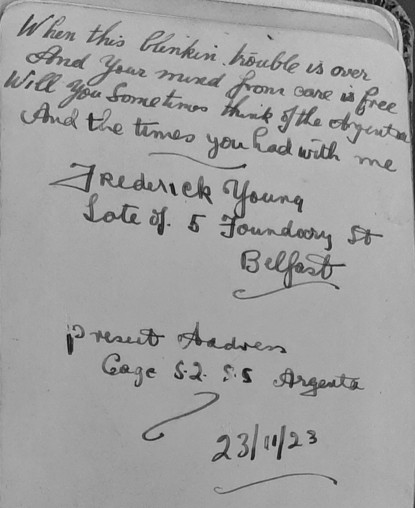
Fred Young’s melancholy contribution to an autograph book (© NLI Ms 50,137 Autograph book – SS Argenta; reproduced courtesy of the National Library of Ireland)
Family poverty
Internment had effects that went beyond the immediate burden on the internees in terms of their loss of freedom. In many cases, their families were suddenly devastated by the total loss of whatever income had been earned by a sole breadwinner: as Robert Graham from Edward Street behind St Anne’s Cathedral put it: “My wife and children are in starvation while I am detained here.”25
When Michael McLaverty from Beechmount was interned, his eight children were left to fend for themselves, as his daughter explained:
“I am his eldest child a girl of twenty years and there are seven others, my mother has been confined to an asylum this last ten years, so I am the only one left to look after them. We had all to depend on our father who was our only support and who was by occupation a waiter.”26
George McCann’s wife wrote to the Ministry of Home Affairs to outline “the serious position in which I am placed”:
“I have five young children to support, one of whom is at present a patient in Graymount Hospital. I am in a delicate state of health myself and may have to go into hospital at any time … it would be impossible to entirely support myself and my children only for the kind assistance of relatives.”27
Shortly after the internment of James Davey from the Lower Falls, his wife pleaded with Bates, “The only thing for my children and myself is the workhouse as I have no other support.”28
John Flanagan’s wife described the crisis facing her family in catastrophic terms:
“My rent man has notice me and summons me out through not able to pay my rent I am starving not even a fire in the house I am in delicate health and attending the doctor I am not able to work for myself to keep me and my three little children so I want you to write back to me if you would be so kind and tell me if my rent man could put me out on the street as I don’t know what to do I want to know if I could get the outdoor relief as I have no money coming in as my husband was my only support.”29
The Ministry of Home Affairs told her to apply to the Belfast Union for outdoor relief. The following April, the authorities on the Argenta intercepted a letter written on Flanagan’s behalf by a fellow-internee, Cahir Healy, asking the guardians of Belfast Union to grant outdoor relief to his wife and children. The letter was suppressed and not sent, although a civil servant gloated, “It is satisfactory to learn from his letter confirmation of our information that the White Cross has ceased to distribute funds.”30
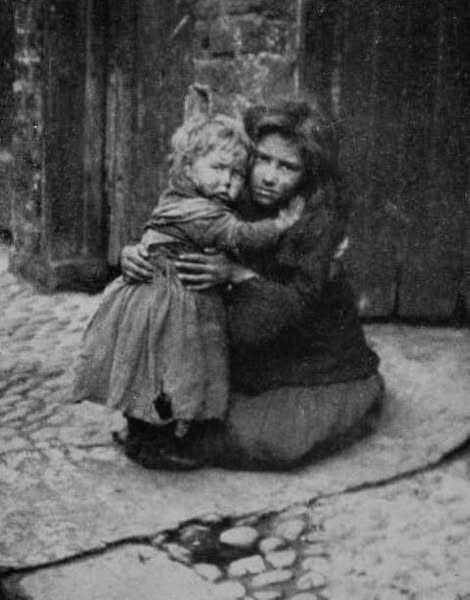
Impoverished children in Belfast (Ireland Old and New, Facebook)
However, the gloating civil servant was mis-informed, as files in the Military Service Pension Collection (MSPC) confirm that the White Cross continued to make payments to republican internees and their families well into the 1920s. John Graham said that he “Received £40 from White Cross which was given for ex-internees.” After the death of her son Hugh in 1924, Josephine Hennon received a £100 grant from them; Bridget O’Reilly got the same amount following the death of her son Thomas in 1926.31
Relationships
With hundreds of men separated from their loved ones, their family relationships came under severe strain.
The question of visits was a constant battleground, largely because the RUC almost had a veto over them being allowed: all requests for visits, whether originating from the internees or their families, had to be made to the Ministry of Home Affairs, who relayed each request to the police for them to recommend whether or not it should go ahead.
Charles Wickham, the RUC’s Inspector General, was hostile to the very idea of internees receiving visits: “All visits are considered objectionable when there is no real need for them.”32
His subordinate, John Gelston, the City Commissioner, not only took his lead from his boss but could be particularly scathing in his denials of requests. When James Gibbons from Ballymacarrett asked for a visit from his mother, Gelston responded, “It would be well for the peace of the city and the locality where he resided that he was always so anxious to seek the counsel of his mother.” However, this was a rare occasion on which Gelston’s objections were over-ruled – the ministry allowed her visit to go ahead. When, in April 1923, the brother and sister of Robert Boyle from Clonard applied to visit him in Larne, Gelston’s assessment was vicious: “If the applicants had taken as deep an interest in his welfare in the past as they seem to do now, he probably might have been a useful citizen, but they did not, nor do I believe they are genuine now.”33
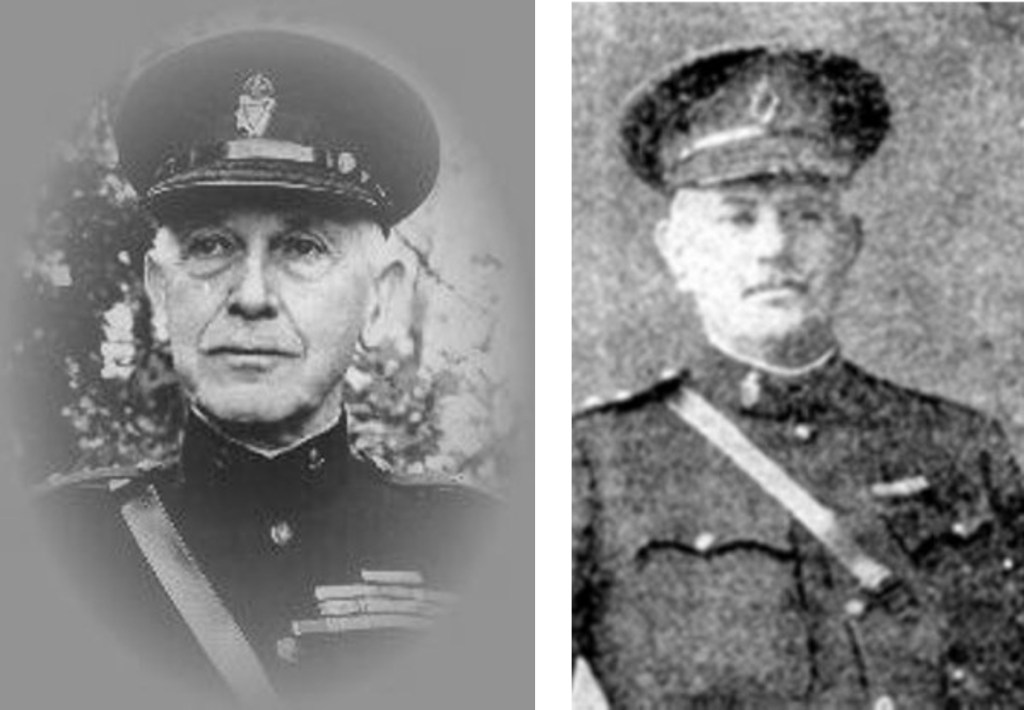
RUC Inspector General Charles Wickham and City Commissioner John Gelston opposed internees being granted visits from loved ones
The experience of the mother of Joseph McDermott from Ballymacarrett was not unusual. He was interned on 30 June 1922 and the police rejected requests from her to be allowed to visit her son in March (twice), April and May 1923; she was only allowed to visit him for the first time in June 1923, a year after he was interned.34
Wedding preparations were abruptly interrupted. Jennie McEvenny was one such bride-to-be, who requested a visit to her fiancé, someone who was previously mentioned in Part 1 of this series:
“I have been engaged to Samuel Largey for the past two years; I was to be married to him in July as arranged. However his arrest and detention at present on S.S. Argenta did prevent our marriage from taking place which has caused me a lot of inconvenience, domestic and otherwise. I had made changes to suit our intentions. These matters are confused and could be straightened out if you would be so kind as to grant me an interview with my fiance.”35
She said his sister would accompany her if the visit was permitted. A police investigation discovered that while the engagement was genuine,
“The application was not written by Miss Mulvenny [sic] but with her knowledge was to be written by Mrs McCotter, a sister of the internee … who seems to be the most interested party … I am of the opinion that the real object of the application is that Mrs McCotter wants to see her brother for some object other than the marriage. The family are disloyal and dangerous and I strongly object to the visit.”36
The visit was not permitted.
One relationship, which may have been an engagement, was brought to an end owing to the internee’s unique background. Charlie Stewart was a Presbyterian from the Shankill, but he was also a member of the IRA. During the Civil War, he was a member of an anti-Treaty IRA flying column operating in east Mayo and south Sligo; after being wounded in May 1923, he returned home to Belfast, but within a couple of months, was captured and the police were finally able to execute the internment order that had been outstanding since August 1922.37
At the start of October, he received an unwelcome letter from an Agnes Blair:
“I would be obliged if your correspondence to me would now cease. I have nothing against you other than that you have placed yourself at the disposal of the Republican Army. Seeing that my mother and father, my sister and myself have been loyal subjects, I think that the best thing for us to do is to remain only friends for the time to come.”38
At the opposite end of the spectrum, at least one wedding went ahead within the confines of Larne Internment Camp, although that was for a very specific reason. In February 1923, the Catholic parish priest in Larne, Fr Daniel Gogarty, who ministered to the spiritual needs of the internees on the Argenta, wrote to the authorities, informing them that one of his “parishioners,” John Magee from the Lower Falls, wished to marry: “The young woman in question is from Belfast and as she is pregnant, it is advisable that the marriage should take place.” He suggested conducting the ceremony “in a room of the workhouse camp in Larne. In that way it could be carried out very quietly, and it would bring peace of mind and heart to all concerned.”39

Larne Workhouse
This was obviously not the first such case, as E.W. Shewell, the Inspector of Prisons, sighed, “This is another case of a ‘marriage of necessity’ which the RC chaplain wishes to take place.” The happy couple were duly married in early March but instead of enjoying a honeymoon, Magee was transferred back to the Argenta.40
Existing marriages could come under pressure.
In July 1923, a nephew of Patrick Barnes from the Lower Falls applied to visit him, but the ministry consulted the police first, as: “He states that he … wishes to see him in connection with … a private family matter the nature of which cannot be disclosed, but it is a matter of the family name being at stake and it is not in any way connected with politics.” Barnes’ brother-in-law appealed to the ministry to forbid the visit: “He states that Robert Barnes is only looking for this visit in order to stir up trouble between Patrick Barnes and his wife, by telling him about her … There is no domestic trouble in the case.”41
The local RUC reported:
“Latterly it has been rumoured that Mrs Barnes has been friendly disposed to another man, but the police are unable to get verification of this rumour. It is assumed this is the family matter referred to in applicant’s letter and it is thought that the real object of the intending visit would be to give the internee all the information in circulation re this matter which would probably cause domestic trouble.”42
The requested visit was not permitted. Barnes’ marriage survived.
Another marriage that appears to have been put under stress was that of James Burns from the Market. His wife had written to him, encouraging him not to go before the Advisory Committee; he evidently replied to her, telling her he was being punished on account of her letter, but she responded “so may be it would be better for me to stop writing altogether. It may be as well for you to write to some one else such as Willie.”43
Enforced separation from family members at Christmas time was difficult for all internees, but it was particularly and poignantly so for John and Patrick Malone from the Springfield Road, who were among several sets of brothers who were interned. By December 1923, John was in Larne Internment Camp, while Patrick was on the Argenta, then moored in Larne Harbour, less than 4 kilometres away. On 21 December, Patrick wrote to the governor of the Argenta, “I beg to make application to be transferred to the internment camp at Larne for Christmas as my brother is at present there and we would both feel very grateful if allowed to be together at Christmas.” He was not told that his request had been rejected until 4 January 1924.44
Bereavements
Separation from families became especially painful for internees when deaths at home intervened.
When John Flanagan’s aunt died in September 1922, he requested parole to attend her funeral, as “You will understand how deeply this affect when I tell you that from the age of six she has been my only parent … I pledge my honour as a God-fearing Catholic and as an Irishman to return within the limit specified.” His request was denied.45
Patrick Kane from Ballymacarrett was interned in September 1922 – at the time of his arrest, he had a newly-born son aged 2 months. In February 1923, the curate of St Matthew’s wrote, “Her child is dying. Her husband is on the Argenta and she is in sore distress. She is very anxious that he would see the child before its death.” A doctor added that “the child has only a faint chance of recovery.”46
The ministry refused to grant Kane parole to visit his son but said that his wife and the child could visit him in Larne; she and her mother visited him on 28 March. By July, when she requested another visit, police reported that the “child was slightly indisposed last week but is quite alright now.”47
Hamilton Young was less fortunate. On 1 April 1924, his wife went to the Ministry of Home Affairs: “She produced a certificate showing that her child had died on this date and asked whether her husband could be released on bail which she states she could obtain.” The following day, Young received a telegram informing him of the news. His wife was told that her husband’s release could not even be considered until after the next visit of the Advisory Committee to Derry Gaol. He was eventually released unconditionally on 15 December that year.48
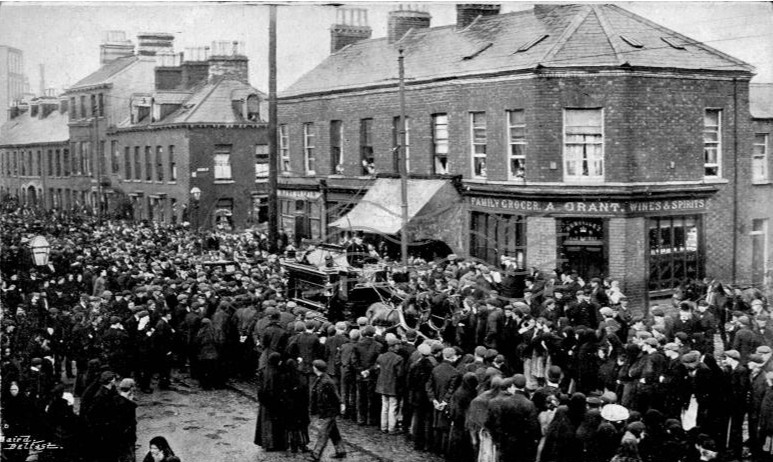
A funeral procession in the Lower Falls (© Linenhall Library Collection)
One particular death outside had serious repercussions in terms of discipline among the internees.
Henry, Charles and John McKee from the Falls Road were three of five brothers who were all suspected of being in the IRA – those three were interned in October 1922. The following April, Charles wrote to Bates, stating their mother was dangerously ill and asking that one of the brothers be released “as a consolation to my mother in her sorrows and suffering.” The family doctor confirmed to the ministry that she was dying, but a file note stated, “Of course parole is out of the question.” McKee was informed of this on 10 April.49
Three days later, the men’s mother died. They were informed by relatives the following day and Charles asked for parole so that at least one of the brothers could attend their mother’s funeral on 16 April. When this was refused, he went on hunger strike on 15 April, and Drysdale reported that “a number of the men are to do the same tomorrow unless one of the McKees is released. Also, that an attempt will be made to fire the Workhouse and damage the property.”50
Henry went on hunger strike on the day of the funeral, 16 April; the following day, all three brothers were transferred to Derry Gaol, and John also went on hunger strike. On 19 April, a general hunger strike began in Larne in protest at the refusal of parole and the transfer of the brothers. However, the internees in Larne ended their hunger strike on 20 April, as did the brothers, and on 23 April, the brothers were transferred back to Larne. Charles was released unconditionally on 3 November 1924, Henry’s unconditional release came three days later and John’s on 12 December.51
Perhaps mindful of the fallout from the McKees’ case, a very different approach was adopted with John McIlduff from the Lower Falls in August 1923. His uncle wrote to him, “Your mother is I am afraid dying. The doctor does not give much hope,” also saying that he had written to Bates, who had replied to say that McIlduff’s release might be obtained through an appearance before the Advisory Committee. The RUC recommended that McIlduff could be released on providing bail and reporting regularly to his local police barracks. He appeared before the Committee on 28 August and was released on 17 September.52
Part 3 of this post will look at at the stories of the Belfast women who were interned and will discuss the hunger strike mounted by internees in October and November 1923.
References
1 William Hyndman to Minister of Home Affairs, 29 November 1922 & Medical Officer, Larne Internment Camp to Governor, Larne Internment Camp, 5 December 1922, PRONI, HA/5/1499 Hyndman, William, Ardilea St.
2 Extracts from Medical Officer’s Journal, Belfast Prison, 10 & 13 January 1923, PRONI, HA/5/1499 Hyndman, William, Ardilea St.
3 Chief Medical Officer to Inspector of Prisons, 15 January 1923, PRONI, HA/5/1499 Hyndman, William, Ardilea St.
4 William Hyndman to Minister of Home Affairs, 17 January 1923, PRONI, HA/5/1499 Hyndman, William, Ardilea St. All letters written by or to internees or politicians are transcribed exactly as they were written, with no corrections made to spelling or punctuation.
5 Medical Officer’s report, 26 March 1923, Public Record Office of Northern Ireland (PRONI), HA/5/1520 Murray, William P., Chemical St.
6 Extract from Medical Officer’s Journal, Londonderry Prison, 14 January 1924 & William Murray to Minister of Home Affairs, n.d., PRONI, HA/5/1520 Murray, William P., Chemical St.
7 Extract from Medical Officer’s Journal, Belfast Prison, 23 January 1924, PRONI, HA/5/1520 Murray, William P., Chemical St.
8 Inspector of Prisons to Minister of Home Affairs, 2 August 1923, PRONI, HA/5/1783 O’Donnell, John, Ardilea St.
9 Medical Officer, Larne Internment Camp to Governor, Larne Internment Camp, 30 August 1923, PRONI, HA/5/1783 O’Donnell, John, Ardilea St.
10 William McMullen, Irish Transport & General Workers Union (ITGWU), to Minister of Home Affairs, 14 March 1924 & Secretary, Ministry of Home Affairs (MHA) to Secretary, ITGWU, 7 April 1924, PRONI, HA/5/1783 O’Donnell, John, Ardilea St.
11 Secretary, Ministry of Home Affairs (MHA), to Brigid O’Donnell, 11 June 1924, PRONI, HA/5/1783 O’Donnell, John, Ardilea St.
12 Army Pensions Board to Bridget O’Donnell, 6 December 1933, Military Archives (MA), Military Service Pensions Collection (MSPC), DP1178 John O’Donnell (W13).
13 Medical Officer, SS Argenta to Governor, SS Argenta, 26 August 1923 & Chief Medical Officer to T.P.B. Townsend, MHA, 29 August 1923, PRONI, HA/5/1880 O’Hara, William, Leeson St.
14 D.M.C. file note [initialled only], 21 September 1923, PRONI, HA/5/1880 O’Hara, William, Leeson St.
15 Inspector of Prisons to Chief Medical Officer, 22 September 1923, PRONI, HA/5/1880 O’Hara, William, Leeson St; Army Pensions Board to Kate Smith, 1 September 1942, MA, MSPC, DP5733 William O’Hara.
16 Statement of Dr M. Bradley, 10 March 1933, MA, MSPC, DP4364 Hugh Hennon. The contents of Hugh Hennon’s internment file in PRONI are missing.
17 Army Pensions Board to Bridget O’Reilly, 31 May 1928, MA, MSPC, DP2852 Thomas O’Reilly.
18 Department of Defence to Annie Tumelty, 17 July 1935, MA, MSPC, DP6561 James Joseph Tumelty; Army Pensions Board to John Graham, 5 April 1929, MA, MSPC DP1822 John Graham (Graham died from TB in 1935 – when his widow lodged a claim for a dependent’s allowance after his death, it was granted as, this time, his disease was “attributable to service”); Department of Defence to Charles Connolly, 10 December 1937, MA, MSPC, DP108 Charles Connolly; Department of Defence to John Magee, 19 August 1936, MA, MSPC, DP5932 John Magee.
19 Governor, Larne Internment Camp to Medical Officer, Larne Internment Camp, 4 January 1923, PRONI, HA/5/1784 Ward, Peter, Library St.
20 Chief Medical Officer to Inspector of Prisons, 13 January 1923 & Extract from Medical Officer’s Journal, Belfast Prison, 22 January 1923, PRONI, HA/5/1784 Ward, Peter, Library St.
21 Inspector of Prisons to Governor, Larne Internment Camp, 6 October 1922, PRONI, HA/5/1923 Donnelly, John, Albert St.
22 T.P.B. Townsend (MHA) to Governor, Belfast Prison, 2 June 1923, PRONI, HA/5/1923 Donnelly, John, Albert St.
23 John Donnelly to Minister of Home Affairs, 10 January 1924, PRONI, HA/5/1923 Donnelly, John, Albert St.
24 A.D. Drysdale file note, 11 December 1923 & Extract from Medical Officer’s Journal, Belfast Prison, 18 December 1923, PRONI, HA/5/1517 Young, Frederick, Foundry St.
25 Robert Graham to Minister of Home Affairs, 9 January 1923, PRONI, HA/5/2089 Graham, Robert, Edward Street.
26 Susan McLaverty to Henry Toppin (MHA), 22 August 1922, PRONI, HA/5/2067 McLaverty, Michael, Clowney Street.
27 Mary McCann to Henry Toppin (MHA), 4 June 1923, PRONI, HA/5/957F McCann, George, McMillen’s Place.
28 Mrs Davey to Minister of Home Affairs, 22 August 1922, PRONI, HA/5/1878, Davey, James, Baker St.
29 Mary Flanagan to Minister of Home Affairs, n.d., PRONI, HA/5/1976 Flanagan, John, Kilmood St.
30 John Flanagan to Clerk, Belfast Union, 12 April 1923 & Henry Toppin (MHA) file note, 14 April 1923, PRONI, HA/5/1976 Flanagan, John, Kilmood St.
31 John Graham application form, 21 April 1928, MA, MSPC, DP1822 John Graham; Josephine Hennon application form, 11 March 1933, MA, MSPC, DP4364 Hugh Hennon; Bridget O’Reilly application form, 12 April 1928, MA, MSPC, DP2852 Thomas O’Reilly.
32 Inspector General to Secretary, MHA, 25 April 1923, PRONI, HA/5/1504 Graham, John, Upper Library St.
33 City Commissioner to Inspector General, 5 May 1923, PRONI, HA/5/1518 Gibbons, James, Seaforde St; City Commissioner to Inspector General, 27 April 1923, PRONI, HA/5/2162 Boyle, Robert, Waterford St.
34 PRONI, HA/5/1519 McDermott, Joseph, Anderson St.
35 Jennie McEvenny to Minister for Home Affairs, 15 November 1922, PRONI, HA/5/1508 Largey, Samuel, California St.
36 City Commissioner to Inspector General, 17 November 1922, PRONI, HA/5/1508 Largey, Samuel, California St.
37 MA, MSPC, MSP34REF10918 Charles McCaull Stewart.
38 Intercepted letter from Agnes Blair to Charles Stewart, 1 October 1923, PRONI, HA/5/2104 Stewart, Charles, Canmore St.
39 Fr Daniel Gogarty to MHA, 17 February 1923, PRONI, HA/5/2177 Magee, John, Osman St.
40 Inspector of Prisons to Secretary, MHA, 17 February 1923, PRONI, HA/5/2177 Magee, John, Osman St.
41 T.P.B. Townsend (MHA) to Inspector General, 1 August 1923 & Minute sheet, n.d., PRONI, HA/5/2181 Barnes, Patrick, Cullingtree Rd.
42 District Inspector R.R. Heggart to Inspector General, 4 August 1923, PRONI, HA/5/2181 Barnes, Patrick, Cullingtree Rd.
43 Intercepted letter from Lizzie Burns to James Burns, 23 May 1924, PRONI HA/5/1985 Burns, James, Raphael St.
44 Patrick Malone to Governor, SS Argenta, 21 December 1923, PRONI, HA/5/629 Internment of John and Patrick Malone, Springfield Rd. Although the Malones were not allowed to spend Christmas 1923 together, they were unique among the sets of brothers interned in that they shared a single internment file.
45 John Flanagan to Secretary, MHA, 17 September 1922, PRONI, HA/5/1976 Flanagan, John, Kilmood St.
46 Fr P.J McAuley [no addressee], 28 February 1923, & Dr F. McSorley [no addressee], 26 February 1923, PRONI, HA/5/961U Internment of Patrick Kane, Vulcan St.
47 City Commissioner to Inspector General, 18 July 1923, PRONI, HA/5/961U Internment of Patrick Kane, Vulcan St.
48 Inspector of Prisons to Inspector General, 1 April 1924 & Inspector of Prisons to Mrs Young, 5 April 1924, PRONI, HA/5/2171 Young, Hamilton, Saul St.
49 Charles McKee to Minister of Home Affairs, 3 April 1923, & A.P. Magill (MHA) file note, 9 April 1923, PRONI, HA/5/2213 McKee, Charles, Falls Rd.
50 Governor, Larne Internment Camp, to Secretary, MHA, 15 April 1923, PRONI, HA/5/2213 McKee, Charles, Falls Rd.
51 T.P.B. Townsend (MHA) file note, n.d., PRONI, HA/5/2213 McKee, Charles, Falls Rd.
52 Bernard McIlduff to John McIlduff, n.d. PRONI, HA/5/2198 McIlduff, John, Scotch St.


Leave a Reply