Estimated reading time: 20 minutes
In some police documents and newspaper reports, the surname McGuinne was spelled M’Guinne or Maguinne, following the spelling conventions of the time; here, these have been corrected to McGuinne, the version used by the men concerned.
The bait is dangled
Near the end of November 1921, a British soldier with an Irish name, Trumpeter Joseph Slattery of the Royal Artillery Mounted Rifles (RAMR), went for a drink in a Belfast city centre pub owned by a well-known nationalist family:
“On Friday the 25th of November 1921, I was in McEntee’s public house, King Street, Belfast and there met a man named Harper … he approached me that evening and asked me if I could get him any revolvers or ammunition. There was a third party present. Harper said if I brought any revolvers or ammunition, I could put them over the bar and they would be safe, that there was a certain price given for revolvers and ammunition. The third man said in Harper’s presence that it would be quite alright. He asked me to meet him the following evening.”1
Two or three further meetings between the soldier and Harper took place, the last of them on Friday 16 December at a house in Scotland Street, around the corner from McEntee’s pub. On this occasion, they were joined by Leo McGuinne and George Hamill, both members of the IRA – Slattery was asked to get rifles rather than revolvers and said he could do so for the price of £20.2
The RAMR were billeted at the Balmoral Showgrounds, off the Malone Road in south Belfast, in what was – and still is – one of the most genteel suburbs of the city. The men arranged to meet at Balmoral at 9pm the following evening, Saturday 17 December, when Slattery would hand over the weapons and ammunition.
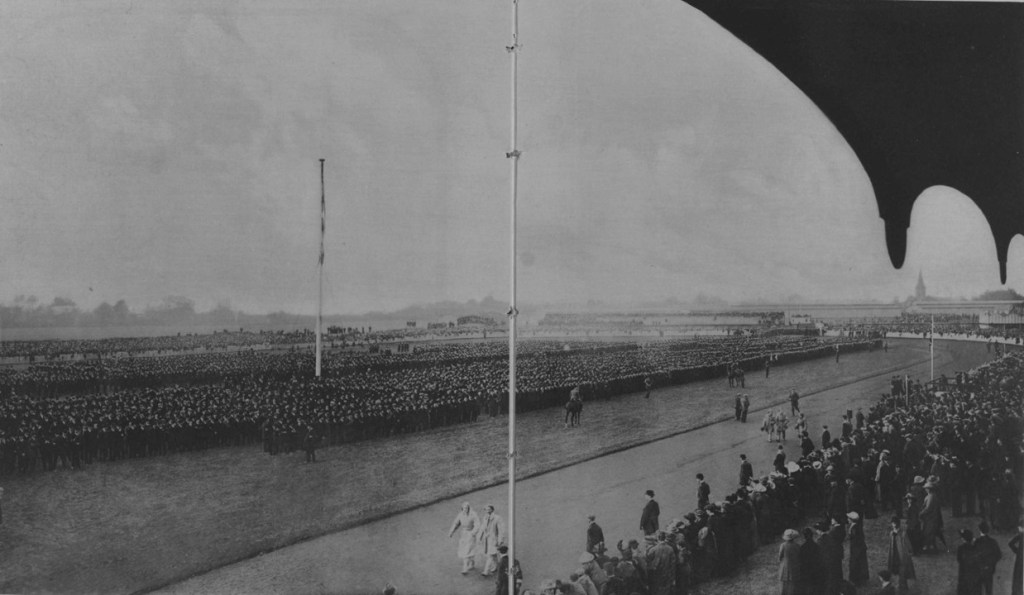
In September 1913, the Balmoral Showgrounds were used to stage a review of the Ulster Volunteer Force by Edward Carson (Illustrated London News, 4 October 1913)
On his return to the camp that night, Slattery informed his commanding officer of the plan. Later challenged as to why he did not report it sooner, he said:
“I reported it when I thought the time was ripe … when the final arrangements were made to raid the camp on the night of the 17th … if I had reported it earlier, they might have sent someone else who would be tempted to sell the rifles or arms.”3
The trap is discovered
However, the IRA already knew that the British military were planning to ensnare the IRA party. The Intelligence Officer of the Belfast Brigade, David McGuinness, had agents in the General Post Office who could listen in on phone calls between the various British Army barracks in the city; he recalled:
“This was a telephone conversation held between the officer who was acting as Duty Officer that night at Victoria Barracks and his corresponding number in the War Hospital which unfolded with gusto the story of a plan to trap the ‘Shinners,’ as they were referred to, at Balmoral. The trap was to be laid on the following Saturday when it was expected to capture the most effective and dangerous IRA men operating Belfast.
I got this information late on Thursday night and related it first thing on Friday morning to my superior officers. This was conveyed immediately to the officer who was working on the supposed handing over of arms which my information concerned.”4
McGuinness’ and Slattery’s statements are at odds on one point: the soldier said he first reported the plan to his superior on the Friday night, but McGuinness said the British were already aware of the plan the night before. Both statements cannot be true. The most likely explanation of the apparent contradiction is that McGuinness’ statement was given to the Bureau of Military History in 1950, so his recollection of the days of the week involved may have been faulty.
Either way, the British Army knew that the IRA were coming and the IRA knew that the British knew. But adding to the intrigue, the Royal Irish Constabulary (RIC) were aware at the time that there were misgivings among the IRA leadership about the whole venture and that it went ahead “against the expressed wish and instructions of the then governing body of the 3rd Northern Division of the IRA in St Mary’s Hall.”5
In a last desperate effort to prevent the unfolding disaster, an order was sent to the IRA party involved, “requiring the six men to parade for duty at Peel Street, Falls Road, at 8:30pm on Saturday night.”6
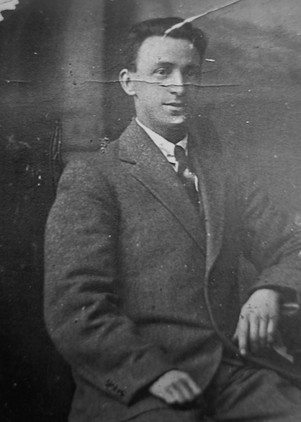
David McGuinness, IRA Intelligence Officer, learned that the British had set a trap for the IRA (photo courtesy Jimmy McDermott)
The order was disregarded. If it had been followed, the men would not have had time to get from the Lower Falls to Balmoral in time for the 9pm rendezvous. That was the moment at which the plan began to unravel completely.
The prey
Six members of the IRA made their way to Balmoral on the Saturday night. Hugh Harper, who had made the initial contact with Trumpeter Slattery in McEntee’s pub, was not among them. In fact, it is doubtful whether Harper was even in the IRA.
A 29-year-old ex-serviceman, who had served in the British Army from November 1915 to January 1919, Harper was not included in the nominal rolls of any company of the IRA in Belfast which were drawn up in the 1930s as part of the Military Service Pensions process. Nor has any Military Service Pensions file been released in respect of him.7
He lived at 10 Omar Street in the Lower Falls – his neighbour across the street, Art McLarnon, who lived at number 11, was a member of D Company of the IRA’s 1st Battalion and it is possible that it was through Harper that McLarnon became involved in the plan. McLarnon was aged 23 and worked as a taxi driver, putting his car at the disposal of the IRA when needed: “he had a taxi which was used for shifting arms, etc and McLarnon always volunteered when any work of this kind turned up.”8
Michael Watters was a member of the same company; he was a 23-year-old coppersmith who lived in Lady Street, also in the Lower Falls. George Hamill was a third member of the same company also aged 23 and also living in the same area, in his case, in Ward Street.9
Joseph and Leo McGuinne lived in a different area, Clonard, and were members of a different unit, B Company. Their involvement seems to have been logistical rather than geographical – their father owned a motor transport business on the Springfield Road, and Joseph, the eldest son, worked in the business with him; he had previously transported arms and ammunition from Belfast to Antrim and to Newry. Although his younger brother Leo had been a marine engineer, he also had a driving licence, so may have been the back-up driver – “he often assisted as the driver of his brother’s motor truck when it was engaged by us.”10
Joseph McGuinne later stated that he “went to Balmoral under orders from Lt James Tumelty.” This would suggest that Tumelty was the leader of the group. Aged 24, from Ross Street, also in the Lower Falls, he had worked as a joiner in Harland & Wolff but was among the thousands expelled from their jobs during the initial outbreak of the Pogrom.11
However, Joseph McGuinne may have been being somewhat disingenuous in his statement, trying to distance himself from responsibility for what transpired. In March 1921, while remaining a Lieutenant in B Company, he was appointed Battalion Engineer of 1st Battalion, being put in charge of a company of engineers which drew from the various “infantry” companies of the battalion. So at Balmoral, Joseph McGuinne was not only the oldest of the raiders at 27, he was also the most senior IRA officer.12
Illustrating the varied backgrounds of the Belfast IRA at the time, Harper was not the only ex-serviceman among the group: Hamill had also volunteered to join the British Army, serving as a member of the 4th Battalion, Royal Irish Fusiliers, from 9 February 1915 to 8 August 1919. On the other hand, McLarnon was a veteran of the Irish Volunteers, having been among the contingent from Belfast who mobilised at Coalisland for the Easter Rising in 1916. Adding another element to the mix, the McGuinnes’ father was a former member of the RIC.13
The trap is sprung
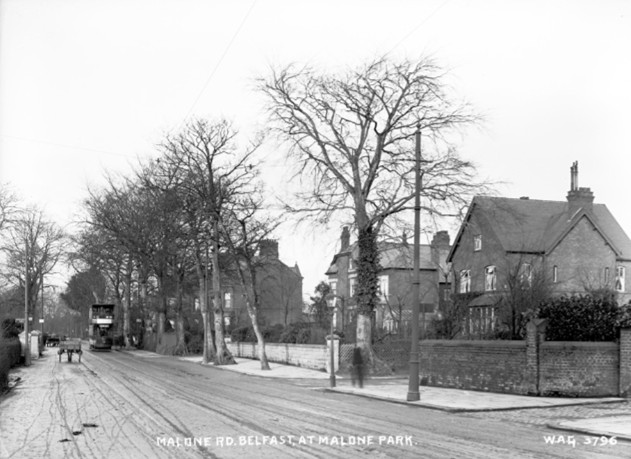
The IRA travelled to the Balmoral military camp via the Malone Road (© National Museums of Northern Ireland
According to a newspaper report, shortly before 9pm on Saturday 17 December,
“[The] motor delivery van containing the republicans arrived at the back of the ground, at a point on Balmoral Avenue where the showground fence is separated from the roadway by a field. It had come by the Malone Road and appeared to the ordinary passerby a van out delivering household weekend grocery orders.”14
Captain Orr Ewing of the RAMR later told a court that he had placed soldiers at three locations around the perimeter of the camp; he joined one of the outposts at 8:30pm:
“There is a corrugated fence at that particular portion of the grounds and I saw a ladder being pushed over that fence from the inside and it was placed in position on the outside. I watched it for a while and noticed a party of about four men come from the direction of Balmoral Avenue about 9 o’clock. I saw one man go up the ladder and into the grounds. I saw him come out the same way. I saw a figure go up the ladder again and go into the showgrounds. A second man went about half way up the ladder and stood there. I heard a shot fired from the direction of Balmoral Avenue and then there was a shot fired from the ladder.”15
When the shooting began, the four men around the ladder ran off, two running across open ground towards Balmoral Avenue, pursued by Ewing and his men:
“I called on them to ‘Halt and put them up.’ They continued to run. I rushed out with my party and again called on them to halt. My party fired on them. When they got to the first hedge, one of the two halted then turned round and afterwards ran again. I went in the direction of where I had seen the men and found two men lying on the ground.”16
Hamill and McLarnon were captured here, Hamill having been wounded in the leg, McLarnon in the head and chest.
Lieutenant Arthur Richardson was in a second position with more troops, who set off after the man who had fired from the ladder. As one newspaper excitedly described it, “a bayonet charge went after him in hot pursuit. He disappeared but in a few minutes a party of troops searching the hedges with their bayonets heard a squeal.” Richardson’s account was more mundane:17
“I went along a sunken ditch. I heard a noise in the ditch. I took it to be made by somebody moving along towards me. I said, ‘Hands up.’ An answer was made like ‘All right I have got them up.’ I found a man there. He was James Tumelty.”18
Major John Wallace was commanding troops at Gate D of the camp which led to Balmoral Avenue when he heard a shot:
“I got into Balmoral Avenue and proceeded with my party towards the Malone Road. I saw a motor car … coming towards me and I ordered it to halt. It increased speed. The car was fired at and it halted as it reached me. I saw three men get out … I ordered them to get out and saw that two of the three were wounded. I left them under military escort.”19
Those three prisoners were the McGuinne brothers and Watters. Leo McGuinne was very seriously wounded, “one bullet passing through his leg at the knee, another entered his body near the shoulder and emerged in the armpit, and still another in the right arm fractured the bone.” His older brother had also been hit in the leg and arm, while Watters was the only one of the raiders who was left unwounded.20
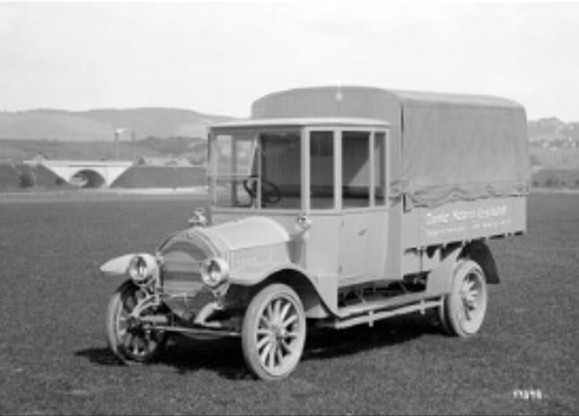
A Daimler delivery lorry, similar to the one driven by Joseph McGuinne
In the lorry, troops found a 6” Webley revolver on the driver’s seat and an automatic revolver on the floor behind the front seat. In a follow-up search of the area in daylight the next morning, Captain Ewing found a 4” Webley revolver, recently fired, and a 6” Smith & Weston revolver near where the ladder had been standing.
District Inspector (DI) Francis Lewis of the RIC barracks in Donegall Pass was called to Balmoral with a party of policemen. They took custody of Tumelty and Watters, who they brought to the central police station in Chichester Street – the others were taken for medical treatment in the military hospital at Victoria Barracks in north Belfast.
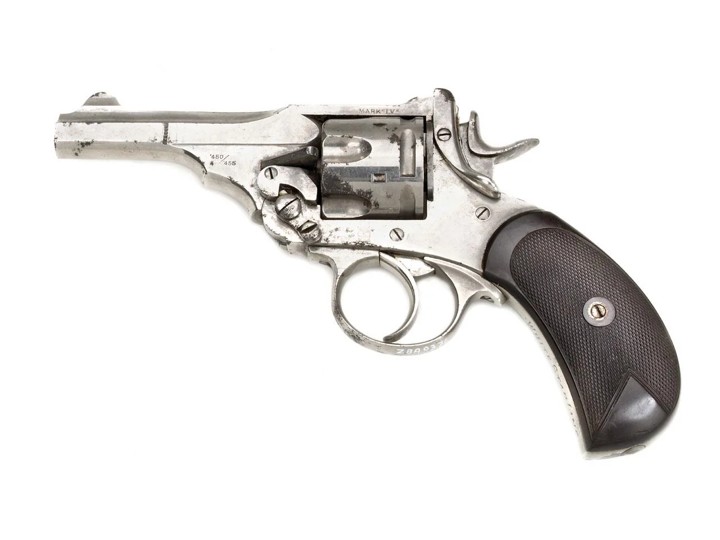
A Webley 4” Mark IV revolver
At this point, none of the troops or police were aware that Tumelty had been bayonetted: “It was only on Sunday afternoon that it was discovered that Tumelty had been wounded. Apparently, not being able bear the pain any longer, he asked for assistance and a doctor was called, who bandaged his knee.”21
The military handed over £22 0s 5d to DI Lewis, evidently the £20 that had been intended to pay Trumpeter Slattery and whatever small change of their own the men had on them. The military also gave DI Lewis the captured weapons, small quantities of ammunition and a Daimler lorry, registration IK 1729 – Joseph McGuinne had a licence on him for this.22
It appears that the men were formally charged as they were released from medical care. DI Lewis charged Watters and Tumelty on 20 December, both replied, “I have nothing to say;” he charged Hamill and McLarnon on 21 December, both replied, “I say he enticed me to do it.” He charged Joseph McGuinne on 9 January 1922, who said, “I’ll not be recognising the court and there is no use in making any statement.” He finally charged Leo McGuinne on 24 January – he replied, “I’ll make my statement in court and ask a few questions.” In the meantime, he also caught up with Hugh Harper on 3 January, who also had “nothing to say” when he was arrested.23
The trial
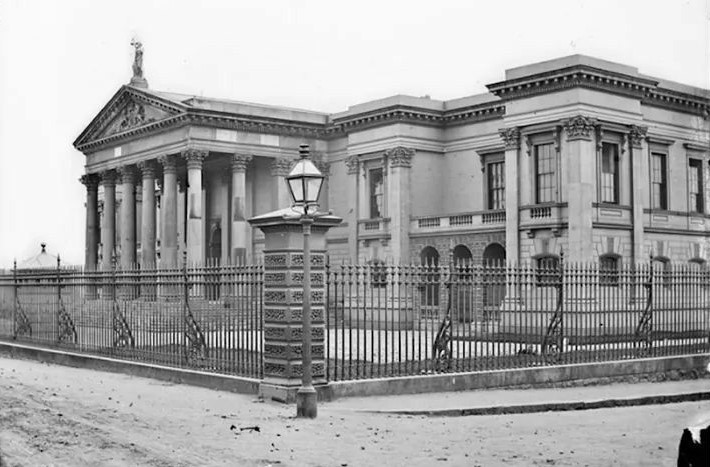
Crumlin Road courthouse (© National Museums of Northern Ireland)
The trial of the seven men was due to begin on 15 February but was delayed after the prosecution objected to some of the jurors. The following day, the men appeared before the Lord Chief Justice, Denis Henry, charged with two colourfully archaic offences: firstly, that they “did endeavour to seduce a soldier serving in His Majesty’s forces from his duty to His Majesty” and secondly, that they “did incite him to commit a traitorous act, to wit the larceny of a number of rifles the property of the Secretary of War.” The men refused to recognise the court and were not legally represented.24
The various military witnesses provided their evidence and although the prisoners had cross-examined them rather half-heartedly and ineffectually when their original depositions were made at the end of January, they did not do so in court.
However, Leo McGuinne did attempt to present a defence: a friend, Mary Lynch, said they had left her house between 6:30pm and 7:30pm on the night before the raid to go to a dance in Royal Avenue, where they stayed until 10:30pm. His father and two other witnesses gave evidence corroborating her testimony. McGuinne then told the jury that Trumpeter Slattery had stated that he (McGuinne) was in the house in Scotland Street that night, but that he had just shown that this was not the case; he now wanted the soldier to be charged with perjury.25
As regards the night of the raid, he lamely claimed that “he was with his brother, whose licence was overdue and as his (Leo McGuinne’s) license still held good, he accompanied his brother in the car but was not aware of its destination.”26
The jury was not convinced by his flimsy arguments. All seven men were found guilty on the first charge and while Harper was acquitted on the second charge, the others were found guilty.
They returned for sentencing on 27 February. “When asked if they had anything say why sentence should not be passed, they replied in chorus: ‘We do not recognise the court’ and one of them declared: ‘It’s all a farce.’”27
Joseph McGuinne made a brief speech from the dock, claiming that at the initial hearing on 15 February, the trial was postponed because they did not recognise the court. “He alleged that that was not the real reason for the postponement of the trial and that when they again appeared a ‘suitable’ jury had been obtained. He further alleged that the summing up of the judge was more like the speech of prosecuting counsel than the impartial statement of a judge.”28
Each of the men was sentenced to six months in jail. “As the prisoners left the dock they shouted, ‘Up Dublin.’”29
The sequel
Leo McGuinne did not serve out his sentence. On 3 March, he was released on parole to have an operation on his wounds, although there were different versions of who arranged for his hospital visit. By his own account, the operation was “performed on my arm and leg by orders of General Michael Collins,” but according to Eoin O’Duffy, for whom he had been a driver in Belfast during the Truce, “After some months he was released under the Cat and Mouse Act. I had him sent to the Mater Hospital Dublin, where he underwent many operations under Surgeon McAuley.” After three weeks’ recuperation, McGuinne joined the National Army in Dublin.30
As regards the others, with varying amounts of remission for good behaviour, all were due to be released on various dates in August 1922. However, on 10 July, DI R.R. Heggart of the Royal Ulster Constabulary (RUC) Detective Branch submitted a request that the Balmoral prisoners still in custody be interned when their sentences expired; as a result, internment orders were served on all six men.31
The authorities also wanted to intern Leo McGuinne but were unsure whether he was well enough to be interned: “Is anything known of the condition of his health and whether it would permit of his being interned, or is it so bad as to make it unlikely that he could engage in crime?”32
The RUC were not even sure where he was or when he had left Belfast: “I am reliably informed that Leo McGuinne left here about the last days of June for Dublin to go to some of the seaside resorts to recuperate.” In fact, with the Civil War in full flow in the south, far from enjoying the sea breezes, McGuinne was now the Barrack Adjutant in Portobello Barracks in Dublin.33
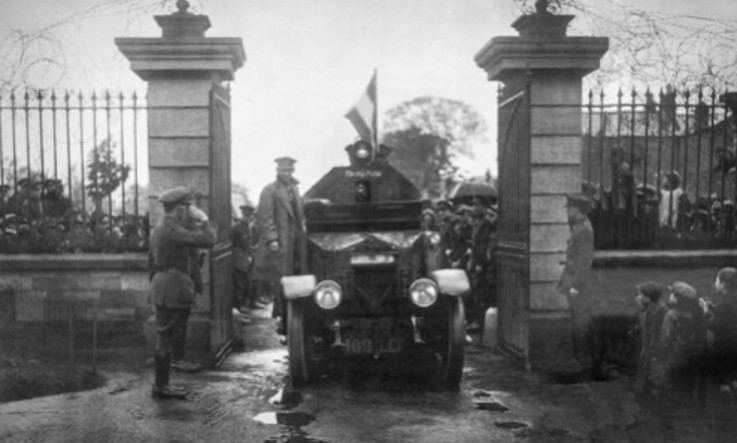
Portobello Barracks was handed over to the National Army on 17 May 1922. Far from taking the sea air to recuperate from his wounds, Leo McGuinne became the Barrack Adjutant
This was not the only fact related to Balmoral about which RUC intelligence was flawed. John Gelston, its City Commissioner for Belfast, claimed that “I received information at the time that this plot was organised by men opposed to the Treaty.” But when Harper first approached Trumpeter Slattery on 25 November 1921, the Treaty negotiations were still in progress and while the Treaty had been signed by the time the raid took place on 17 December, it had not yet been voted on by the Dáil.34
Even more ludicrously, Gelston claimed that Hamill had been a member of the anti-Treaty IRA before the IRA had even split: “Very reliable information in possession of the police [showed that he] was a member of the Irregular republican forces and organised with other Irregulars the raid for arms at Balmoral and for which he was convicted.”35
While the RUC knew that the IRA leadership had tried to get the raid called off, Gelston was also mistaken in his understanding of why it had gone ahead: “Searches of their houses afterwards revealed correspondence that clearly showed that these men were dangerous IRA men and opposed the liaison work that was then being carried on by the IRA Officer in St Mary’s Hall.”36
The one thing that the authorities got right was that, perhaps because Joseph McGuinne had been the only defendant to make a speech from the dock at the trial, he was believed to have been in charge at Balmoral: “This raid was carried out on instructions from Joseph McGuinne.”37
The internees had varying experiences of incarceration.
Tumelty remained a militant opponent of the northern government. He was noted as being a “Leader in hunger strike on SS Argenta” and he spent seventeen days on that hunger strike. He never applied to appear before the Ministry of Home Affairs’ Advisory Committee, which heard internees’ appeals for release, and was eventually released unconditionally on 12 November 1924.38
Harper adopted an approach that was the polar opposite. He went before the Advisory Committee as early as October 1922, still maintaining that he had been set up by Trumpeter Slattery:
“I am not and never was a Sinn Feiner. I got mixed up in it in a public house. I was approached by a soldier of Artillery who asked if I knew anyone who would buy ammunition. I said ‘No,’ but I introduced him to another man and my name was to be used for a parcel of ammunition. I knew the ammunition was for the IRA.”39
At Christmas 1922, he asked for three days’ parole, pleading, “I have spent four of these seasons in France and Belgium and I would like to get spending this one with my wife and child.”40

Larne Internment Camp: Hugh Harper wrote to the governor, offering to become an informer
When these requests for release were rejected, he offered to become an informer, attempting to bargain with the governor of Larne Internment Camp: “I am in a position to put what I consider very valuable information before the Minister of Home Affairs concerning two recent hold-ups in Belfast but before disclosing same I would like to know in what way the authorities are prepared to meet me.” The authorities were naturally interested and suggested transferring him to Crumlin Road prison where he could make a statement, although with no promise of release, but he was afraid of the potential reaction of other internees and withdrew his offer just over a week later.41
In the meantime in early January, underscoring his distance from the republican movement, his wife – using her workplace rather than her home as a correspondence address – drummed up letters of support advocating his release from three Justices of the Peace living along the Falls Road, Arthur Hopkins, John M. Heggarty and James Macklin; she said he would be willing the leave the north for two years if released. Harper was released on this condition the following September.42
Watters’ internment was far less eventful. He had a couple of visits from his wife, before being released in February 1924 on the same basis as Harper.43
McLarnon’s period in detention was almost identically quiet. His mother was allowed visit him twice, he declined to appear before the Advisory Committee and was finally released on his own £10 bond to keep the peace in April 1924.44
Hamill’s route to freedom was probably the most roundabout, novel and audacious. He added to the authorities’ confusion regarding Balmoral by telling the Advisory Committee, “I got the orders to go to the raid from McKelvey who was executed.” He had contracted tuberculosis while serving in the British Army in Palestine during the Great War; after being transferred from Larne Internment Camp to Derry Gaol as a punishment for misbehaviour, his illness flared up and he requested to be sent back to the Argenta for the good of his health – this was rejected.45
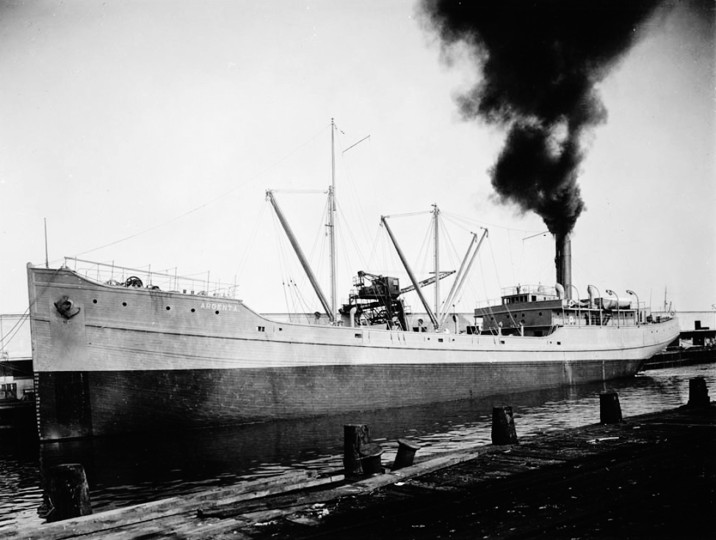
The SS Argenta: George Hamill was probably one of the few internees to request a transfer back to the ship for the sake of his health
In the summer of 1923, Hamill came up with a new plan: he asked to be allowed to book a ticket to go to the United States, with a commitment to stay out of Northern Ireland for two years. The authorities accepted the proposal, but he then realised that having tuberculosis would bar him from entering the USA, so he offered to go to Canada instead. Eventually, his ticket to Montreal was secured, so he was released on 27 September and left Belfast on 11 October on a ship that was stopping first in England. In Liverpool, he simply jumped ship and made his way to Dublin. From there, with breathtaking cheek, he wrote to Richard Dawson Bates, the Minister of Home Affairs, asking permission to visit his mother in Belfast and “wishing you and members of your government a Happy Xmas and a bright and peaceful New Year.” Unsurprisingly, Hamill’s request was rejected. The ministry did not reciprocate his season’s greetings.46
Joseph McGuinne probably suffered from being identified by the northern authorities as being the ringleader of the Balmoral raiders – it was September 1923 before he was even allowed a visit, from his sister who was home from the USA; the following month, his parents were finally allowed visit him as well. He made one appearance before the Advisory Committee in November 1922, asking to be released on condition he leave the north for two years; he remained interned.47
In mid-July 1924, his father wrote to him:
“Things in the boundary line are proceeding apace slowly but all the same making for the final. The end will be in view in wind up of July, and [God willing] with it the release of you and your tried comrades accompanied by the satisfaction that you have been constant to our ideals as the magnet to the pole.”48
His father’s prediction proved perceptive – McGuinne was released unconditionally two weeks later.
Military Service Pensions files have been released in respect of five of the six IRA men captured on the night of the raid, Watters being the exception. The files show that, as with their periods of internment, the men fared very differently afterwards.
Tumelty died only eighteen months after being released. The cause of death was a combination of influenza and scarlatina (scarlet fever), which his mother claimed was due to his imprisonment. However, the Department of Defence told her that “The death of your son, James, was due to disease not attributable to service.”49
Hamill had more success with the pension authorities. After his request to visit his mother at Christmas 1923 was turned down, he was granted permission to visit her for two weeks in July 1924 and he evidently remained in Belfast undetected as it was from her address in Cairns Street in the Lower Falls that he applied for a Military Service Pension in February 1925. Although this application was rejected, he applied again in the 1930s and was granted a service pension of £25 a year; he had previously received a £30 gratuity for the head wound he had sustained at Balmoral.50
Leo McGuinne was demobilised from the National Army in December 1923. His application under the 1924 Military Service Pensions Act was rejected, most likely on the basis of a scathing “reference” provided by Seán O’Neill, who had been the O/C of the Belfast Brigade at the time of the Balmoral raid:
“[He] was not at any time an enrolled member of the IRA. He was … (willing) to assist but was so irresponsible he could not be considered fit for enrolment … The raid was a trap set by the British military, was called off but the above with others, in spite of orders, proceeded with job which resulted in several being wounded.”51
However, McGuinne was granted a wound gratuity of £50 in 1926 and a subsequent wound pension of 14s 8d per week in 1939. He applied for a pension again under the 1934 Military Service Pensions Act but was told that he was “not a person to whom the Act applies.”52
His brother Joseph was granted a wound pension of £60 a year and supplied with a surgical boot for the wounds he had sustained at Balmoral, but his application for a service pension under the 1924 Act was rejected as he had not been a member of the National Army. He applied again under the 1934 Act and this time, was successful, although he had to appeal the grade before being awarded a pension of £56 13s 4d a year.53
McLarnon’s post-internment years were probably the most tragic. His application for a service pension was rejected in 1927 – he was regarded as having had no active service in 1916 or indeed, until early 1921, and none after June 1922. After being shot near the heart at Balmoral, his mother said he suffered from “turns;” in October 1926, while working as a labourer on road works in Armagh, he had one of these episodes and died, suffering “Extensive burns and shock as a result of falling into boiling tar.” When she applied for a dependents’ allowance or gratuity, she was told his death was “not attributable to service.”54
Summary and conclusions
Balmoral was one of the Belfast IRA’s worst losses of men in a single incident. On 15 April 1921, twelve men had been captured at Dunmurry during an operation to burn bread vans in connection with the Belfast Boycott imposed by Dáil Éireann; Balmoral, with six men captured, ranked second only to that.55
However, it was a disaster that could easily have been avoided. The IRA leadership had intelligence which clearly showed that the operation had been compromised and that the men were driving into a trap.
Why the six men chose to ignore the order to call off the raid and instead drove out to Balmoral can be explained in terms of the IRA’s poverty as regards weapons. This can be seen by how poorly-armed the raiders were: just four pistols between six men, none with more than six rounds of ammunition, and five spare rounds. The prospect of bolstering such a threadbare armoury by acquiring British military rifles simply proved too tempting a prize to ignore.56
Balmoral also provides an interesting insight into the intelligence capabilities of the protagonists. On one hand, the IRA were able to eavesdrop on British military phone calls. On the other, the RIC drew some laughably erroneous conclusions from documents they captured on the raiders and retrospectively tried to suggest that they had known about the IRA’s misgivings all along.
It is also telling that DI Lewis and his men were only called to Balmoral after the six IRA raiders had been captured by the military. The fact that the RIC were not alerted by the RAMR in advance of the raid and were not waiting with them to spring the trap suggests that, at the very least, the troops lacked confidence in the police.
The news of the foiled arms raid was over-shadowed by reports on the continuing sectarian violence in Belfast and especially by the ongoing Dáil debate over the Treaty. This probably suited the IRA – for them, it was an embarrassing fiasco, best forgotten about as soon as possible; unlike the Raglan Street ambush the previous July, there would be no ballads written about Balmoral.
However, the RUC had longer memories. Before the IRA raiders’ six-month prison sentences had even expired, the police were already taking steps to ensure that the men who had driven into the British Army trap would remain in captivity for an even longer period.
References
1 Deposition of Trumpeter Joseph Slattery, 31 January 1922, Public Record Office of Northern Ireland (PRONI), BELF/1/1/2/67/40 Leo McGuinne – incitement to commit larceny. In the PRONI catalogue, Leo McGuinne is the only one of those charged whose name appears in the file description, however, the documents in the file refer to all those charged.
2 Belfast News-Letter, 17 February 1922.
3 Deposition of Trumpeter Joseph Slattery, 31 January 1922, PRONI, BELF/1/1/2/67/40 Leo McGuinne – incitement to commit larceny.
4 David McGuinness statement, Military Archives (MA), Bureau of Military History, WS0417.
5 City Commissioner to Inspector General, Royal Ulster Constabulary (RUC), 8 January 1923, PRONI, HA/5/2024 Hamill, George, Ward St, Belfast.
6 Larne Times, 24 December 1921.
7 Hugh Harper to Ministry of Home Affairs, 1 August 1922, PRONI, HA/5/2026 Harper, Hugh, Omar St, Belfast.
8 Séamus Woods to Board of Assessors, 8 December 1925, MA, Military Service Pensions Collection (MSPC), 24SP10337 Arthur McLarnon.
9 Governor, Larne Internment camp to Secretary, Ministry of Home Affairs, 16 February 1924, PRONI, HA/5/2022 Watters, Michael, Lady St, Belfast; Prisoners’ record sheet, HM Prison SS Argenta, n.d., PRONI, HA/5/2024 Hamill, George, Ward St, Belfast.
10 Prisoners’ record sheet, HM Prison SS Argenta, n.d., PRONI, HA/5/2023 McGuinne, Joseph, Springfield Road, Belfast; Joseph McGuinne to Secretary, Department of Defence, 30 December 1935, MA, MSPC, MSP34REF22927 Joseph McGuinne; Certificate of discharge, 2 February 1921, MA, MSPC, MSP34REF25752 Michael Leo McGuinne; Seán O’Neill to Board of Assessors, 14 December 1925, MA, MSPC, 24SP11832 Michael Leo McGuinne. The McGuinnes’ father was named Michael, so his younger son who shared the same first name was known as Michael Leo, and more commonly as Leo, to differentiate them.
11 Annie Tumelty application form, 13 February 1933, MA, MSPC, DP6561 James Joseph Tumelty; Joseph McGuinne interview, n.d., MA, MSPC, 24SP6161 Joseph McGuinne. There is some confusion over which unit of the IRA Tumelty was in: in his mother’s application for a dependent’s allowance, she named Tommy Flynn, Captain of D Company in 1st Battalion, as his commanding officer, but Tumelty is listed as a member of C Company in the nominal roll for the 1st Battalion (MA, MSPC, RO/403 3rd Northern Division, 1st Brigade [Belfast], 1st Battalion).
12 Joe Cullen reference, 20 May 1940, MA, MSPC, MSP34REF22927 Joseph McGuinne.
13 George Hamill to Army Pensions Board, 18 May 1937, MA, MSPC, 1P244 George Hamill; David McGuinness to Board of Assessors, 1 December 1925, MA, MSPC, 24SP10337 Arthur McLarnon; Leo McGuinne recognizance, 3 February 1922, PRONI, BELF/1/1/2/67/40 Leo McGuinne – incitement to commit larceny.
14 Larne Times, 24 December 1921.
15 Deposition of Captain Orr Ewing, 31 January 1922, PRONI, BELF/1/1/2/67/40 Leo McGuinne – incitement to commit larceny.
16 Ibid.
17 Larne Times, 24 December 1921.
18 Deposition of Lieutenant Arthur Richardson, 31 January 1922, PRONI, BELF/1/1/2/67/40 Leo McGuinne – incitement to commit larceny.
19 Deposition of Major John Wallace, 31 January 1922, PRONI BELF/1/1/2/67/40 Leo McGuinne – incitement to commit larceny.
20 Eoin O’Duffy to Board of Assessors, n.d., MA, MSPC, 24SP11832 Michael Leo McGuinne; Joseph McGuinne to Department of Defence, 30 December 1935, MA, MSPC, MSP34REF22927 Joseph McGuinne.
21 Larne Times, 24 December 1921.
22 Deposition of DI Francis Lewis, 31 January 1922, PRONI BELF/1/1/2/67/40 Leo McGuinne – incitement to commit larceny.
23 Ibid.
24 Statement of the accused, 31 January 1922, PRONI BELF/1/1/2/67/40 Leo McGuinne – incitement to commit larceny; Belfast News-Letter, 17 February 1922.
25 Belfast News-Letter, 17 February 1922.
26 Ibid.
27 Northern Whig, 28 February 1922.
28 Ibid.
29 Ibid.
30 Leo McGuinne application form, n.d., & Eoin O’Duffy to Board of Assessors, n.d., MA, MSPC, 24SP11832 Michael Leo McGuinne.
31 DI R.R. Heggart to Inspector General, 10 July 1922, PRONI, HA/5/2023 McGuinne, Joseph, Springfield Road, Belfast.
32 E.W. Shewell to Inspector General, RUC, 15 July 1922, PRONI, HA/5/2021 McGuinne, Leo, Springfield Rd, Belfast.
33 DI R.R. Heggart to Inspector General, RUC, 31 July 1922, PRONI, HA/5/2021 McGuinne, Leo, Springfield Rd, Belfast.
34 City Commissioner to Inspector General, RUC, 11 August 1922, PRONI, HA/5/2026 Harper, Hugh, Omar St, Belfast.
35 City Commissioner to Inspector General, RUC, 8 January 1923, PRONI, HA/5/2024 Hamill, George, Ward St, Belfast.
36 City Commissioner to Inspector General, RUC, 8 September 1922, PRONI, HA/5/2024 Hamill, George, Ward St, Belfast.
37 Minute sheet, n.d., PRONI, HA/5/2022 Watters, Michael, Lady St, Belfast.
38 File note, 23 October 1923, PRONI, HA/5/2027 Tumelty, James, Ross St, Belfast; Military Service Registration Board, 1 March 1935, MA, MSPC, DP6561 James Joseph Tumelty.
39 T.B.P. Townsend to Inspector General, RUC, 15 January 1923, PRONI, HA/5/2026 Harper, Hugh, Omar St, Belfast.
40 Hugh Harper to Minister of Home Affairs, 6 November 1922, PRONI, HA/5/2026 Harper, Hugh, Omar St, Belfast.
41 Hugh Harper to Governor, Larne Internment Camp, 5 & 14 March 1923, PRONI, HA/5/2026 Harper, Hugh, Omar St, Belfast.
42 Mrs M. Harper to Ministry of Home Affairs, 4 January 1923 & Release order, 11 September 1923, PRONI, HA/5/2026 Harper, Hugh, Omar St, Belfast.
43 Release order, 23 February 1924, PRONI, HA/5/2022 Watters, Michael, Lady St, Belfast.
44 Release order, 16 April 1924, PRONI, HA/5/2025 McLarnon, Arthur, Omar St, Belfast.
45 George Hamill to Advisory Committee, 18 January 1923; George Hamill to Ministry of Home Affairs, 4 December 1922; E.W. Shewell to Colonel Toppin, 26 April 1923; all PRONI, HA/5/2024 Hamill, George, Ward St, Belfast.
46 George Hamill to Ministry of Home Affairs, 17 July 1923; E.W. Shewell to Governor, HM Prison Londonderry, 3 September 1923; George Hamill to Ministry of Home Affairs, 5 September 1923; Release order, 24 September 1923; George Hamill to Minister of Home Affairs, 3 December 1923; Secretary, Ministry of Home Affairs, to George Hamill, 19 December 1923; all PRONI, HA/5/2024 Hamill, George, Ward St, Belfast.
47 Joseph McGuinne to Governor, HM Prison SS Argenta, 6 November 1922, PRONI, HA/5/2023 McGuinne, Joseph, Springfield Road, Belfast.
48 Michael McGuinne to Joseph McGuinne, 15 July 1924, PRONI, HA/5/2023 McGuinne, Joseph, Springfield Road, Belfast.
49 Department of Defence to Annie Tumelty 17 July 1935, MA, MSPC, DP6561 James Joseph Tumelty.
50 Ministry of Home Affairs to George Hamill, 6July 1924, PRONI, HA/5/2024 Hamill, George, Ward St, Belfast; Board of Assessors report, 28 February 1927, MA, MSPC, 24SP7525 George Hamill; Award certificate, 9 February 1938, MA, MSPC, 34E2938 George Hamill; Army Pensions Board, 24 July 1924, MA, MSPC, 1P244 George Hamill.
51 Seán O’Neill to Board of Assessors, 14 December 1925, MA, MSPC, 24SP11832 Michael Leo McGuinne.
52 Award certificates, 13 July 1926 & 25 February 1939, MA, MSPC, 3P360 Michael Leo McGuinne; Department of Defence to Michael Leo McGuinne, 10 October 1940, MA, MSPC, 34SP23044 Michael Leo McGuinne.
53 Certificate of assessment, 25 November 1924, MA, MSPC, 1P435 Joseph McGuinne; Board of Assessors, 14 March 1927, MA, MSPC, 24SP6161 Joseph McGuinne; Award certificate, 20 August 1941, MA, MSPC, 34D1918 Joseph McGuinne.
54 Board of Assessors, 1 April 1927, MA, MSPC, 24SP10337 Arthur McLarnon; Sarah McLarnon application form, 21 February 1933 & Department of Defence to Sarah McLarnon, 28 July 1934, MA, MSPC, DP3274 Arthur McLarnon.
55 Belfast Brigade Operation Report for April 1921, Richard Mulcahy Papers, UCD Archives, P7/A/18.
56 Deposition of DI Francis Lewis, 31 January 1922, PRONI BELF/1/1/2/67/40 Leo McGuinne – incitement to commit larceny.
 The Belfast Pogrom
Leave a comment