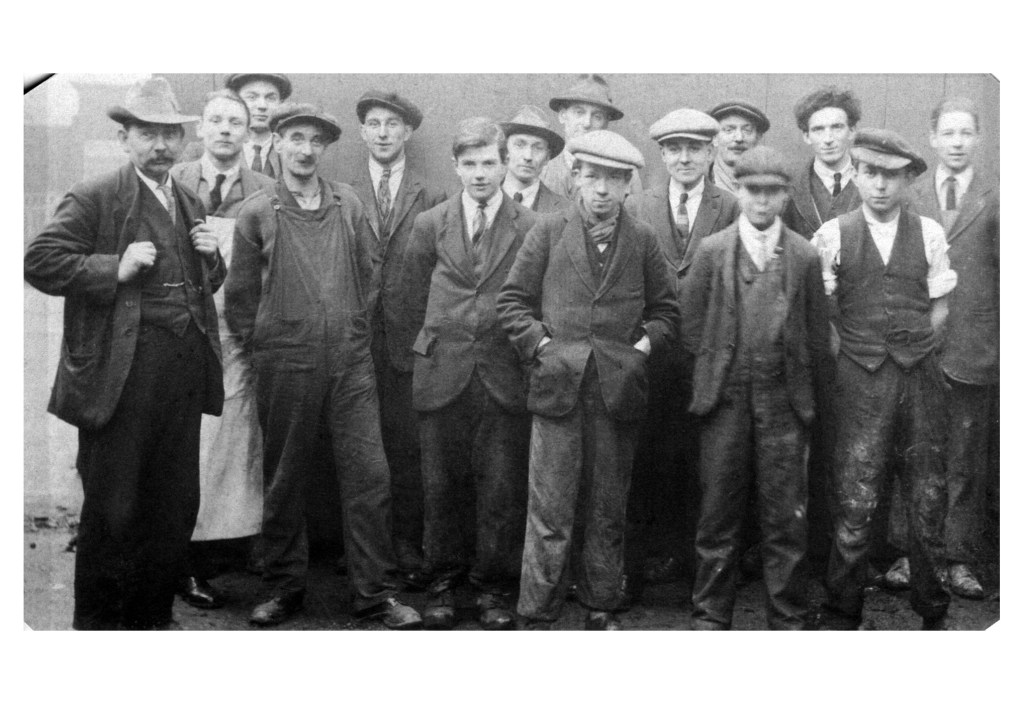
In a survey of the social structure of the IRA across Ireland during the revolutionary period, historian Peter Hart declared that “‘The boys’ were farmers’ or shopkeepers’ sons rather than owners; apprentices or journeymen rather than tradesmen or masters; junior clerks and assistant teachers. Property, money and security, like marriage, lay in the future.”1
To what extent was this true of the IRA’s 3rd Northern Division?
An article by me on this subject appeared on www.theirishstory.com in January 2021, titled “From the Shipyards to the Poitín Still – Social Class and the IRA’s 3rd Northern Division.” Since then, the sample has been greatly expanded and the conclusions revisited.
Estimated reading time: 25 minutes
The Military Service Pensions Collection
Apart from telling us what veterans of the struggle for independence did, the files of the Military Service Pensions Collection (MSPC) also provide valuable insights into who they were. So far, Military Archives have released files relating to 289 former members of the IRA, Cumann na mBan and Na Fianna from Belfast, Antrim and East Down, the three constituent Brigades of the 3rd Northern Division.
Depending on the nature of the application, the files provide varying levels of detail on the occupations of those members and can be broken down into three groups:
- Application forms for dependent’s allowances or for wound/disability compensation involved explicit questions relating to the member’s occupation and earnings, as these were central to that process.
- People providing references for applicants under the 1924 Military Service Pensions Act, which was limited to former members of the National Army, had to complete a form that asked, “What was his occupation prior to and subsequent to this period and to what extent was his living interfered with by his work as a Volunteer?”
- For applications under the 1934 Act, which was widened to include former members of Cumann na mBan and also IRA members who opposed the Treaty, the form did not ask about occupation but instead focussed exclusively on “military operations or engagements or service.”
So, there was a diminishing hierarchy of interest on the part of the authorities in who the applicant was and increasingly exclusive levels of focus on incidents of combat in which they had participated. This created particular obstacles for members of Cumann na mBan: “As no legislative definition of active service was provided, different assessors used different criteria at different times. Both the legislation and the subsequent assessors’ interpretations valued the role of women considerably lower than that of men…”2
In effect, the women of Cumann na mBan were treated as second-class revolutionaries: “A strict demarcation between the less-regarded work of Cumann na mBan and that of providing military support for the IRA informed the attitude of pension assessors.”3
However, the assessors also interviewed the applicants and the transcripts of these interviews often provide information relating to their employment.
In order to present as broad a picture as possible of the wider republican movement in the 3rd Northern area, Cumann na mBan and Fianna applicants are included here. Antrim and East Down are included to avoid a Belfast urban bias, although there were fewer applications from those areas.
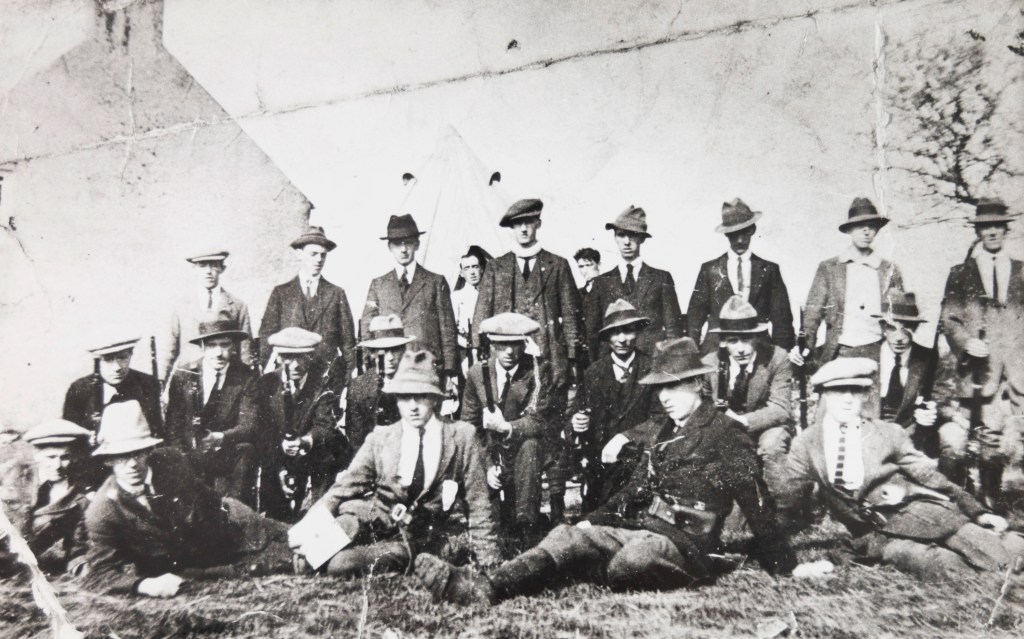
Members of the IRA’s Antrim Brigade, 1920
Information from other sources has also been included to provide a final sample of 360 people from the Divisional area, most notably: Jim McDermott’s ground-breaking book, Northern Divisions, individuals’ internment files, Denise Kleinrichert’s Republican Internment and the Prison Ship Argenta 1922 and an unpublished memoir by a former Belfast Brigade officer, Thomas Gunn.4
This new sample of 360 is 80% bigger than the figure of 201 used for my 2021 article and more than two-and-a-half times’ bigger than the sample of just 138 for the whole of Ulster used by Hart in his analysis.5
Social classes
While many of the IRA members ended up having to go on the run and/or took up full-time roles within the organisation, it is their occupation prior to that which is used to classify them. For the purposes of this analysis, a number of social classes have been used, which are broadly similar to those used by the Central Statistics Office, with a couple of additions:
- Professional
- Managerial
- Non-manual
- Skilled manual
- Semi-skilled manual
- Unskilled manual
- Not employed
- Farming
- Not known
More detail about each of these classes is provided in the footnotes. In general terms, the middle class would comprise groups 1 and 2 taken together, while groups 3, 4, 5 and 6 combined would make up the working class.6

The leadership of the 3rd Northern Division in 1921. L-R: an accountant, a railway clerk, a trainee accountant and a school headmaster
Before moving to consider the makeup of the republican movement in the 3rd Northern area, it is necessary to understand the wider context, as shown in the 1911 Census:
“In 1911 Catholic men were over-represented, in descending order, in general labour, flax spinning, factory labour and boot and shoe manufacturing. They were under-represented, in descending order, among shipwrights and carpenters, shipbuilders, boilermakers, engine and machine makers, house carpenters, plumbers, fitters and turners, drapers/mercers and printers. Catholic women were similarly disadvantaged.”7
On this basis, we should expect the unskilled and semi-skilled manual workers to account for high percentages of the sample. Similarly, we should expect the middle class, the professional and managerial groups, to be relatively small: “The Catholic middle class was not numerically large. In 1911 there were only 17 Catholic merchants out of 132 enumerated, and just over 1,000 male and female clerks out of well over 7,000 in the city.”8
Who were they?
The first thing that can be said, using the definitions above, is that the republican movement in the 3rd Northern area was predominantly working class – the four component groups of that class account for 62% of all members (79% excluding not knowns). This percentage increases to 71% of IRA members only (81% excluding not knowns).

The middle class made up just 6% of total members, so it was a small component, in line with expectations. There were only seven professionals, three of whom were doctors who acted as Medical Officers at either Divisional or Brigade Staff level. Sixteen were managerial, most of whom were owners of small businesses, such as Ned Trodden who owned a hairdressers on the Falls Road.9
Sixty-one were non-manual workers, involved in a wide range of occupations such as teacher, clerk, shop assistant and barman. There were 67 skilled manual workers, making them the largest group, though only by a narrow margin – engineers, electricians, car mechanics and so on. The sizes of these two groups do not match expectations, as each is considerably bigger than might have been anticipated.
However, the two groups that might have been expected to be over-represented, the semi-skilled and unskilled manual workers, were actually relatively small in size. Almost half of the semi-skilled manual group, 18 out of 40, were apprentices, while over half of the unskilled manual workers, 32 out of 54, were labourers.
The unskilled manual group also includes ex-servicemen for whom no other post-war occupation can be found – for example, IRA member Joseph Giles, one of the first people to be killed in the political violence which erupted in Belfast in July 1920, was described as being “only recently demobilised.”10
In total, there were 31 ex-servicemen, representing 11% of the IRA portion of the sample. Some of them would have been reservists called up when the Great War began, like Patrick Barnes and Seán Cusack. But as conscription was never introduced in Ireland, the remainder were men who volunteered to join the British Army during the war, like William Delaney, who joined the Royal Irish Fusiliers in 1915 and was wounded. Some of them would have enlisted as Home Rulers, following the urgings of John Redmond and Joe Devlin – their conversion to republicanism came later.11
Of the 15 members not employed, four were students. Annie McGarry was the only member of Cumann na mBan described as being engaged in “home duties;” Mary Hannan was a nun.12
While it might be expected that most members from the “country” Brigades in Antrim and East Down were engaged in farming, this was not so: only 19 of the total sample were classed under this heading. Ignoring the Belfast Brigade for obvious reasons – although it did actually have one farmer in its ranks – the farming group still accounted for only 20% of the combined membership from the Antrim and East Down Brigades (35% excluding not knowns).13
In fact, in the IRA’s Antrim Brigade, there were 15 in non-farming occupations as opposed to just six farmers. This may reflect the geography of the county, as nationalists were concentrated in the Glens of Antrim where the land was poorer: it is perhaps indicative that of the nine glens, the name Glenariff is an anglicisation of Gleann Áireamh, “the arable glen” or “glen of the ploughman”, but the names of the other eight have no such agricultural reference.14
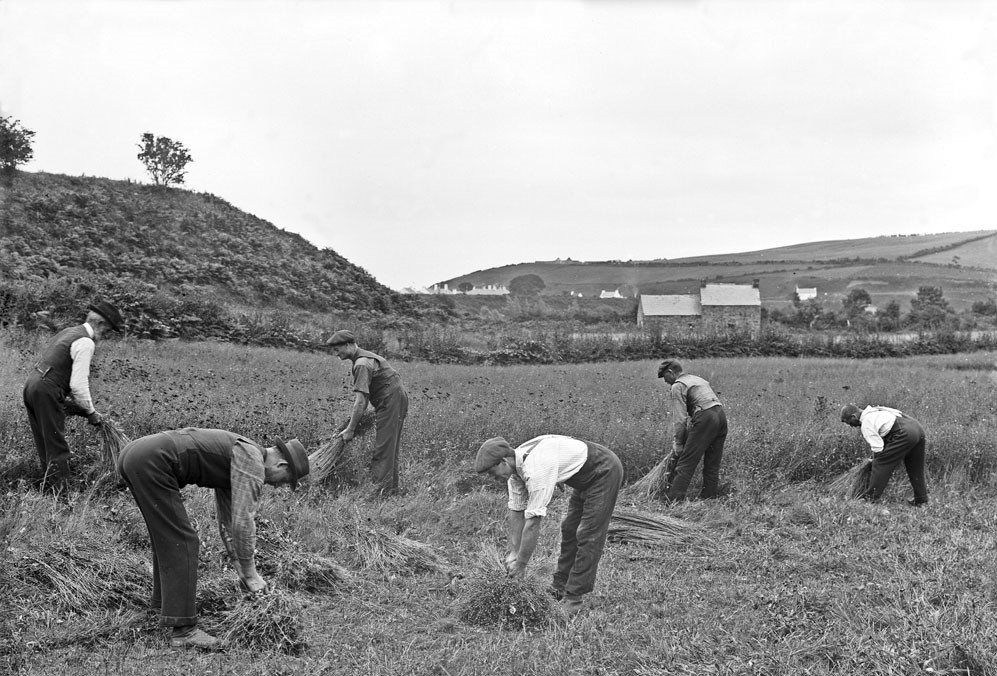
Gathering flax in county Antrim
It is striking that the occupation of almost two-thirds of the Cumann na mBan members is not known – 44 out of the 68. This begs the question: were they even asked? It might be understandable, given the prevailing social attitudes in the 1930s, that the pension authorities would simply assume that all Antrim Cumann na mBan members worked on the family farms. But in Belfast, where opportunities for women to work outside the home were more plentiful, such an assumption is less forgivable. Among the Belfast women, ten had non-manual jobs such as clerical/secretarial or shop assistant, one worked in a workshop and another in a linen mill on the Springfield Road.
Two IRA members in the sample almost defy classification.
In addition to the ex-servicemen, there was a serving British soldier in the IRA’s Belfast Brigade – Sergeant James Tully, who was a clerk at Victoria Barracks on the Antrim Road:
“Sometime in 1919 he intended to resign but remained in his position at our request. In addition to intelligence from military quarters, his uniform made him a welcome guest in the different RIC Barracks and he often supplied us with information re. RIC. In Feb 1923 documents containing information which could only have been supplied by Tully were captured by the RUC and as result he was compelled to cross the border.”15
On account of his military duties, Tully is classed as “non-manual” in the sample.
At the completely opposite end of the spectrum of legality was Mick McIlhaton, listed on the nominal roll of members of the Ballycastle company in the Antrim Brigade’s 1st Battalion. He was arrested and interned on the Argenta: “He came up, I guess, Mick McIlhaton said ‘I was a shepherd or I was a poitín maker?’ Says he was both!” Despite this obvious entrepreneurial flair, McIlhaton is classed as “farming” in the sample.16
Officers
Compared to the total sample, the composition of the officer cadre was noticeably different. Seventy-three individuals can be identified as having been staff officers, at either Battalion, Brigade or Divisional level for one of the three republican organisations – 68 IRA, three Cumann na mBan and two Fianna; two of the women were attached to the Brigade Staff of the IRA rather than that of Cumann na mBan.17

While the four working class groups still accounted for the majority (60%) of all officers, there was a marked shift in the balance between those four groups, with a distinct swing away from the skilled and semi-skilled manual groups towards the non-manual group, which became the largest group among the officers.
Taken together, the professional, managerial and non-manual groups accounted for just under half, or 47%, of all officers. But as the semi- and unskilled manual workers still provided more officers than the professionals and managers, it is most accurate to say that the officers of the republican movement were more white-collar – as opposed to more middle class – than the wider membership.
“I was chased from the shipyard”
The events known as the Belfast Pogrom began on 21st July 1920 with the driving out by loyalist mobs of thousands of workers from the shipyards, including both Catholics and so-called “rotten Prods”, socialists and trade unionists who were also viewed as being “disloyal.” The expulsions spread the following day to other notable Belfast employers, especially those in the engineering industry.
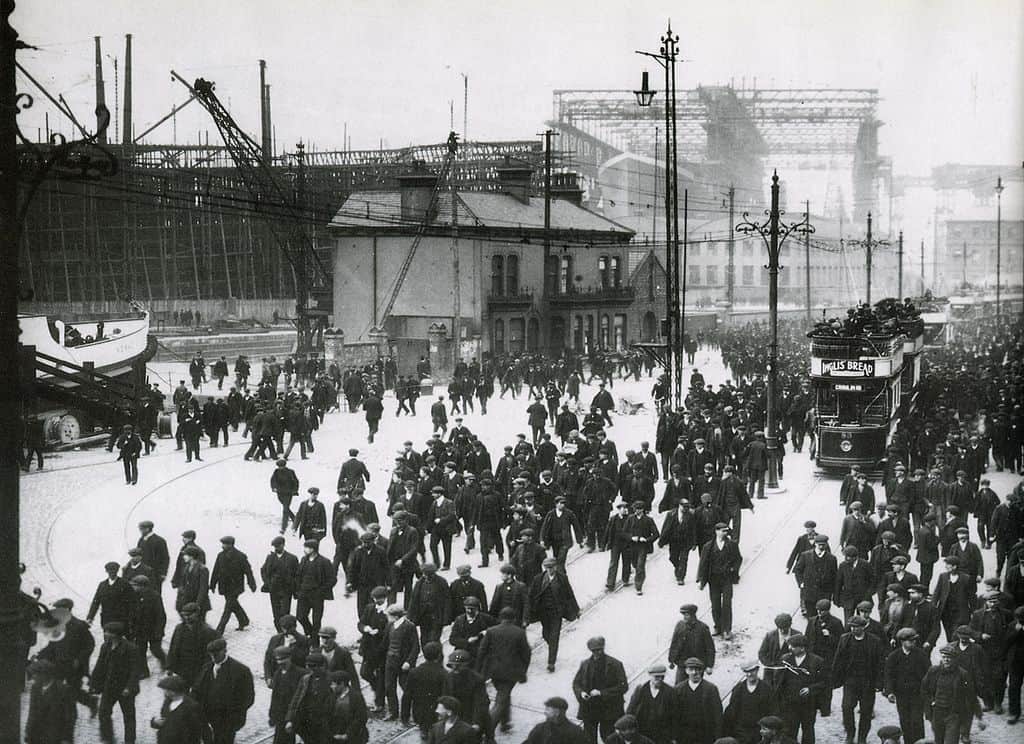
Seventeen members of the Belfast IRA worked in the shipyards
As shipbuilding was a significant industry and source of employment in Belfast, it is not surprising that IRA members worked in the shipyards. Seventeen members, or 8% of the Belfast Brigade in the sample were employed in either Harland & Wolff or the “wee yard”, Workman Clark. In addition, a member of 3rd Northern’s Divisional staff, Quartermaster Frank McArdle, was employed in the drawing office of Harland & Wolff and was well-regarded by no less a luminary than the owner, Lord Pirrie.18
Six more IRA members worked in Combe Barbour, an engineering firm that saw expulsions on 22nd July 1920, the day after the initial outbreak in the shipyards, while Bernard McAvoy was an apprentice fitter in Mackie’s and Robert Copeland was an apprentice moulder in the Sirocco Ropeworks, two other sites of workplace expulsions.19
They shared the same experience as many Belfast Catholics: Patrick McWilliams was an apprentice machinist in Harland & Wolff but “I was chased from the shipyard;” James McDermott was an apprentice smith in the same firm until he was “expelled at [the] pogrom;” Tom McNally was a railway clerk until he was “hunted from my work by one of these mobs.” Others, while not physically driven out themselves, simply deemed it more prudent to no longer show up for work: “Frank McArdle himself had to be kept in close cover to protect him from the mob until late evening and then smuggled out of the premises. It was, I think, his final departure from the shipyards.”20
All of these men had been in the IRA prior to July 1920, so their membership pre-dated the workplace expulsions. But the case of James McLaughlin is more intriguing: also employed in the shipyards, he lived in Foundry St, Ballymacarrett in east Belfast, where rioting broke out at teatime on the first day of the expulsions; although he doesn’t mention being driven from his work, his file states that he joined the IRA in July 1920 – what were his motives for joining…?21
Charles Stewart was an apprentice machinist in Harland & Wolff who joined the IRA in March 1921; however, he was an exceptional recruit, as “…being a Presbyterian I was not expelled at time of pogrom but owing to activities with IRA was expelled later.”22
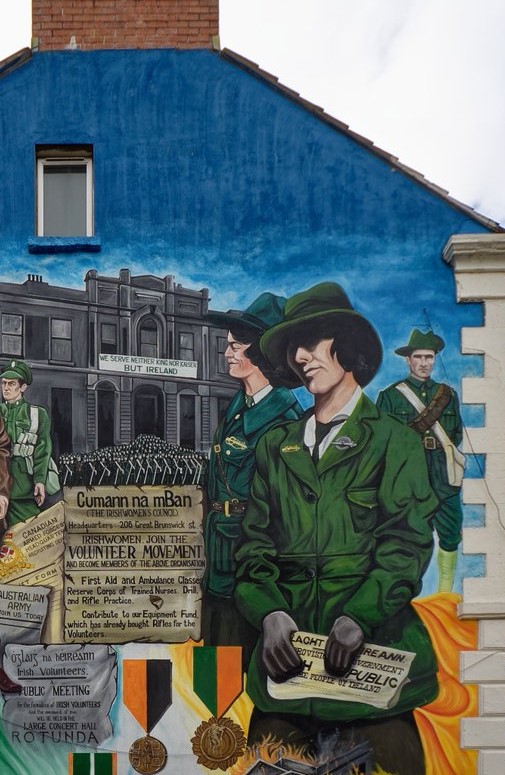
Elizabeth Corr (pictured right on this Ormeau Road, Belfast mural) was one of several Cumann na mBan members to lose their jobs
But it was the women of Cumann na mBan who were more likely to explicitly highlight the impact of this period on their livelihoods.
Eleven said they lost their jobs as a result of their republican involvement, beginning with Elizabeth Corr who was dismissed from her position as a librarian with Belfast Corporation because of her role in the 1916 Easter Rising. Mary Hackett lost her job when “ammunition was found in my workshop”. Jane O’Neill had been a typist in a solicitor’s office in Ballymena but lost her position and “believes it was as a result of her activities.” Mary Russell worked in Spence & Johnson, a Belfast motor company attacked by the IRA: “I was in business until the day I was arrested & the firm I was in, the workers refused to work with me, the result was I could not get in any place.”23
Nellie O’Boyle and Breid McCamphil add to the growing body of evidence linking Belfast republicans to the anti-Treaty side in the Civil War: O’Boyle ferried arms to a Belfast IRA column operating in Louth; arrested by Free State authorities in 1923, “she was unable to resume her old employment in a loyalist firm by reason of her political activities, arrest, etc and the subsequent depression in other firms rendered it impossible to obtain other employment.” Having been both “hunted from my employment” and evicted, McCamphil moved to Dublin, where she acted as a nurse in Barry’s Hotel during the fighting after the capture of the Four Courts.24
One of the possible reasons why Cumann na mBan applicants were more likely to highlight their loss of livelihood may be that while some women had received the right to vote in 1918, by the time of the pogrom, many Cumann na mBan women were still excluded from the franchise on the grounds of age and/or lack of property qualifications. They may therefore have felt the loss of whatever scraps of economic agency they had achieved more keenly than their IRA counterparts.
Apart from the women who were sacked, sisters Alice and Annie McKeever ran a confectionery and tobacco shop at 74 Cromac St in the Market, but by the mid-1930s, “As a result of our national sympathies and work, our business was boycotted and as a result my sister and myself are entirely without means.”25
Emily Valentine also lost everything: in August 1920, her parents’ home was burnt out by a hostile mob and the family had to move to Dublin. Breid McCamphil was evicted not once, but twice: “…we lived in Ormeau Road and we were put out on the street;” then, after her family moved to Raglan St, in April 1922, “…furniture and everything we had was put on the street about five minutes before curfew and we had to come to Dublin.”26
Summary and conclusions
In 1920, although a post-war recession was looming and thousands of recently demobilised ex-servicemen were adding to the existing competition for jobs, Belfast was still the leading industrial city in Ireland, with two large shipyards and many other significant companies in the engineering, linen, tobacco and rope-making industries.
The working-class population of the city was therefore much more sizeable than was the case in other cities and towns around Ireland at the time. However, discriminatory employment practices meant that within the Belfast working class, Catholics were disproportionately over-represented at the lower rungs while being under-represented among the skilled manual layer. We would therefore anticipate that membership of republican organisations in the city would be skewed towards the unskilled and semi-skilled manual working class. Adding the membership from the two “country” Brigades of the 3rd Northern Division could be expected to significantly increase the proportion engaged in farming.
Analysis of the sample of 360 members shows that neither was the case.
Almost two-thirds, or 62%, of those in the sample were working class. But the single largest group was the very one in which Catholics were under-represented generally – skilled manual workers, who accounted for 19% of the total; the next-biggest group was drawn from the non-manual working class, another section of the workforce among which Catholics were generally under-represented.
Outside Belfast, farmers and their families were only a minority of republican activists – in both Antrim and East Down, they were outnumbered by those in non-farming occupations.
The officers of the republican movement were also substantially drawn from the working class, with 60% of them from that background. However, this leadership had a distinctively different composition, with a pronounced white-collar, though not middle class, slant. While skilled manual workers were the largest group among the total membership, non-manual workers were by far the biggest among the officers.
With the shipyards being the biggest employers in Belfast, it was perhaps only natural that several IRA members were also employed there. What is surprising is that only two of those made any reference to have been driven from those jobs at the outset of the pogrom; another, working as a railway clerk, was also expelled from his position. Other Belfast IRA members may have been ejected from their jobs, but if they were, they didn’t say so. Given that July 1920 was the defining moment that marked the start of the Pogrom, with a wave of workplace expulsions, it is perhaps extraordinary that so few of the Belfast IRA, over 90% of whom were working, claimed to have been victims of that outbreak.
Being expelled from their jobs was a consequence of their religion. But being active republicans had other consequences.
IRA and Fianna members faced a particular risk that of being killed or wounded. Thirty-five IRA and Fianna members were killed in Belfast, four in Antrim and one from the East Down Brigade. While attacking an RIC Barracks in April 1920, Hugh MacGlennon was accidentally doused in burning petrol and suffered horrific injuries to his face and hands; for years afterwards, the Free State authorities not alone paid him a disability pension but also provided plastic surgery for him. The application for an IRA wound pension by Charles Stewart, the Presbyterian one-time apprentice in Harland & Wolff, was supported by letters written by a doctor from the Shankill Road in Belfast – probably one of the more unusual requests that particular medic had to deal with.27
Cumann na mBan members were not immune from the risk of injury: Annie McGarry was helping to store ammunition near Ballycastle in July 1922 when a defective detonator exploded, as a result of which she lost a thumb and two fingers from her left hand.28
Members of all three republican organisations also lived with the constant threat of being punished by either the authorities or their employers for their activities.
Of the total 3rd Northern membership, around 130 were interned. But for some of these, there could later be redemption, at least in terms of their occupation: Hugh Corvin, Quartermaster and later O/C of the “Executive” or anti-Treaty 3rd Northern after the 1922 split, was interned on the Argenta but by the mid-1930s, he had his own accountant’s firm in Belfast.29
Several of the Cumann na mBan members in the sample were also arrested and/or interned. But for the women of this organisation, the impact on their employment prospects seemed to be more lasting and more acutely felt. We only know what 17 of them worked at, other than in farming, but ten of those lost their jobs or livelihoods as a result of their activities.
By the time internees started being released, Belfast’s industrial heyday was ebbing away., as the post-war recession devastated the three traditional key pillars of employment in the north: agriculture, linen and shipbuilding. In 1923, unemployment in Northern Ireland was already running at 18.2%; by 1925, it had reached 23.9% – nearly a quarter of the population were out of work, more than double the rate for Britain, which then stood at 11.4%. Discrimination in employment against Catholics had already been present before the Great War, now it was reinforced by discrimination in housing and voting as unionism strengthened the structures of a sectarian state.30
On 30th October 1924, the remains of Joe McKelvey, the first O/C of the 3rd Northern Division, executed by the Provisional Government on 8th December 1922, were buried in Belfast’s Milltown Cemetery. The symbolism of the funeral need hardly be emphasised – as well as McKelvey, the 3rd Northern was also finally buried. The funeral acted as the catalyst for republicans to begin trying to rebuild the IRA in Belfast. But they were doing so in a vastly different world.31
This post was updated on 25th February 2024 with additional information kindly supplied by Margaret Ward.
References
1 Peter Hart, The IRA at War 1916-1923, (Oxford, Oxford University Press, 2003), p121-122.
2 Marie Coleman, Compensation Claims and Women’s Experience of Violence in Linda Connolly (ed.), Women and the Irish Revolution (Newbridge, Irish Academic Press, 2020), p130.
3 Margaret Ward, Gendered Memories and Belfast Cumann na mBan, 1917-1922 in Connolly (ed.), Women and the Irish Revolution, p59.
4 Jim McDermott, Northern Divisions – The Old IRA and the Belfast Pogroms 1920–22 (Belfast, Beyond The Pale Publications, 2001); Public Record Office of Northern Ireland (PRONI) HA/5 series; Denise Kleinrichert, Republican Internment and the Prison Ship Argenta 1922 (Dublin, Irish Academic Press, 2001); Thomas Gunn memoir, ‘Statement of Lieutenant Colonel T. Gunn, relating to operations in Ulster pre-Truce,’ Historical Section Collection, Military Archives (MA), HS/A/0148.
5 Hart, The IRA at War 1916-1923, p137.
6 Examples of the different groups are as follows:
• Professional: doctor, dentist, lawyer, etc.
• Managerial: higher-ranking “white-collar” e.g., school principal as opposed to teacher. Also included here are people who would otherwise be classed as skilled or semi-skilled but who owned their own business e.g., William Lynn was a car mechanic but owned his own garage in Ballycastle, Co. Antrim – William Lynn, Military Service Pensions Collection (MSPC), MA, MSP34REF7497.
• Non-manual: teacher, accountant, clerk, shop assistant, barman, etc. Owing to the general (in some cases, extreme) youth of the activists, most of them can safely be assumed to have been at non-managerial grades e.g., accountant Seamus Woods, O/C of 3rd Northern Division in 1922, was then aged only 22 – Séamus Woods, MSPC, MA, 24D39; his predecessor, Joe McKelvey, a trainee accountant, was aged only 24 when executed in Mountjoy Prison in December 1922 – Jim McVeigh, Goodbye, Dearest Heart (Belfast, National Graves, 2017), p1.
• Skilled manual: electrician, engineer, etc e.g., John Lynn was also a car mechanic, working in his brother William’s garage – John Lynn, MSPC, MA, MSP34REF22241.
• Semi-skilled manual: taxi driver, apprentice, etc.
• Unskilled manual: labourer, carter, etc.
7 Austen Morgan, Labour and Partition, The Belfast Working Class 1905-23 (London, Pluto Press, 1991), p10.
8 Ibid, p14. Morgan counts clerks as middle class but in the current analysis, they are counted as (non-manual) working class – although they may well have had different perspectives on potential social mobility to their manual working class counterparts.
9 Edward Trodden, MSPC, MA, 1D153. Winifred Carney is also included in this group – while it may seem contradictory to describe a trade union official as “managerial”, this was felt to be the best fit for her leadership role as Secretary for the Belfast branch of the Irish Transport & General Workers’ Union – Winifred Carney, MSPC, MA, MSP34REF56077.
10 Belfast News-Letter, 23rd July 1920. Ex-servicemen who did find employment after being demobilised are classified according to their post-war job.
11 Barnes, Patrick, Cullingtree Rd, Belfast, PRONI HA/5/2181; Seán Cusack, MSPC, MA, 24SP308; Delaney, William, Reilly’s Place, Belfast, PRONI HA/5/1983.
12 Annie McGarry, MSPC, MA, MSP34REF28687; Mary Hannan, MSPC, MA, 34SP10713 – although she carried out the same tasks as members of Cumann na mBan, Hannan’s pension application was rejected as she had not been a member of a “qualifying organisation,” her religious vows having precluded her from formally joining the organisation.
13 Hugh Close owned a farm at Braniel, near Castlereagh: Hugh Close, MSPC, MA, MSP34REF6166.
14 https://antrimcoastandglensaonb.ccght.org/cultural-heritage/
15 James Tully, MSPC, MA, 24SP11058.
16 Nominal Roll, 1st Battalion, 2nd Brigade, 3rd Northern Division, MSPC, MA, MSPC/RO/408; Kleinrichert, Republican Internment, p243.
17 Rose Black was attached to the IRA Belfast Brigade staff and instructed not to attend Cumann na mBan meetings – Rose Black, MSPC, MA, MSP34REF22470. Similarly, Alice Flynn was also attached to the IRA Belfast Brigade staff and in her interview with the pension board assessors, she stated that she wasn’t in Cumann na mBan (although her application form says she was) – Alice Flynn, MSPC, MA, MSP34REF57942. While Winifred Carney stepped down as President of Belfast Cumann na mBan around March 1919, she was, after appealing the initial finding, recognised as an officer for pension purposes – Winifred Carney, MSPC, MA, MSP34REF56077.
18 McDermott, Northern Divisions, p38.
19 Bernard McAvoy, Pensions & Awards files, MSPC, MA, 24SP12878; Robert Copeland, MSPC, MA, MSP34REF8434.
20 Patrick McWilliams, MSPC, MA, MSP34REF51215; James McDermott, MSPC, MA, 24SP9856; Tom McNally statement, Bureau of Military History (BMH), MA, WS410; J. Anthony Gaughan (ed.), Memoirs of Senator Joseph Connolly, a Founder of Modern Ireland (Dublin, Irish Academic Press, 1996), p176.
21 James McLaughlin, MSPC, MA, 24SP7961.
22 Charles Stewart, MSPC, MA, DP7030.
23 Elizabeth Corr, MSPC, MA, MSP34REF10854; Mary Hackett, MSPC, MA, MSP34REF23258; Jane O’Neill, MSPC, MA, MSP34REF34428; Mary Russell, MSPC, MA, MSP34REF24769.
24 Nellie Neeson née O’Boyle, MSPC, MA, MSP34REF11037; Breid Dobbyn née McCamphil, MSPC, MA, MSP34REF20630.
25 Alice McKeever, MSPC, MA, MSP34REF51358.
26 Emily Valentine, MSPC, MA, MSP34REF56551; Breid Dobbyn née McCamphil, MSPC, MA, MSP34REF20630.
27 Hugh MacGlennon, MSPC, MA, 1P566; Charles Stewart, MSPC, MA, DP7030.
28 Annie McGarry, MSPC, MA, DP6968.
29 Corvin provided references for applicants under the 1934 Act on the headed notepaper of Corvin & Thornbury, Auditors & Accountants, of 4 College Square North in Belfast – see for example: Terence Lee, MSPC, MA, MSP34REF6056 and Nellie Neeson née O’Boyle, MSPC, MA, MSP34REF11037.
30 Meredith M. Paker, Industrial, regional, and gender divides in British unemployment between the wars, paper prepared for Department of Economics, University of Oxford, https://www.economics.ox.ac.uk/files/jobmarketpaper-meredithpakerpdf
31 John Ó Néill, Belfast Battalion – A History of the Belfast IRA, 1922-1969 (Wexford, Litter Press, 2018), p21.
 The Belfast Pogrom
Leave a comment