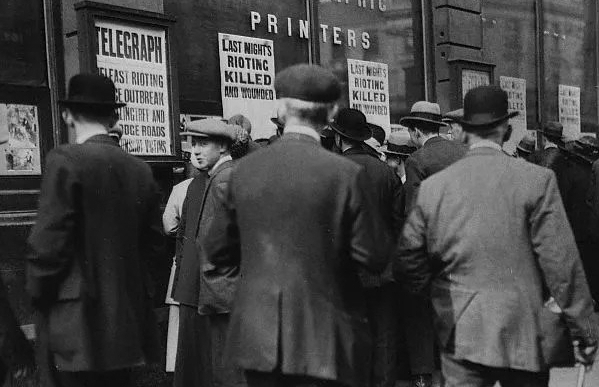
This blog post originally appeared as two articles on www.theirishstory.com, the first in October 2020, with an addendum following in January 2022. Here, those two articles are merged and, on the basis of additional research conducted since, the information has been updated. The total number of dead now stands at 500.
This post was updated on 16 February 2025 to reflect additional research conducted for the Map of the Belfast Pogrom
In the course of that research, I discovered that I had duplicated two names, James Green/Greer, killed in Ballymacarrett on 18 April 1922, and William Smith, also killed in Ballymacarrett, on 27 May 1922. However, I also found that just over two weeks after William Smith was killed, a second man with the same name was killed in North Queen Street on 13 June; the second man has now been added to the database.
The killing of John Taylor on 16 March 1922 turned out to be the result of the unintended discharge of a soldier’s weapon, so his death has been moved to the Accidental group and is no longer included in the total.
The assignment of killings to areas has also been tidied up: for example, killings that happened in North Thomas Street in Sailortown were previously counted under York Street & North Queen Street, but it makes more sense to include them with killings in the docks.
Estimated reading time: 45 minutes.
Introduction
By the time violence erupted in Belfast in the summer of 1920, the War of Independence was already eighteen months old. Although the latter was brought to a close in the south with the signing of the Treaty in December 1921, the Belfast Pogrom continued well into 1922 while at the same time, the northern IRA continued its War of Independence by mounting attacks against the Unionist government of Northern Ireland until the summer of that year.
The use of the term “pogrom” to describe the events of that period in Belfast is disputed. It is almost never used by unionists. Some historians have challenged its use, most notably Robert Lynch, who said that what happened in Belfast “lacked many of the key characteristics that are inherent in the term ‘pogrom.’”1
What happened in Belfast does not strictly conform to dictionary definitions of the word “pogrom” as that term began to be understood in the early twentieth century, most notably in the wake of pogroms directed at Jews in eastern Europe. However, the term was widely used at the time by nationalists, as those against whom the vast majority of the violence in Belfast was directed felt that what was being done to them corresponded with what they understood a pogrom to entail. Respecting that lived experience, I use the word.
Nor is there agreement about the impact of the Pogrom in terms of the number of fatalities involved.
The starting point for most historians is a list of 455 people – 267 Catholic, 185 Protestant and 3 “unascertained” – who were killed in Belfast from July 1920 to June 1922; this list was contained in the pamphlet Facts and Figures of the Belfast Pogrom, written in 1922 under the pseudonym G.B. Kenna by a Belfast priest, Fr John Hassan. For reasons that will be explored below, Hassan’s list is incomplete and in some respects, inaccurate.2
His list has since been added to, with different authors arriving at different totals for the number of deaths. Belfast local historian Joe Baker had a more extensive list of 469 deaths. Robert Lynch had a total of 464, while Peter Hart had two different totals, 409 and 470; neither of these writers identified the fatalities individually by name. Using accounts in contemporary Belfast newspapers, Alan Parkinson had a figure of 498 and the circumstances of most of these deaths are described in his book Belfast’s Unholy War.3
The lists compiled by Hassan and Baker were initially cross-referenced with Parkinson’s accounts and reports in the Belfast newspapers as well as summaries compiled for the Provisional Government’s North East Boundary Bureau. In order to be included, three separate sources were required.4
Additional detail came from the press reports of the City Coroner’s inquests held to establish the causes of deaths. These provide more definitive evidence of the circumstances in which people were killed and, in some cases, highlight killings which had originally gone unreported by newspapers – by the later stages of the conflict, the level of violence was such that the Coroner was forced to conduct inquests in batches, so searching for an inquest report for one particular killing could sometimes lead to discovery of an entirely new fatality. So far, press reports of inquests or the proceedings of military courts of inquiry have been identified for 88% of those killed.
Finally, the release of files in the Military Service Pensions Collection (MSPC) show that some of those killed in this period were more involved in the political violence of the time than the Coroner was led to believe.
The total number of fatalities arrived at by this process now stands at 500. The updated database can be viewed here: The Dead of the Belfast Pogrom v7
The chronology of killing
In this section, deaths are recorded as far as possible on the dates on which the incidents occurred, rather than the date of death. Victims could sometimes cling on for weeks or even – in some instances – months after sustaining the injuries that would ultimately prove fatal, so capturing the dates of the incidents gives a more accurate picture of the pattern of violence.
Four distinct peaks can be seen in the killings.
The initial outbreak of violence was on 21 July 1920, when thousands of Catholics and “rotten Prods” – socialists and trade unionists, also viewed as “disloyal” – were expelled from their jobs in Belfast’s shipyards. Similar expulsions took place in other prominent Belfast firms in the following days. Sectarian rioting broke out and in four days, twenty-one people were killed.5
For a month, Belfast was relatively quiet, but worse violence flared after the funeral of Royal Irish Constabulary (RIC) District Inspector Oswald Swanzy on 25 August; he had been killed by the IRA in Lisburn several days earlier. In the week that followed, 33 people were killed.

The next major outbreak came at the end of September, following the killing by the IRA of RIC Constable Thomas Leonard while attempting to disarm him; he was the first policeman to be killed in Belfast since the start of the Pogrom. Ten people died over the next few days, including the first victims of what nationalists came to call the police “murder gang” – a group within the RIC who carried out reprisals for the deaths of policemen, killing nationalists and republicans in their own homes and in nearly every case, leaving witnesses behind, usually family members.6
In the spring of 1921, a new active service unit in the IRA began targeting police in Belfast’s city centre. In three separate attacks, they killed seven members of the RIC, although none of those were members of the Belfast RIC: two were officers from the south escorting a witness to the trial in Belfast of an IRA member, two were Auxiliaries on leave in Belfast and three were Black & Tans in Belfast to collect lorries and bring them back to their depot in Gormanstown, Co. Meath. Two of these incidents prompted revenge killings by the RIC “murder gang.”7
The second peak in killings came in the summer of 1921. On 10 June, the IRA killed Constable James Glover, who they had identified as a member of the “murder gang.” Thirteen people were killed over the next few days, including three Catholic civilians killed by a “murder gang” of RIC Auxiliaries and local Belfast Special Constables.
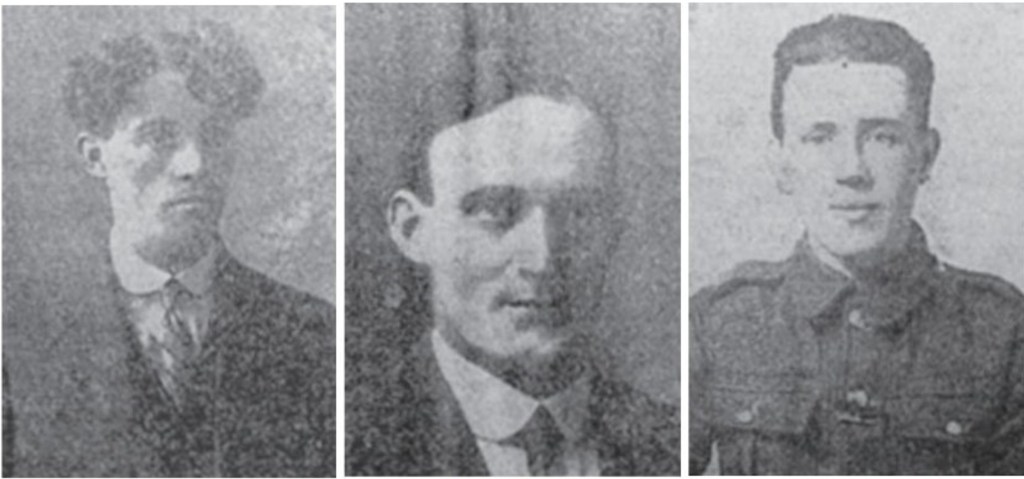
Three Catholic civilians killed by an RIC “murder gang” in June 1920: William Kerr, Alexander McBride and ex-serviceman Malachy Halfpenny
Of the twenty-five people killed in July, all but one died in the aftermath of an IRA ambush on an RIC patrol in Raglan St in the Lower Falls on 10 July, the day before the Truce came into effect, but one which became known as “Belfast’s Bloody Sunday”. The killings in August were similarly concentrated, all but two of the twenty-four coming in the last three days of the month.
The third peak came in November 1921, which was the worst month yet.
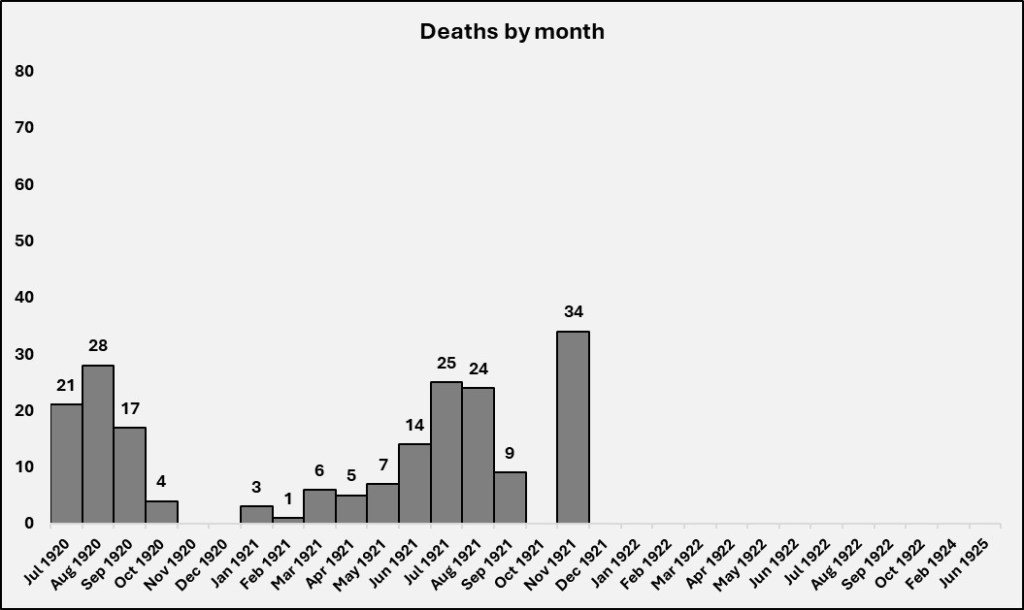
Two significant developments led to 34 killings in the last ten days of that month. The first was that responsibility for security and policing was handed over from the British government to the Unionist government of Northern Ireland, established earlier that year under the terms of the Government of Ireland Act. One of their first acts was to re-mobilise the Ulster Special Constabulary (USC), known as the “Specials”, who had been stood down under the terms of the Truce.
The second development was that the IRA began mounting indiscriminate sectarian attacks on trams: on 22 November, a bomb, or grenade, was thrown into a tram carrying shipyard workers in Corporation Street, killing three (their names were omitted from Hassan’s list of deaths). A similar attack happened in Royal Avenue two days later, this time targeting a tram destined for the unionist Shankill Road – four people were killed.8
The final, most savage and most prolonged peak of killings was not in response to the signing of the Treaty but came in the spring of 1922. This period differed from earlier upsurges in that the killings were not concentrated in a few days – now, they were continuous and sustained.

In the four months from February to May, 229 people were killed, more than in the preceding nineteen months combined. This period also saw the three worst incidents of the whole Pogrom in terms of multiple fatalities.
On 13 February, a bomb was thrown into a group of Catholic children playing in Weaver Street in north Belfast: four children and two women were killed.9
On the night of 23/24 March, in response to the killing by the IRA of two Special Constables earlier that day, a gang of Specials most likely led by Imperial Guard and Special Constable David Duncan broke into the home of publican Owen McMahon; all the male members of the household were lined up in the front room, at which point the police opened fire on them. McMahon, four of his sons and his lodger were all killed; two of his sons survived.10

A religious painting, punctured by bullet-holes, from the McMahon family home (Republican History Museum, Belfast)
The RIC “murder gang” struck once more on the night of 1/2 April, again in response to the killing of a policeman. In what became known as the “Arnon St killings” (although two attacks took place in other streets), five people were killed in their homes, among them a 7-year-old boy and also including the boy’s father, who was bludgeoned to death with the sledgehammer used to smash open the family’s front door.11
May saw the launching of the IRA’s ill-fated Northern Offensive, organised with the assistance of both sides of the Treaty split in the south. This was the single worst month of the entire Pogrom period, with 75 killings. May also marked another overtly sectarian attack mounted by the IRA, this time in a cooper’s yard in Little Patrick St in the north of the city: five workmen there were lined up and asked their religions, the single Catholic was let go and the four Protestants were shot – three were killed.
The failure of the IRA’s offensive and the introduction of internment by the Unionist government, as well as other provisions of the Special Powers Act, meant the scale of violence gradually diminished over the summer of 1922.
On 5 October, a Catholic woman, Mary Sherlock, went to buy food for her family’s dinner. As she left a butchers on the Newtownards Road in east Belfast, a gunman walked up behind her and shot her in the head. She was the last person to be killed during the Pogrom.12
Dead of the Pogrom but not during the Pogrom
In this latest update, three deaths have now been included which occurred after that of Mary Sherlock, so did not occur during the Pogrom, but should be counted as deaths of the Pogrom.
On 30 May 1922, Special Constable William Campbell was wounded in the lung in the course of an IRA attack on him and a colleague in Millfield – Special Constable Andrew Roulston and IRA Volunteer George McCaughey were killed on the spot. Campbell died in June 1924 – he “never recovered from his wounds, and had practically been confined to bed since.”13
Hugh Hennon was an IRA member from the Lower Falls interned in 1922, first on the SS Argenta, later in Larne Workhouse; in November 1923, he spent seven days on hunger strike. As a result, when he was released in July 1924, “he was a complete wreck having developed nephritis” as well as hepatitis and oedemia of the lungs; he died the following September. His mother was awarded a gratuity by the Military Service Pensions board as they deemed he had been on active service while interned.14
In a similar vein, John O’Donnell, another IRA internee, contracted tuberculosis while on the Argenta and was released in October 1923 on grounds of ill-health but “was anointed for death before leaving.” He eventually died from the illness in June 1925 and his widow was also awarded a gratuity.15
Deaths not included
Among the list of deaths compiled by Hassan, there are a number which, for various reasons, are not included in the total of 500.
In compiling the database, accidental deaths were excluded. While not all victims were individually targeted in particular by their killers, a clear intention to kill someone was required for inclusion – for example, those killed in the IRA tram bombings.
Several of those named by Hassan were victims of accidental shootings, fatally wounded when guns went off unintentionally. Matthew Parke was the stepson of a policeman who, on 9 August 1920, found his stepfather’s gun in a drawer and was playing with it when he pulled the trigger by mistake and shot himself.16 Private Frederick Bundy was killed on 21 November 1920 when a fellow soldier was cleaning his rifle and it went off.17 On 6 April 1922, nine-year-old Joseph Hannigan was talking to two British soldiers when one of the soldiers’ rifles was accidentally discharged, killing the boy.18 The family of William Cowan were at pains to point out that his death on 14 April 1922 had been accidental – they stressed this in the death notice they placed in the Northern Whig newspaper.19 On 30 April 1922, Ellen Greer was examining the gun of a friend who was a Special Constable when it went off, killing her.20
The first week of September 1920 was a confusing one in relation to British military casualties. On 2 September, Lance-Corporal Harold Green was shot and wounded in Sultan Street in the Lower Falls. On 4 September, according to Hassan and to Baker, a Private Charles Harold died in a military hospital as a result of wounds previously received. The original chronology assumed that Kenna and Baker had got the name wrong and that it was Lance-Corporal Green who had died.
However, Eunan O’Halpin and Daithí Ó Corráin’s The Dead of the Irish Revolution brought to light the death of Sergeant Percy Harold Charles Turner. As noted in his death certificate, he died in a Belfast military hospital on 4 September after gangrene had set into a leg wound.
The revised conclusion is that of these three soldiers with Harold in their names, only one died. Lance-Corporal Harold Green, happily for him, survived so his name has been removed. Kenna and Baker now appear to have conflated Private Charles Harold with Sergeant Percy Harold Charles Turner; the latter’s death is recorded as an accident by www.cairogang.com and as accidental deaths are not included in the chronology, neither is his.21
Two of those listed by Hassan were victims of incidents which happened outside Belfast. On 4 November 1920, RIC Sergeant Sam Lucas died in a Belfast hospital – however his wounds had been received in the course of an IRA attack on the RIC barracks in Tempo, Co. Fermanagh.22 Hassan recorded the death of a “Private Hepworth” on 25 February 1921; in reality, this referred to the death of RAF Flight Officer Hepworth Ambrose Vyvian Hill, who was shot when he failed to answer the challenge of a sentry at Aldergrove Aerodrome near Lough Neagh.23
Four deaths on Hassan’s list were not Pogrom-related. William Bell, who died on 2 December 1920, was killed when a wall fell on him during a thunderstorm.24 Joseph Blakely died in a workplace accident in the Workman Clark shipyard on 9 September 1921.25 The death of a Mrs O’Brennan on 15 February 1922 was attributed to “shock sustained some time ago when some men endeavoured to force an entrance to her house.”26 Head Constable John Boyd was killed on 22 March 1922 when he was shot by a suspected burglar whose house he was searching.27
Two of the victims were double-counted by Hassan. The first of these cases involved Henry Bowers, shot on 30 August 1921 and “Robert Barnes” also listed on that date, a likely mis-hearing of Bowers’ surname and for whose death no corroboration could be found in any of the Belfast newspapers.28 The second case of double-counting was that of Charles Harvey, who Hassan listed on the day that he was wounded, 30 August 1921, and again when he died on 6 September 1921.29
Three of the deaths listed by Hassan could not be corroborated by reports in any of the Belfast newspapers.
Other accidental deaths were not included in Hassan’s list, nor are they included in the total of 500 here.
On 28 June 1921, an inquest was held into the death of a man who had not yet been identified. He had been arrested for a curfew violation on 19 June but while being transported to a police barracks, he jumped from the RIC Crossley tender and sustained head injuries from which he subsequently died. Joe Devlin, MP for Belfast West, raised the incident with the Chief Secretary for Ireland in the House of Commons at Westminster, asking him whether the dead man was in fact named Edward Fitzgerald; Devlin was told that betting papers with the name “Edward Fitzgerald, commission agent” had been found on the man. He is included under that name in The Dead of the Irish Revolution.30
Joseph Burns died having been shot on the night of 12/13 January 1922. He is named as a member of Na Fianna on the Co. Antrim Memorial to Republican dead in Belfast’s Milltown Cemetery, but for years, an element of mystery surrounded his inclusion on this memorial, as his death was not reported in any of the Belfast newspapers. The mystery was only finally resolved when his Military Service Pension Collection (MSPC) file was released: this describes how Burns was cleaning weapons along with two IRA members that night, when a gun went off, fatally wounding him. In 1932, Burns’ mother wrote to the MSP Board, saying that “I had to take his death quietly as the police were making active enquiries in the case…”31
Sergeant Eugene Ahern of the RIC was killed accidentally on 15 February 1922: a Special Constable was cleaning a Lewis gun in Springfield Road Barracks when it went off, fatally wounding the Sergeant.32
A final accidental shooting happened on 24 September 1922 when a four-year-old boy was killed. John McGuigan’s parents were at a party in Bond Street in the Market area; Special Constable William Mawhinney, who was known to the hosts of the party, came into the house shortly before 2:30am – joking that “You need not be afeared. There is none in the spout, but there soon will be one in,” he raised his rifle towards the ceiling and it went off. At that instant, a woman in the room upstairs was passing the child to his father – the bullet came through the ceiling, grazing the woman but killing the boy. Mawhinney was subsequently charged with murder but pleaded guilty to manslaughter, for which he was sentenced to six months’ imprisonment with hard labour.33
Altogether, there were 15 accidental Pogrom-related deaths not included in the total of 500: twelve shootings, two people knocked down by a police or military vehicles and one man who jumped from a police tender having been arrested for a curfew violation.
There was one other intentional killing which is not included in the total either: on 18 September 1922, the body of Special Constable John Bailey was found off the Whiterock Road, a revolver in his hand. The newspaper report said, “all the circumstances point to suicide.”34
Identities of those killed
If “nationalists” are defined as members of the IRA or Na Fianna and Catholic civilians, and “unionists” defined as British troops, members of the RIC, RUC or USC and Protestant civilians, then we can see an immediate disparity in the fatalities.
The population of Belfast in the 1911 Census was split 24% Catholic and 76% Protestant.35 But the 500 deaths were split 56% nationalist and 44% unionist, so nationalists’ share of the fatalities was more than double their share of the population.
In addition, if we look at the relative numbers of killings over time, then the Pogrom can be seen to be composed of two distinct phases.
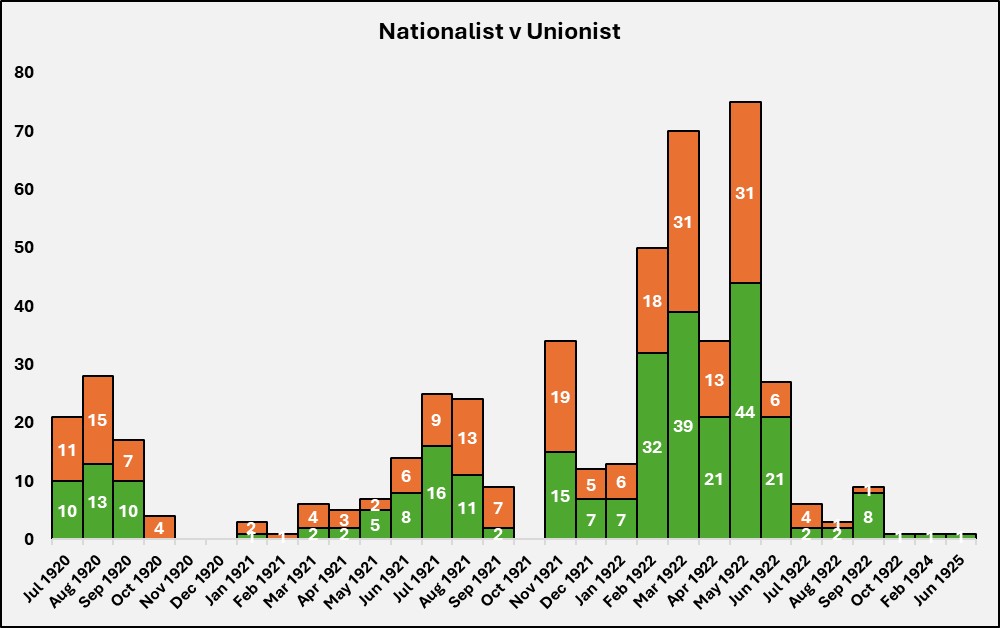
In the 16 months up to October 1921, there were 164 killings – 80 nationalists and 84 unionists. In other words, an almost-even split.
But as noted above, in November 1921, the Unionist government of Northern Ireland gained control of policing and security and re-mobilised the USC. In the 12 months, there were 334 killings, twice as many as in the first 16 months. However, in this period, the tide turned decisively against nationalists – they were the victims in 199, or 60% of these killings.
If we sub-divide those killed according to which organisation (or none) they belonged to, then we see that the state forces – British military, RIC, RUC and Specials – made up only 8% of the total. Three British soldiers were killed, 20 regular police (including the seven southern-based officers killed in the spring of 1921) and 15 Specials.
Using intelligence supplied by sympathetic policemen, two of the RIC officers killed had been identified by the IRA as being members of the “murder gang”: Constable James Glover, already mentioned, and Sergeant Christy Clarke, killed on 13 March 1922.
One soldier and one Special Constable were killed by state forces in what would nowadays be termed “blue on blue incidents”: on 31 August 1920, Private James Jamieson walked across the line of fire of other members of his patrol who were shooting at rioters on Linfield Road and on 12 March 1922, Special Constable Charles Vokes was killed by British soldiers while attempting to escape from a military patrol which had arrested him earlier that evening.36
On the nationalist side, 29 members of the IRA and six of Na Fianna died. There is an important caveat about these figures: successive releases of files from the MSPC have revealed that some nationalists killed, previously thought to have been civilians, were actually members of one of the Republican organisations; it is quite possible that future MSPC releases will reveal more such cases.37
So far, MSPC files have been released for 21 of the 29 dead IRA members. In addition, three other IRA members killed were identified as such in the pension files of other veterans of the Belfast Brigade.38
Little doubt surrounds the membership of the remaining IRA members killed: two were victims of the RIC “murder gang”, Seán Gaynor, killed on 26 September 1920 and Dan Duffin, killed on 23 April 1921, both listed on the Republican movement’s Co. Antrim Memorial in Milltown Cemetery. Edward McKinney, an employee and lodger of Owen McMahon, killed in the same incident as the family members, was named as an IRA member in a statement made by Belfast IRA veteran Seán Montgomery.39
An unusual case is that of John Dempsey, killed on 26 March 1922 at Mountcollyer Avenue off North Queen Street. His mother heard knocking at the family’s front door, looked out and saw two men, who then left; one of the men returned, armed, but went away again so Dempsey went to take refuge in a neighbour’s house. Minutes later, his mother heard shots and found her son lying in the neighbour’s hallway. Dempsey had been classed as a Catholic civilian until a press clipping was sent to the author: this was a memorial, inserted in a Waterford paper in 1958, stating that Dempsey had been an IRA member who was shot and killed by B Specials. Although no MSPC file on Dempsey has yet been released, it seems improbable that anyone would fabricate such a claim almost forty years later. On that basis, he is now counted as an IRA member.40

Memorial to John Dempsey, Waterford News, 28th March 1958
MSPC files have been released for five of the six Fianna members killed. The sixth, James Smith, killed on 18 April 1922, is almost certainly the same person commemorated on the Co. Antrim Memorial in Milltown Cemetery as J.P. Smyth, killed on 18th April 1922.41
Nine men previously described as Protestant civilians are now classed as combatants – members of the Imperial Guards. This was a loyalist paramilitary organisation initially founded in August 1921 by members of the Ulster Ex Servicemen’s Association following the de-mobilisation of the B Specials under the terms of the Truce.42
A press report on the joint funeral of Andrew James and Bertie Phillips, killed on 21 and 23 November 1921 respectively, noted that the pallbearers were provided by the Imperial Guards. Similarly, companies of the Imperial Guards formed part of the corteges in the funerals of David Cunningham, killed on 22 November, and Alex Reid, killed eight days later. The York Street Battalion of the Imperial Guards sent a representative to the funeral of Walter Pritchard, killed on 17 December, and the entire battalion marched in the funeral procession of Herbert Hazzard, killed on 8 March 1922.43

Imperial Guards in the funeral procession of Herbert Hazzard (Belfast Weekly Telegraph, 18 March 1922)
Funerals of other Protestant victims of the violence were reported on, but with no mention made of Imperial Guards participating – so their presence was the exception rather than the rule. The implication is that they only attended funerals of members who had been killed. Press reports or a photograph of an IRA presence at funerals were previously accepted as evidence of IRA membership; similar weight is now being given to the evidence of these six men’s membership of the Imperial Guards.44
Three other Imperial Guards have been identified. Alexander Turtle was killed by a British soldier on 2 January 1922 – the Imperial Guards took revenge by killing a soldier later that night. Ben Lundy was named as an Imperial Guard in press reports of his killing on 13 February 1922. Robert Beattie, killed in Ardoyne on 13 May 1922, was described as an Imperial Guard by Edward Burke.45
Three other armed loyalists were also killed, although their affiliations are unclear. Alexander McCrea was killed by British soldiers on 3 January 1922, as was Robert Dudgeon on 17 May 1922. In between those two, Thomas Neill was killed by police on 15 February.46
However, members of all combatant organisations, whether state or Republican, make up only 17% of the killings. The remaining 415 are split between 246 Catholic and 169 Protestant civilians. To describe all of these as “non-combatants” would be a misnomer, as many were killed during rioting.
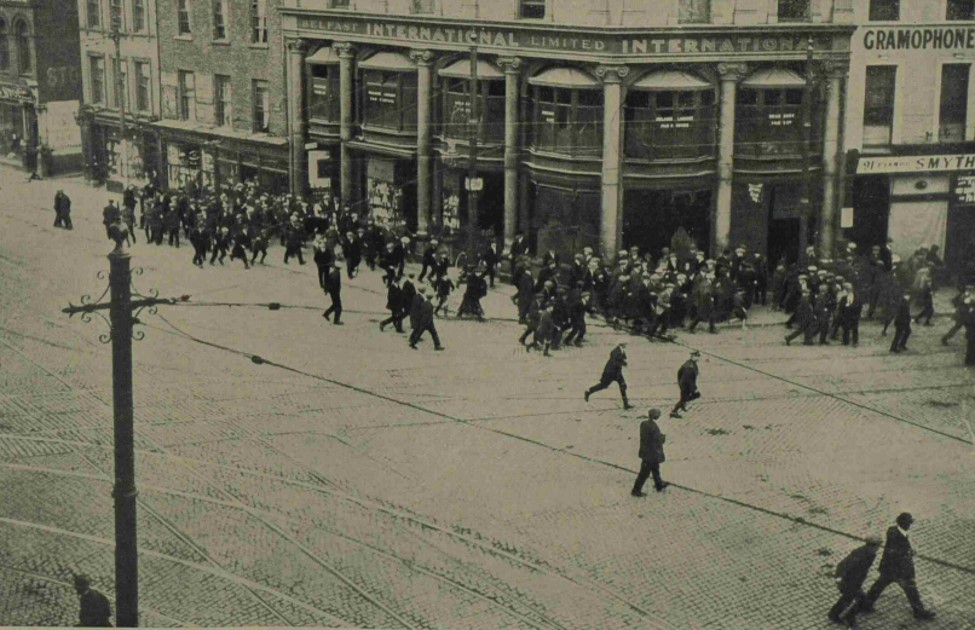
Crowds scatter as snipers open fire in York St (Illustrated London News, 10 September 1921)
But many more were innocent of any violent activity at the time they were killed: people shot in their homes by stray bullets; people abducted and killed by the police “murder gang”; people shot by snipers from the other side while trying to flee to safety; people killed at, or on their way to or from work; children killed while playing or on their way to Sunday School; people caught by hostile mobs in the wrong place or on the wrong tram.
Of the 500 people killed, 75, or 15%, were female. This relatively high proportion of female fatalities reflects the degree to which the violence was directed at civilians. That figure, in turn, is composed of 54 nationalists and 21 unionists, a split of 72% nationalists and 28% unionists. Compared to the figures for Belfast fatalities as a whole, this shows that female nationalists were at far more risk than their unionist counterparts; given the social roles played by men and women at the time, this in turn implies that the violence was geographically skewed towards where nationalists lived.
The geography of killing
Having looked at the when and the who, the final area to examine is where the killings occurred.
The lists compiled by Hassan and Baker gave the home addresses of those killed, but in this section, deaths are recorded as far as possible in terms of where the fatal incidents took place – again, the intention is to provide a more accurate picture of the patterns of the violence. For example, in the initial outbreak of July 1920, three men who lived in the unionist Shankill area were killed – but they were all shot either in or on the edge of the nationalist Clonard district; recording their deaths as having happened in the latter is more informative.

A shop is looted in Kashmir Road, Clonard, July 1920 (Illustrated London News, 31 July 1920)
A previous study analysed the deaths according to the city’s local electoral wards.47 However, for the sake of familiarity, this analysis uses thirteen broad areas where most of the killings took place: Ardoyne & The ‘Bone (Marrowbone), Ballymacarrett, the city centre, Clonard, the Crumlin Road, the docks, the Falls–Shankill interface, the Falls Road itself, the Lower Falls, the Market, Millfield & Carrick Hill, the New Lodge & Oldpark and York Street & North Queen Street.
The definitions of these areas are admittedly subjective and some of the boundaries used are somewhat arbitrary; for example, Weaver Street, where the children were attacked while playing, was actually off the York Road, which is a continuation of York Street, but here, Weaver Street is included under “York Street & North Queen Street.”
Areas where fewer than ten killings took place are grouped together under “Others.” Finally, some casualties, either already dead or fatally injured, were carried into hospital and it is unclear from press reports where they had been wounded – these are treated as “Unknown.”
Given that the largest concentration of nationalists in Belfast lived in the west of the city – on the Falls Road and in the districts off it (Clonard, the Lower Falls and the streets of the Falls–Shankill interface) – then one might expect that this was where most of the killings took place.
But as the map below shows, it was actually north Belfast – stretching from the docks through to York Street & North Queen Street, Millfield & Carrick Hill, the New Lodge & Oldpark and on out the Crumlin Road to Ardoyne & The ‘Bone – which bore the brunt of the violence. York Street & North Queen Street was the district with the single highest total of killings, at 88.
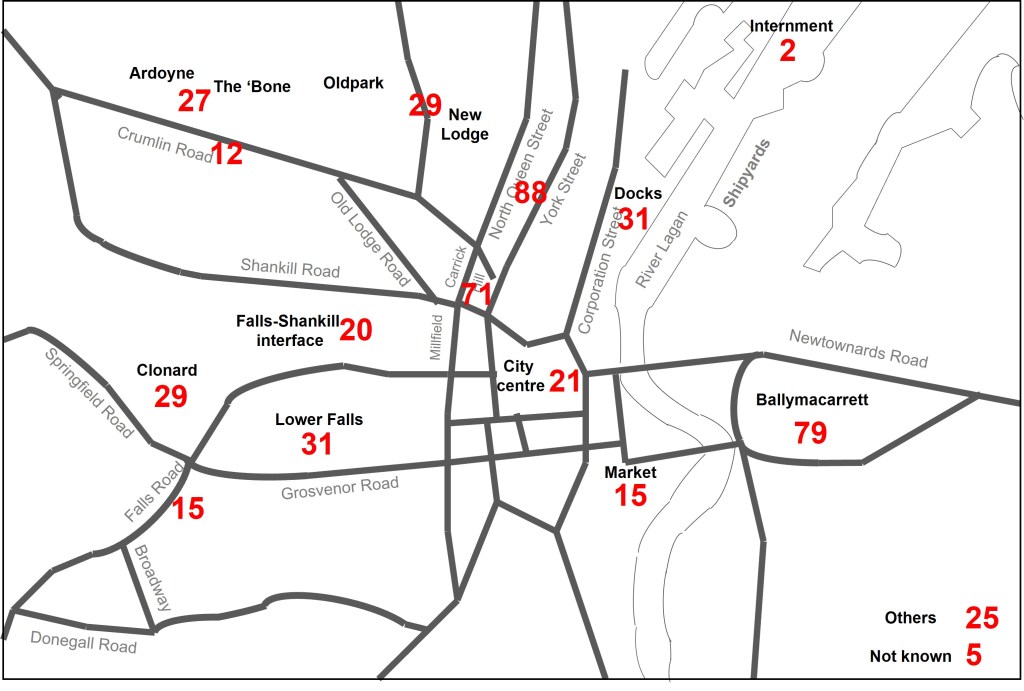
Across the river in east Belfast, Ballymacarrett was a significant outlier: largely consisting of, but not confined to, the nationalist Short Strand district, this part of the city had the second-highest number of killings, at 79.
A further level of detail can be seen if we sub-divide the killings in each district according to the presumed allegiances of the dead.
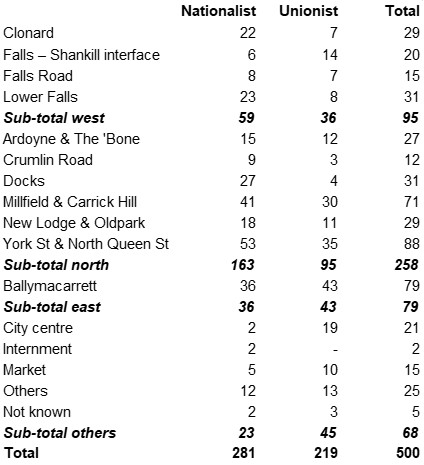
In west Belfast as a whole, nationalists made up 62% of the fatalities, but in both Clonard and the Lower Falls, the figure was over 70%. Across the whole of north Belfast, nationalists were 63% of those killed, but this rose to 87% around the docks. In only four districts out of the thirteen were more unionists killed than nationalists: on the Falls-Shankill interface, in Ballymacarrett, the city centre and the Market.
So why, if most nationalists lived in west Belfast, did just over two-thirds of the total number of killings take place in north and east Belfast? There are two possible explanations.
One is that, precisely because so much of the city’s sectarian geography was well-established by 1920 and nationalists were concentrated in west Belfast, the greater homogeneity on and around the Falls Road meant nationalists in west Belfast had strength in numbers as a defence against attack from outside. In contrast, the communities in north Belfast were, at the time, more mixed – even as late as the 1960s, unionists still lived in the New Lodge which nowadays would be considered a republican stronghold; in north Belfast, being less concentrated, nationalists were more vulnerable to attack. Similarly, they were relatively weak in east Belfast – there, a small nationalist enclave had its back to the River Lagan but was otherwise surrounded by unionist opponents.
The other potential explanation – perhaps related – has to do with the development of the IRA in the city.
The Belfast Battalion was initially established in the nationalist heartland of west Belfast and it was not until September 1920 that a 2nd Battalion was formed – its constituent companies were based in various nationalist pockets elsewhere in the city: A Company in Ardoyne & The ‘Bone, B Company in Ballymacarrett, C Company in the Market and D Company in the New Lodge and North Queen Street. Two more battalions were formed after the Truce of 1921, but the records that remain of these battalions are so scant that it is impossible to say with certainty where they were based.
Of the 967 Belfast Brigade members still living in the city in the 1930s whose addresses are known, 641 or two-thirds, lived in west Belfast. Even though many of these 1930s addresses may obscure the degree to which people had moved between districts in the city since the 1920s, it is clear that the IRA was far more organised in west Belfast and thus in a far better position to provide some level of armed defence to the nationalists living there. In north Belfast, by contrast, the IRA was much weaker and so could offer less protection to nationalists.48
Conclusions
There were two distinct periods within the Pogrom.
In the first, from July 1920 to October 1921, while the general level of underlying violence was almost incessant, actual killings generally peaked when unionists reacted violently to particular actions of the IRA – for example the killings of DI Swanzy, Constables Leonard and Glover and the Raglan Street ambush. However, the balance of killings between the two sides was almost even in this period, indicating that while the IRA and others could not completely defend nationalist areas from attack, nationalists could at least give as good (or bad) as they got.
The turning point of events in the south was the signing of the Treaty in December 1921. But the turning point in Belfast came a month earlier in November, when the Unionist government gained control of the RIC and re-mobilised the Special Constabulary.
This represented a significant realignment of forces and ushered in the second period of the Pogrom, which lasted until October 1922. Now, rather than being sporadic and concentrated into periods of a few days, the killings were almost constant. Now, while there continued to be violent responses by the police “murder gang” to IRA actions – as with the McMahon family and Arnon Street killings – broader unionist violence was less reactive and seemed more aimed at suppressing nationalism entirely. However now, rather than holding their own, nationalists began to be overwhelmed by unionists in and out of uniform and made up 60% of those killed.
The geographical spread of killings within Belfast shows that the worst of the violence took place not, as might be supposed, in west Belfast where nationalists were at their most numerous, but rather in the north and east of the city, where they were at their most vulnerable – in the case of the former, where the communities were less homogenous, and in the latter where a pocket of nationalists was isolated.
Some context for the killings in Belfast during the Pogrom is provided by The Dead of the Irish Revolution: this catalogues 2,346 people who died from political violence in Ireland between 1917–21. This total includes 211 in Belfast, so leaving 2,135 who died elsewhere on the island, the vast majority of them in the three-year period from January 1919 to December 1921. In Belfast, 500 people were killed in a conflict that lasted just over two years.49
So along with Dublin and Cork, Belfast was clearly one of the most violent places in Ireland during the entire revolutionary period. What distinguishes it from anywhere else on the island is the degree to which that violence was consciously directed at civilians – 84% of those killed in Belfast were not members of combatant organisations.
The violence in Belfast was not one-sided, nor were sectarian attacks the exclusive preserve of one side. But as previously noted, in a city in which nationalists made up just under a quarter of the population, they were the victims in over half of the killings. So, it is clear that the political violence of the Belfast Pogrom was perpetrated against this minority to a hugely disproportionate degree.
References
1 Robert Lynch, The People’s Protectors? The Irish Republican Army and the “Belfast Pogrom,” 1920–1922, Journal of British Studies, Vol. 47, No. 2 (April 2008), p377.
2 G.B. Kenna. (pseudonym of Fr John Hassan), Facts and Figures of the Belfast Pogrom 1920–22 (O’Connell Publishing, Dublin, 1922 – reprinted, Belfast, 1997), pp161-172.
3 Joe Baker, The McMahon Family Murders (Glenravel Publications, Belfast, 2003); Robert Lynch, The Northern IRA and the Early Years of Partition 1920–1922 (Irish Academic Press, Dublin, 2006), p227; Peter Hart, The IRA At War 1916–1923 (Oxford University Press, Oxford, 2005), p248; Alan Parkinson, Belfast’s Unholy War (Four Courts Press, Dublin, 2004).
4 In seven cases, two sources were accepted, provided that at least one of these was a contemporary Belfast newspaper.
5 Parkinson, Belfast’s Unholy War, p33; Michael Farrell, Northern Ireland: The Orange State (Pluto Press, London, 1980), p28; Austen Morgan, Labour and Partition, The Belfast Working Class 1905-23 (Pluto Press, London, 1991), pp270-1.
6 For an extensive description of the activities of the RIC “murder gang”, see Confidential Report on D.I. Nixon, UCD Archives (UCDA), Blythe Papers, P24/176.
7 Roger McCorley statement, Military Archives (MA), Bureau of Military History (BMH), WS 0389; Séamus Woods interview with Ernie O’Malley in Síobhra Aiken, Fearghal Mac Bhloscaidh, Liam Ó Duibhir & Diarmuid Ó Tuama (eds) The Men Will Talk to Me: Ernie O’Malley’s Interviews with the Northern Divisions (Kildare, Merrion Press, 2018).
8 IRA member Seán Montgomery admitted in an unpublished memoir to having been involved in the Corporation Street attack: Statement of Seán Montgomery, O’Mahony Papers, National Library of Ireland (NLI), Ms 44,061/6.
9 For a detailed account of this incident, see https://treasonfelony.wordpress.com/2016/02/04/the-weaver-street-bombing-and-not-dealing-with-the-past/
10 Parkinson, Belfast’s Unholy War, p230-231; Baker, McMahon Family Killings, p6-21.
11 Extracts from statutory declarations on Arnon Street and Stanhope Street massacre, National Archives of Ireland, D/Taoiseach S1801.
12 Freemans Journal, 6 October 1922.
13 Belfast News-Letter, 14 June 1924.
14 Hugh Hennon, MA, Military Service Pensions Collection (MSPC), DP4364.
15 John O’Donnell, MA, MSPC, DP1178.
16 Belfast News Letter, 10 August 1920.
17 Named by Hassan as “Private Arthur Bundry” – Kenna, Facts and Figures, p161; https://www.cairogang.com/soldiers-killed/bundy-fa/bundy.html
18 Belfast News-Letter, 23 June 1922. This death was removed from the chronology in April 2023 on discovery of this press report on the inquest.
19 Northern Whig, 17 & 20 April 1922.
20 Belfast News-Letter, 4 May 1922.
21 Belfast News-Letter, 4 September 1920; Kenna, Facts & Figures, p160; Baker, McMahon Family Murders, p49; Eunan O’Halpin & Daithí Ó Corráin, The Dead of the Irish Revolution (Yale University Press, London, 2020), p173; https://www.cairogang.com/soldiers-killed/turner-ph/ph-turner.html; https://www.cwgc.org/find-records/find-war-dead/casualty-details/401621/p-h-c-turner/. In the unlikely event of the author ever having a son, he will definitely not be named Harold.
22 Belfast News-Letter 24 November 1920.
23 https://www.cairogang.com/soldiers-killed/hill-hav/hill-hav.html
24 Belfast News-Letter, 4 December 1920; two others died in the same incident but their names were not listed by Hassan.
25 Northern Whig, 17 November 1921.
26 Irish Independent, 16 February 1922.
27 http://policerollofhonour.org.uk/forces/ireland_to_1922/ric/ric_roll.htm
28 Kenna, Facts and Figures, p164.
29 Ibid.
30 Northern Whig, 29 June 1922; Belfast Weekly Telegraph, 16 July 1921; O’Halpin & Ó Corráin, Dead of the Irish Revolution, p472.
31 Joseph Burns file, MSPC, MA, DP934; Burns’ death, though not the circumstances of it, was reported in the Freemans Journal, 14 January 1922.
32 Northern Whig, 24 March 1922.
33 Northern Whig, 27 September 1922; Belfast Telegraph, 23 & 25 November 1922.
34 Northern Whig, 19 September 1922.
35 http://www.census.nationalarchives.ie/exhibition/belfast/main.html
36 https://www.cairogang.com/soldiers-killed/jameison/jamieson.html; Belfast News-Letter, 21 March 1922.
37 For example: John (or Jack) Coogan, killed on 30 August 1921 in North Queen Street – he is referred to as an IRA member at https://en.wikipedia.org/wiki/List_of_members_of_the_Irish_Republican_Army#K_3; Augustine Orange, killed on 19 March 1922 in Clermont St off the Albertbridge Road in Ballymacarrett – he is listed in the pamphlet, Antrim’s Patriot Dead (Belfast, National Graves Association, n.d.), p75. In either of these cases, an MSPC file could confirm their IRA membership, but none has yet been released.
38 Owen Moan, DP3403 (claim rejected; previously counted as a civilian, but named as a member of the IRA in the MSPC file of Desmond Crean released in November 2023; MA, MSPC, MSP34REF4970 Desmond Crean); John O’Brien, 2RB109; Edward Trodden, 1D153; Michael Garvey, DP376; Alexander Hamilton, 1D147 (claim rejected but listed as a member of A Company “killed in action” in Nominal Roll of 3rd Northern Division, 1st Brigade (Belfast), 4th Battalion, MA, MSPC/RO-406); James Ledlie, 1D325; Frederick Fox, 1D38; Murtagh McAstocker, DP6618; Bernard Shanley, 1D145; David Morrison, 1D168; Thomas Gray, DP1832; Frank McCoy, DP8252; James Morrison, 1D212; Andrew Leonard, 1D398; James Magee, 1D213; John Walker, 1D446; John Hughes, DP5846; George McCaughey, DP8007; William Thornton, 1D127; Hugh Hennon, DP4364; John O’Donnell, DP1178 (all MA, MSPC). Davy Mathews named Joseph Giles, killed on 2 July in Bombay St, and John McCartney, killed on 23 July 1920 in Kashmir Road, as IRA members; MA, MSPC, MSP34REF60258 David Mathews. Robert Graham named Henry Mulholland, killed on 10 July 1921 in Bombay St, as a member; MA, MSPC, MSP34REF6078 Robert Graham.
39 McKinney was buried in his native Donegal; Montgomery statement, NLI, O’Mahony Papers, Ms 44,061/6.
40 Northern Whig, 29 April 1922; Waterford News, 28 March 1958 – the author would like to thank Éireann Nic Uaitéir for sharing this information.
41 John Murray, 2RBSD107; Thomas Heathwood, DP4309; William Toal, DP6722; Leo Rea, 2D504; Joseph Hurson, 2D502 (all MA, MSPC).
42 Michael Farrell, Arming the Protestants – The Formation of the Ulster Special Constabulary and the Royal Ulster Constabulary 1920-27 (Pluto Press, London, 1983), p28; Northern Whig, 14 November 1921.
43 Belfast News-Letter, 25 November, 5 & 21 December 1921; Northern Whig, 28 November 1921 & 13 March 1922.
44 For example, Murtagh McAstocker; his MSPC file has been released since the original article was written – see: Murtagh McAstocker, MA, MSPC, DP6618.
45 (Turtle) Statement of Lance Corporal R. Turner, Courts of Inquiry in Lieu of Inquests, Civilians – Alexander Turtle, Belfast, The National Archives, UK, WO/35/160/27, see https://search.findmypast.ie/record?id=IRE%2FWO35%2F160%2F00574&parentid=IRE%2FEAS%2FRIS%2F013266; (Lundy) Northern Whig, 17 February 1922 & Burke, Ghosts of a Family: Ireland’s Most Infamous Unsolved Murder, the Outbreak of the Civil War and the Origins of the Modern Troubles (Newbridge, Merrion Press, 2024), p65; (Beattie) Burke, Ghosts of a Family, p178.
46 (McCrea) Statement of Lieutenant S.J. Livingstone-Leasmouth, Courts of Inquiry in Lieu of Inquests, Civilians – Alexander McCrae, Belfast, The National Archives (UK), WO/35/154/31, see https://search.findmypast.ie/record/browse?id=ire%2fwo35%2f154%2f00234; (Dudgeon) Belfast News-Letter, 29 June 1922; (Neill), Belfast News-Letter, 24 March 1922.
47 Niall Cunningham, Mapping the Doctrine of Vicarious Punishment: Space, Religion and the Belfast Troubles of 1920–22, paper delivered to European Social Science History Conference at Glasgow University on 14 April 2012.
48 Nominal Rolls, 3rd Northern Division, 1st Brigade (Belfast), MA, MSPC, MSPC/RO/402-406A; Applicants Resident in the Six Counties General File, MA, MSPC, SPG/10; Special Investigation of Six County Cases, MSPC, MA, SPG-10A2; Thomas Gunn memoir, ‘Reorganisation in Antrim’, MA, Historical Collection, MA/HS/A/0148; 1917-21 Medal recipients, http://mspcsearch.militaryarchives.ie/brief.aspx
49 O’Halpin & Ó Corráin, Dead of the Irish Revolution, p543. As well as 210 Pogrom killings up to December 1921, the figure of 211 for Belfast includes RIC Head Constable Samuel Perrott, whose death during rioting on Sandy Row on 1 July 1920 pre-dates the start of the Pogrom.
 The Belfast Pogrom
Leave a comment